The Independent Ear

Ain’t But a Few of Us #12

Our contributor to this latest installment of the series Ain’t But a Few of Us — black music writers telling their story — is Twin Cities-based writer Robin James.  I first met Robin at an IAJE conference and later worked with her as part of the short-lived Jazz Journalists Association mentoring program for young African-American writers in honor of the late Harlemite writer Clarence Atkins.  That program enabled a small coterie of talented young black writers, including Rahsaan Clark Morris and Bridget Arnwine who earlier contributed to this series, to attend a national critics conference.

Robin James has written a jazz column for several years at the Minnesota Spokesman-Recorder, the Twin Cities African American newspaper.  She has continued to contribute to various prints, including a rare interview with Ornette Coleman that she wrote for DownBeat magazine.

What motivated you to write about this music?

At first it was curiosity, which stemmed from attending two jazz concerts in Minneapolis.  The first jazz concert I attended was with Joshua Redman and his band in 1996, the other was the Lincoln Center Jazz Orchestra with Wynton Marsalis in 2000.  Both men, both concerts changed my thinking about jazz and what this peculiar American art form means to this country.  But even before these experiences I had a history with jazz.  My grandmother had told me stories about how her husband, a Pullman porter, had developed friendships with jazzmen like Hot Lips Page, Buck Clayton, and Dizzy Gillespie.  It took some time before I would learn about who they were.

At the concerts I noticed that there were hardly any women or people of color in the audience. It concerned me.  So I wrote about those concert experiences after I was given the tremendous opportunity by the Minnesota Spokesman-Recorder, an historic Black newspaper and the oldest minority owned company in Minnesota, to write a jazz column, which I began in September 2000.

Then I heard a selection from Joshua’s Spirit of the Moment: Live at the Village Vanguard album on the radio and it pulled me in.  I remember diggin’ the music and then becoming curious about it.  It was an inspirational moment for me.  Then I found out he was on his way to town, so I asked for an interview and, luckily, got one (on his birthday). I was a new reporter and my interview went over its alloted time.  But he was very kind to me over the phone and in-person.  At the time, I knew nothing except that I was falling in love with the music.  And I loved the way it made me feel.

The second jazz concert I attended was the LCJO with Wynton Marsalis.  I was dating someone that had spoken very highly of Wynton and the band.  During my first trip to visit him in New York, I bought him Wynton’s book, Sweet Sing Blues on the Road as a Christmas gift.  Beyond that, I knew nothing about Wynton or his orchestra.  But I was deeply curious.

When the band came to town I attended and reviewed the concert.  After the concert, at the venue I met Wynton.  Someone introduced us and took our picture. 

Immediately, he was very warm and his spirit was very welcoming.  After seeing LCJO and Wynton in action, I began to question why more people like myself didn’t feel drawn to the music.  Although I feel very strongly that jazz chose me, I still have a curiosity that drives me.  It makes me want to share my experiences with readers.  I hope that someone out there will get curious and inspired to learn more, and explore the music more fully for themselves, in much the same way that I did.

About a year later, I was at the Book Expo America in Chicago where I had traveled to work with book authors.  I was a publicist at the time.  Wynton’s book Jazz in the Bittersweet Bluees of Life was being released, so it was being promoted there.  He played a concert to help with promotions.  Briefly we were re-acquainted at the book publisher’s after party.

A month later I was back in Chicago for the Ravinia Festival, where the LCJO and Wynton were performing.  It was there that he read aloud my first column where I stated my concern about why more women and people of color were not feeling drawn to jazz.  After he read my piece, he offered me encouraging words that inspired me to keep writing about jazz.  Wynton also recognized and acknowledged how difficult it is to write.

For someone so accomplished like that to take an interest in me and make time to read my work, at such an early stage, well it made me want to keep going.  Keep writing and learning about jazz.  I am forever grateful.  That meeting changed my life.

After this initial meeting with Wynton, I got in touch with Bob Protzman, who at the time was one of the only full-time jazz writers at a major daily, the St. Paul Pioneer Press.  He helped make it possible for me to write jazz previews and reviews for the newspaper.  Plus, Protzman was hosting a show on our jazz station KBEM, Jazz 88FM.  I listened to him and learned a lot.  After that, at my first Jazz Journalists Association event in New York City in 2003, I reached out to veteran jazz writers Ashley Kahn and Gary Giddins.  Both were very supportive and also helped me along the way.  Due to a referral by Gary, I received my first and only assignment from the Village Voice.  I wrote a CD review.  My experience working with Village Voice editor Chuck Eddy left a lasting impression on me as well.  He taught me how to say something with 250 words or less.  Ashley encouraged me by teaching me how to craft pitch letters.  I also reached out to Stanley Crouch.  He too offered me encouraging words of wisdom andd instruction.

When you began this quest were you aware of the dearth of African Americans writing about this music?

No, I had no idea.

Why do you suppose that’s still such a glaring disparity — where you have a significant number of black musicians making this music but so few black media commentators?

I suppose it comes down to power, access, and interest.  Having knowledge of and access to art is powerful.  But first you’ve got to have interest, interest in art.  Interest in the artist, interest in an audience.  All it takes is one voice to spark something great, which can then inspire individuals and a nation.  That’s power.  But it goes even deeper than that.  And as far as I know, the people who’ve been in this business the longest, who have benefited the most, have yet to fully explain their process.  Until that happens, and that news is documented or talked about openly, by African Americans and all of those who know the difference, we’re not going to get very far.  Very little light has been shed on the subject for whatever reasons.  Too much time is devoted to and focused upon everything but the real important issues, which relate directly to economics.  People in positions of power feel more comfortable with the same people writing the same things and in the same way.  I would welcome a healthy discussion by veteran jazz writers, authors, and editors from jazz publications, and African American-oriented publications in the near future.  What it boils down to is that we’re talking about the human condition and humanizing that condition.  The music, it’s sources, and implications.

Do you think that disparity or dearth of African American writers contributes to how the music is covered?

Absolutely.  From a cultural enrichment standpoint, there’s a lot that has the potential to get missed and/or misunderstood, which can lead to miscommunication.  When you’re documenting what’s happening now, you’ve got to be careful about how the information is transmitted.  When you’re considering future generations with respect to African American history, I know I strive to get the perspective right, because it may be my one and only shot at doing so.  By shaping the now, you’re shaping the future and how it gets viewed later.  It’s like African American folklore.  When the truth doesn’t get told, you have alternative stories going, that then can get viewed as being myths.  The truth doesn’t always get the forum it deserves.  Some things get lost in translation.  Yes, that’s unfortunate.  And yes, that’s 100% preventable.

Since you’ve been writing about this music, have you ever found yourself questioning why some musicians may be elevated over others and is it your sense that has anything to do with the lack of cultural diversity among writers covering the music?

At first I used to wonder and question, but now I don’t.  I get it.  Editors are key here.  How they think matters.  Or, we’ve been conditioned to believe that.  Sure, they get pitched by writers, which in turn helps shape their decision making process.  But it still comes down to how they think, which directly relates to what gets covered and who covers what.  Again, that leads to economics, and relationships.  I don’t know how much a writer’s actual talent, and abilities, or interest adds to the equation.  I suppose all of that ought to be considered.  In my case, I’m very fortunate in that I write a jazz column and so, my editors let me have free reign.  My position is extremely unique, I realize this and feel very grateful to have the freedom to pretty much write about whatever I want to.  Of course, I’m asked to be mindful of our audience when I do make my choices.

You are one of the few who have written about the music for an African American-oriented publication.  What’s your sense of the indifference of so many African American publications towards this music, despite the fact that so many African American artists continue to create the music?

Again, it comes down to economics.  I imagine, other publications have to consider their overall space, content, and advertising budgets.  With MSR, the publisher made a conscious choice to devote space to jazz, in good and not so good economic times.  We still have a long way to go in this arena.  I definitely don’t see a lot of coverage being devoted to jazz [elsewhere], which is very disappointing and troubling to me.

How would you react to the contention that the way and tone of how this music is covered has something to do with who is writing about it?

The way and tone of how serious music is covered has everything to do with who is covering it.  It’s like comparing Ben Ratliff’s coverage of Wynton Marsalis to Nate Chinen’s coverage of Wynton.  Here we’re talking about individual experience.  Individual taste, so an individual’s background, experience and education comes into play.  It’s all very intimate in nature.  And you can sense the enthusiasm level a writer has for the piece he or she has written.  It’s inescapable.

In your experience writing about serious music, what have been some of your most rewarding encounters?

Besides my encounters with Wynton, interviewing Ornette Coleman for a cover story for DownBeat has been a major career high point.  Meeting Kenny Burrell and Charlie Haden  at the Jazz Bakery.  Having Gary Giddins refer me for a CD review for the Village Voice. Receiving the Clarence Atkins fellowship award and attending the National Critics Conference, and from that experience meeting David Ritz, from whom I still seek advice.  Co-hosting and creating the jazz radio show Sweet on Jazz with KBEM’s music director Kevin O’Connor.  With his invaluable guidance and support I was fortunate enough to interview artists such as Jackie McLean, Lou Rawls, Sonny Rollins, Patrice Rushen, Nnenna Freelon, among others.  Writing for the Village Voice and EQ magazine.  Becoming a contributing writer for DownBeat.  Having had the opportunity to write about jazz for a weekly, a daily, a national jazz magazine, and to broadcast a jazz show, I feel extremely fortunate.  All these experiences fuel my passion to keep moving in positive directions with the music.  Building long-term relationships with musicians of all calibre and earning their respect and trust is of the utmost importance to me.


What obstacles have you run up against — besides difficult editors and indifferent publications — in your efforts at covering this music?

MSR is a weekly newspaper so I encounter a number of obstacles.  My mail gets lost.  Sometimes I don’t always get clips out to the labels who don’t have clipping services.  I don’t always receive invites to music-related functions.  My name doesn’t always appear on regular reviewers mailing lists so I don’t get CDs to review from all record companies releasing jazz or jazz-related music in a timely fashion.  I understand the timing that’s involved when it comes to reviewing a CD, but I’ve learned to just keep doing the best I can to get the news out.  I’ve come to accept that doing some extra leg work is necessary if I want to keep up and stay on top of the news.  It’s tough, but well worth the effort.  A column might get bumped, or a front page story could get eliminated or delayed.  It all depends on developing news.

If you were pressed to list several musicians who may be somewhat bubbling under the surface or just about to break through as far as wider spread public consiousness, who might they be and why?

Dana Hall and Winard Harper are two terriffic drummers out there who don’t record a lot or get a ton of gigs, but they are rich on talent.  They deserve more exposure as they have demonstrated commitment and a deep understanding of the music and how it relates to the times we live in now.  Jeremy Pelt is another extraordinary talent that you just don’t see or hear enough about.  He’s very history-minded, yet future-minded and presents a balanced view of both while he’s telling his story.

What were some of the most intriguing new records you heard in 2009?  

Christian McBride’s Kind of Brown featuring his acoustic jazz quintet Inside Straight stands out.  It’s a deluxe package.  It grooves, swings, it’s bluesy.  Speaking of Jeremy, his debut recording Men of Honor for HighNote came out in January, its beautiful.  I had the honor of writing the liner notes.  All of my writing experiences have brought me to this important assignment.  I have a lot of respect for David Ritz who has won several Grammys for his work on liner notes.  

Posted in General Discussion | 1 Comment

NEA Jazz Masters 2010

Full disclosure: Willard Jenkins is a coordinator of the NEA Jazz Masters Live program which funds NEAJM presentations at sites around the country.  Email if you’d like further information…


Last Tuesday evening was yet another sublime NEA Jazz Masters awards concert at Jazz at Lincoln Center’s sumptuous Rose Theatre.  The evening commenced with each of the living Masters in the house being introduced at their seats to warm applause as the audience saluted these great artists who’ve meant so much to the development of jazz music.  Members of the 2010 class were introduced separately starting with revealing excerpts from video interviews conducted by writer and former NEA official A.B. Spellman.  Several of the 2010 class also performed during the evening.


Muhal Richard Abrams

(photo by Alan Nahigian)

    The first presentation featured 2010 inductee pianist-composer and founder of the AACM Muhal Richard Abrams, conducting the Jazz at Lincoln Center Orchestra through one of his typically knotty and challenging compositions.  This in itself was a revelation, given that some misguidedly view the orchestra as a representative of staunch jazz conservativism.  They played Muhal’s music with grace and skill; a later conversation with JALCO alto saxophonist Ted Nash revealed eager enthusiasm for such an opportunity because it afforded the band a chance to really stretch.


Yusef Lateef

    Later in the evening another stunning performance was turned in by the duo of 2010 NEAJM Yusef Lateef and his percussionist Adam Rudolph.  If there as a deeper, more satisfying sound on flute than Lateef’s rich tone then I haven’t heard it.  He worked his way through several manner of flutes, including a couple of haunting end blown instruments – which Lateef also employed for their inherent percussiveness – tenor sax, and traditional western flute while Rudolph tastefully accompanied on frame drum, small flutes, piano, and dijeridoo. 


Annie Ross

    These were but two in an evening of immense celebration and abundant love for this great art form that was summed up so beautifully by vocalist Annie Ross.  After her acceptance speech Ms. Ross sang a piece whose lyrics were a litany of jazz greats that aptly recognized the ancestors. 


    NEA Jazz Masters are selected annually — and along with the recognition each receives a check for $25K — through nominees from the general public subsequently selected by a panel of Masters.  For further information on the NEA Jazz Masters who’ve been selected since the 1982 inception of the program (must be living), and how you may nominate some deserving Master who has not yet been selected, visit www.arts.endow.gov and click on the Lifetime Honors icon.  All it takes is a simple one-page letter.

Posted in General Discussion | 4 Comments

Ain’t But a Few of Us: #13

This latest installment in our ongoing series of black music writers telling their story comes from Bill FrancisBrooklyn-based Bill Francis is a music and jazz journalist whose byline has appeared on countless stories and profiles ranging from bebop to hip hop, in the pages of Billboard, Spin, Essence, The Source, among many other publications.


Bill Francis


The son of a saxophone-playing Tuskegee Airman, Bill formerly covered Kansas City’s legendary jazz scene as a feature reporter and jazz columnist for The Kansas City Star.  He has also hosted an FM jazz radio program which was heard around the world on the ‘Net.  Bill writes regularly about the artists and the thriving jazz scene in Brooklyn.


What motivated you to write about this music?


My father was a jazz musician, as well as one of the legendary Tuskegee Airmen.  From an early age, jazz has been part of my world.  In college, playing in a jazz fusion group, and hearing and meeting some of the greatest jazzmen of the day (e.g. Herbie Hancock, Freddie Hubbard), I realized that jazz was much more than a music genre, it was a culture and important part of African American history.


When you first started writing about music were you aware of the dearth of African Americans writing about this music?


When I began writing about music professionally, as a reporter and music columnist at The Kansas City Star, there seemed to be few African Americans getting mass exposure for writing about any serious subjects.  At the time Baraka’s Blues People was my only inspiration for thinking I could make a difference as an African American jazz journalist.


Why do you suppose that’s still such a glaring disparity — where you have a significant number of Black musicians making serious music but so few Black media commentators on the music?


There is no mystery for the disparity.  It is a direct result of African Americans and other minorities being greatly underrepresented in the ranks of publishers, editors, and producers at newspapers, magazines and in television.  Whether it’s jazz, culture, or everyday life, African American stories are seldom told in the media, and even less often written or produced by African Americans.


Do you think that disparity or dearth of African American jazz writers contributes to how the music is covered?


The lack of African American writers, who understand the culture that jazz sprang from and who feel jazz rhythms in their souls, certainly has influenced how the music has been represented.  Look no further than the preeminence of ‘smooth jazz’ on concert lineups and what is left of jazz radio.

[Editor’s note: Smooth jazz radio stations are dropping like flies; that “preeminence” is over, at least as far as radio is concerned; though in fairness to Bill he submitted this contribution before so many smooth jazz radio stations across the country began summarily changing formats.] 

With so few African American jazz writers being read, it’s not surprising that ‘smooth jazz’ — less challenging, more appealing to white writers, media executives, and audiences — has become the definition of jazz for much of America.


Since you’ve been writing about this music, have you ever found yourself questioning why some musicians may be elevated over others, and is it your sense that has anything to do with the lack of cultural diversity among writers covering the music?


Which musicians and artists succeed commercially and which do not is a popular subject of conversation for those of us who write or cover music, particularly among African Americans.  Of course, the answer is pretty obvious when viewed in the larger context of the lack of cultural diversity among those who decide which stories about art, culture and music are written and which artists get hyped and marketed in America.  Even more than a lack of African American writers with jazz in their souls, it is the lack of Black editors to champion greater diversity in the stories assigned that relegates blues and jazz to second class status commercially in America.


[Editor’s note/ Rhetorical question department: When was the last African American in an editorial position at the most prominent jazz prints, DownBeat or JazzTimes magazines (throw Cadence and Coda in that mix as well, and for the sake of modernity, the web-based publications All About Jazz and Jazz.com as well)?  Just as we thought…]


What is your sense of the indifference of so many African American-oriented publications towards this music, despite the fact that so many African American artists have been historically prominent in the music?


Black publications reflect their readership.  Unfortunately, for reasons often debated, African Americans haven’t supported jazz as popular music since its earliest days.  Go to any jazz club or jazz concert in America and you will be saddened by the lack of African Americans in attendance.  Of course, Black publications could take the lead in educating and promoting jazz, as not only America’s only true original art form and important part of our heritage, but as an unrivaled improvisational music experience.  But the marketing realities in America require deep pockets and a deep committment on the part of minority publishers whose bottom line is usually more tenuous than their white music publication counterparts.


How would you react to the contention that the way and tone of how this music is covered has something to do with who is writing about it?


Ask most African American jazz musicians and they will express gratitude for the white writers at leading jazz magazines who love the music and write about the Black jazzmen who aren’t on the jazz charts and whose names aren’t Herbie or Wynton.  I have no doubt, however, that if there were more African Americans writing about the music and being read, the tone of jazz journalism would be far different and more accessible to read.  Think of what major league baseball was before Jackie Robinson or the NBA before Connie Hawkins and Dr. J.  That’s what jazz journalism for the most part is like today, without the major influence of Black writers.


In your experience writing about this music, what have been some of your most rewarding encounters?


As a resident of Brooklyn, I’ve frequently written about the vibrant jazz scene there, including several articles about the wonderful Parlor jazz phenomenon of top-flight live jazz being hosted in people’s homes.  Being privileged to hear, get to know and spread the word about incredible artists such as Mem Nahadr, Carla Cook, Cal Payne, or Onaje Allan Gumbs, whose music and talents warrant much greater recognition than they have, has been among my most rewarding encounters as a writer.


What obstacles have you encountered — besides difficult editors and indifferent publications — in your efforts at covering serious music?


Convincing publications that stories about jazz and jazz musicians can be compelling for their readers is a constant frustration to overcome.  Like jazz musicians, jazz journalists who are committed to writing about the music and must constantly work to stay positive in the face of the reality of their standing in the music marketplace and journalistic hierarchy.


What were a couple of the most intriguing records you heard in ’09?


EclecticisM by Mem Nahadr (LiveWired Music)…  To fully experience and appreciate her extraordinary talent you must see this striking African American, dread-locked albino live.  However on her latest appropriately titled CD, this jazz and performance artist diva with the incredible vocal range proves that there is nothing she can’t do vocally, from jazz ballads to funky pop.


Watts from Jeff “Tain” Watts (Dark Key Music)… Tain is a monster drummer and his playing here as a leader is ferocious but controlled.  With frequent collaborators Branford Marsalis, Terence Blanchard, and bassist Christian McBride in top form, the CD mixes some tongue-in-cheek humor and social commentary with a hard swinging mix of bop, funk, and blues.  Proving that jazz can still be relevant, as well as music of the highest order.


Posted in General Discussion | 1 Comment

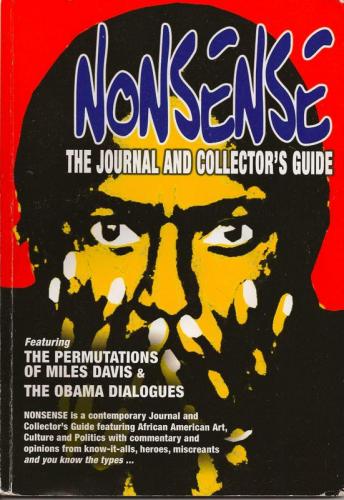
NONSENSE: Journal & Collector’s Guide

Nonsense is a hip new glossy periodical published from an African-American and politically progressive perspective that engages art, culture and politics as its three guiding pillars.  Published by Bob Daughtry and Norman Reid, the premier issue of Nonsense features such lead articles as "The Permutations of Miles Davis" and "The Obama Dialogues", and a good deal more rewards.


Bob Daughtry has been a friend, colleague and fellow WPFW radio broadcaster since I first relocated to DC in ’89.  Right away I admired his knowledge, advanced perspectives, and ability to intelligently blend jazz and related musics from the ancient to the future.  Not to be missed is Daughtry’s annual Jimi Hendrix radio celebration, often featuring rare interviews and recordings, ala the extensive live interview he conducted with Band of Gypsys bassist Billy Cox during his November ’09 Hendrix special.


Several months ago when Bob related that he was about to launch a new magazine, the warning bells sounded: Was this really a good time for a hard copy start-up periodical?  Scanning the prototype — with its shades of the very informative, edgy periodical Wax Poetics — I was convinced that indeed here was something a bit different.  So I quickly offered Bob an opportunity to us why and how Nonsense would go about the business of proferring fresh perspectives.  


Why Nonsense, and why now?


Here is what we say in the premier issue of Nonsense: The Journal & Collector’s Guide about the idea of nonsense, I believe this will strike you as it did me; my partner Norman Reid found this and it appears on the inside cover of our premier issue:


 "Nonsense is that which does not fit into the prearranged

  patterns, which we have superimposed on reality.  There

 is no such thing as "nonsense" apart from the judgmental

 intellect, which calls it that.


 Nonsense is nonsense only when we have not yet found that

 point of view from which it makes sense."

                   — From The Dancing Wu Li Masters by Gary Zukav 


I find that a little something to stimulate one’s thinking and expand one’s horizons.  Norm and I believe that among the more important challenges for any of us to continue to grow as human beings it is vitally important to be open to the infinite number of possibilities that every situation has the potential for.  The danger of course is that complancency is always lurking and it is one of the more difficult conditions to see and overcome.


So what are the guiding principles behind your development of Nonsense?


We believe in Go for it…  Aim low you’ll hit low…  Aim high you’ll hit high…  Nothing ventured, nothing gained."  Chatter from the sidelines at your own peril and risk becoming irrelevant if you wish.  I’m going to say what I think.  I am going to do my homework and then write it down.  There will be some issues and ideas that my children will be able to say that they definitively know what their dad’s position was.  We hope that we can contribute to the thinking and ideas we encounter in some humble way.


    There are so many of our people who have made us all better because they lived and chronicled their thoughts and feelings.  They were compelled to ply their trade, to create art, to play music, to run for political office, to speak out, to take a stand and most importantly to whenever possible directly help others.  It’s my and my partners’ desire to be involved in these kind of high aspirations.  To know that way back in the day there were men and women like Paul Robeson and Marian Anderson who were out on the front lines speaking substantively to the issues of concern for ordinary Black folk when they could easily have given in and become comfortable and well paid house niggas complicit in keeping us confused about this vicious system designed to fully exploit us.  Each issue will cover the areas of Black culture, music, art, and politics… as a starting point.


What’s the publishing plan for Nonsense?


Our intention is to publish three issues over a one-year period.  We debuted our first issue in mid-July 2009.  The next issue will hit in late January 2010, and our initial plan is for the third issue to be out by July 2010.  We anticipate that by the third issue (possibly the second) we’ll be online at the same time.  The hard copy issues are intended as collector’s items.


What’s coming in your next issues?


The most likely that I am completely comfortable in mentioning is the "Obama Dialogues."  We are planning features, reviews and interviews with or about people we would like to bring to a wider audience.  Musicians and artists like John Coltrane, Jimi Hendrix, and Thornton Dial.  I’m trying to catch up to the metal sculptor Uzikee.  I hope to interview Tricia Rose who has written extensively on hip-hop culture.  There are so many ‘masters’ past and present that should be featured.  A now departed and very creative [WPFW] music programmer named Jimmy Gray used to say about putting together music shows on the radio ‘Just play the Masters of your time.’  That’s it!  We are looking to bring to ever-widening understanding the ‘Masters’ for all our times.  The Great Greats, known, unknown, and under known… Black Patti, James Baldwin, Chancellor Williams, Howard Thurman…


    We are going to feature serious music and musicians, serious art and artists in various parts of those disciplines and the issues of the day from our vantage point.  We are living in an increasingly judgmental world.  In these times real nonsense has become increasingly prevalent.  I say this because no one answers questions directly anymore.  The cause and effect of such deception, duplicity, disingenousness, or whatever you’d like to call it, is that the questions asked are often as stupid or as calculated as the evasive and self-serving answers.


    Much of what we see is pre-determined by the so-called ‘experts’, the insiders who want us to think they know everything.  We are not supposed to think.  All we should do, if these ‘experts’ have their way, is listen and regurgitate to others their views verbatim.  So it feels like what passes for discourse, conversation, or whatever you call it is really bullshit.  It’s meaningless and intended for the purpose of dumbing down society.  It is a masquerade that is properly called NONSENSE.


Are you interested in submissions from artists or pitches of story ideas?


We would love to receive submissions for publication AND we appreciate feedback — positive or negative — but especially constructive, giving us a sense of how we can improve.  We believe in the genius of the public.  We are very interested in having women widely represented in our publication; but please, no rants because we’ll take care of that department.  [I’m grinning as I say this.]


How are you going about developing a readership for Nonsense?


We are reaching out to get a feel for what people are interested in.  We are looking for strong opinion pieces on the difficult issues of our time, especially from a cultural perspective.  Number one is, and always has been, RACE, the giant elephant in the room!


    Other issues of the day need full explication.  There are all manner of perspectives to be considered; e.g. has the larger society altered the dynamics of issues like ‘gay marriage’ within ethnic enclaves where it has always existed and been treated respectfully?  Has the system with its ulterior motives of for profit and its incessant march of commercializing, privatizing, and codifyiing everything in controlling and oppressive ways, created new frictions that have never previously existed or never before had a place in the cultural interactions of the African-American and Hispanic communities?


    There is the larger societal issue of individual freedom.  That’s not just an issue for Black people.  I want to highlight The Real ID Act and other very dangerous programs that have been quietly put into law or are currently being seriously considered that impact everyone.  These threats to our freedom are like a fire in a partitioned home.  It does not matter which little piece of a divided setting you live in because fire is an equal opportunity destroyer.  So is Facism.  Nonsense, the Journal & Collector’s Guide, takes the position that the decade of American ignorance, i.e. the first decade of this new century needs to be seen for what it is.  That decade sold us 9/11, that sold us two costly wars and that elevated an idea called Enron, which in our lexicon means Sham from the git go, or ‘white boys gone wild’.


    A decade that showed the ugly face of racism again in New Orleans during Katrina, as well as in the Immigration debacle, and both continue.  More shams like derivitaves and credit default swaps.  Racist killers celebrated like Karl Rove and the fat bastartd bionic hearted cheesy SOB ‘tiny [penis envy] Dick Cheney, and his lap dog ‘Junior’ (better known as "Shrub" in Texas ’cause he was never cool enough to be a Bush).  Let’s pause to hear from Big Mama Capon, great Aunt to Mother Goose, who says in her modern urban griot all encompassing way…

                    It’s automatic push button remote control’

                    gentrified ‘genetics command your soul.’  Keep

                    spending your money ’cause that’s how it works.

                    If you think too much we’ll put you with the jerks.

                    Shine Shine I hear you can swim mighty fine

                    But one missed stroke and your ass is mine.’


Big Mama Capon says that this language is all the contracts you sign with the Moneychangers.  Remember them?  What happened to the rhythm…? 


    On and on the public relations machines and the ‘behind the curtain’ fake-a-trons and their three card Monty mis-direction magic tricks show rolls on, giving us the great ‘Barry’ himself and even the King of the Jungle — all fakes.  It’s time to see our times and the Decade of American Ignorance for what it really is, total and complete Nonsense.  Hotep!


Contact: Robert D. Daughtry rddaughtry@yahoo.com

Posted in General Discussion | Leave a comment

Ain’t But a Few of Us: Black music writers telling their story #13

                                                            RAHSAAN CLARK MORRIS


RAHSAAN CLARK MORRIS (center) with Amiri Baraka and William Parker


I first encountered Chicago-based writer Rahsaan Clark Morris a few years back when working with the Jazz Journalists Association to establish fellowships to a journalist conference in California in the name of my late friend and colleague, the Harlemite jazz writer Clarence Atkins.  Rahsaan was one of the young African American writers who were supported through this effort to attend the conference.  Rahsaan’s writings have appeared at Jazzhouse.org (the JJA site), the Jazz Institute of Chicago publication, the Great Black Music Project, JazzReview.com, and Creativity Magazine among other sources for his thoughtful voice.


What motivated you to write about this music in the first place?


I guess the thing that motivated me and got me thinking about writing in the first place was Amiri Baraka’s essay "Jazz and the White Critic" published in his collection of essays entitled Black Music from 1968.  The thought occurred to me that Black folks should be in control of their own culture and how it is appraised and critically approached.  I always thought it was the highest order of cultural arrogance to assume that someone from outside a group that had been culturally dispossessed could come in and present criticism of that culture, especially because of the pre-60s American separatism that had gone on for so long.  Baraka’s argument made the most sense to me, especially if you go from the lead point that this music comes out of the Black experience in this country.


When you first started writing about music were you aware of the dearth of African Americans writing about this music?

After reading the mastheads of certain jazz publications and reading the names of a lot of liner note authors, I could guess that there were not that many writers of color, and because they were so few in number, I could tell from the tone of the writing and some of the allusions in the writing, that there weren’t that many brothers — or sisters — writing about the music.


Why do you suppose that’s still such a glaring disparity — where you have a significant number of black musicians making this music but so few black media commentators on the music?


I think it has something to do with power: the power to put certain people into writing positions, the power to put certain people into editorial positions.  If the publications are of the commercial nature, as most are, and they are owned by white media conglomerates that live on sponsorship and backing, how can we expect an independent Afro-centric position to be put out before one that will safely further the commercial interests of the publication or media conglomerate?  I’m not saying I like it, but I am saying that’s the way it seems.  Then, there must be some networking from the journalism departments putting out writers at Berkley, NYU, Columbia, and Northwestern, and I can’t think of many who are African American males. 


    I left Denison University after my junior year to make a living in theater and always enjoyed music and writing.  But the jobs are given to graduates because, I suppose, it looks better to the employer if a resume is degree-laden.  Do you know a lot of degree-laden brothers who choose to write about Ornette Coleman or the AACM… besides maybe George Lewis


Do you think that disparity or dearth of African American jazz writers contributes to how the music is covered?


To some extent yes.  But, you do have certain publications like Wire, or Wax Poetics that do a good job of covering other stories that wouldn’t necessarily be covered in Downbeat or Jazziz, like a story on the development of the Fania record label, or how Creed Taylor put together the sound that became CTI Records.  {Editor’s note: those treatments appeared in issues of the estimable Wax Poetics]


Since you’ve been writing about this music, have you ever found yourself questioning why some musicians may be elevated over others, and is it your sense that has anything to do with the lack of cultural diversity among writers covering the music?


In my experience, it has been up to the editor who gets covered.  I write about, or "cover", anybody I choose and then it is up to the editors or people putting the pubkication together to include my pieces or not.  Sometimes, there are two African-American musicians’ CDs to be reviewed and only space enough for one review.  A white writer does one review and I do another.  I don’t think lack of cultural diversity ends up determining who gets published first, but it definitely could be a factor.  We all like to think the better piece gets published and if it is not mine but the other writers’… so be it because I know mine was good or I wouldn’t have handed it in.


What’s your sense of the indifference of so many African American-oriented publications towards serious music, despite the fact that so many African American artists continue to create serious music?


Now that is a multi-faceted question which could be explored for a while.  Most of those publications are market-driven.  Secondly, this form of Black music is not the most popular form.  At least, it seems, among American Blacks by and large.  So the publications appear to push music product that is (a) commercially viable and, (b) musically popular and/or accessible, so that months’ copy of Essence or Jet can move off the shelf.  Things may be changing, but it can’t come fast enough as far as I’m concerned.  The National Association of Negro Musicians held its convention here in Chicago andd there wasn’t a rush to get tickets.


How would you react to the contention that the way and tone of how this music is covered has something to do with who is writing about it?


That’s pretty much true of whatever topic you’re talking about.  I found some Black folks who go to hear serious music regularly who could probably write about it better than some Black writers who never get to that kind of show.  But, of course, a writer who comes from the same background as the artists involved would by nature be more sympathetic to what the artist is up to than someone who does not come from that environment.


In your experience writing about this music what have been some of your more rewarding encounters?


This actually happened before I actively started writing about the music.  I had gone with my wife to New York in the late 80s to see some plays, particularly Denzel Washington’s Shakespeare-in-the-Park production of Richard lll.  We were waiting in the line with our vouchers, which is what you have to have to get a ticket, and I was playing a cassette I had recorded probably 10 years earlier of Ornette Coleman and Dewey Redman playing live at the Jazz Showcase here in Chicago.  As we were waiting I spotted Ornette walking with his daughter through the park by the theater.  He heard the music playing and came over.  He remembered me from the Showcase concert because I had given him the master and dubbed a copy for myself that night.


    Another time later on, I was doing the lights for the Chicago Jazz Festival one year and I had been talking to Famoudou Don Moye about doing an interview with he and Lester Bowie, calling myseelf covering their performance of Brass Fantasy.  I didn’t know it, but as I was watching the rehearsal in the afternoon a woman wearing a light straw hat came down stage right in a wheel chair.  I recognized her almost immediately — it was Melba Liston.  I found out later from Dr. Bowie she had done a lot of the charts for the band and she was just checking out the rehearsal.  I asked if I could take her picture and she graciously consented.  After I got my camera out Lester and Rufus Reid came up and I took a shot of all three of them.  It is one of my favorite shots.  I noticed people asking each other, who was that woman in the wheelchair and I just smiled to myself.


What obstacles have you encountered — besides difficult editors and indifferent publications — in your efforts at covering the music?


Even though I am in the stagehands union and can get backstage to most events anywhere in this country, security is a problem and a lot of the time I will have credentials but some folks don’t believe me when I tell them I’m a freelancer for different publications.


What have been the most intriguing records released so far this year?


I still love the music of and have a lot of hope for the alto saxophonist Matana Roberts [Editor’s note: check The Independent Ear for more on Matana].  She’s originally from around [Chicago] but I think she spends more time now in Boston.  She recently made a splash with her trio Sticks and Stones on Thrill Jockey Records.  Then there is the lithe singer Ugochi (full name: Ugochi Nwaogwugguw) with Nicole Mitchell’s Black Earth Ensemble.  Her coming out will probably take somee time, but she has a remarkable voice and a great talent for delivery.  (Go to the archives at www.greatblackmusicproject.org for a review of a poetry performance by Ugochi at Malcolm X College here in [Chicago].  There is the young drummer Isaiah Spencer, who works with Ernest Dawkins’ New Horizons Ensemble and the Fred Anderson Trio.  (I call him Young Elvin because his style is as energetic and flowing as Elvin’s was.)  He also leads jam sessions every Sunday night at Fred Anderson’s Velvet Lounge.  Then there is the wordsmith Khari B., AACM saxophonist Mwata Bowden’s son who plies his trade with Ernest Dawkins’s Big Band, the Chicago Twelve, creating provocative poetry both with that ensemble and at other poetry slams.  I love the playing of vibraphonist Jason Adesiewisz, he of the young avant gardists helmed by Ken Vandermark and Hamid Drake.  Then of course the bassist Darius Savage, who sometimes shares the stage with Isaiah Spencer. 


    Nicholas Payton’s Into the Blue; Christian McBride’s Inside Straight with Steve Wilson, Eric Reed, Carl Allen & vibraphonist Warren Wolf, Jr. Kind of Brown; Nicole Mitchell’s Black Earth Strings Renegades on Delmark; Oliver Lake Organ Trio Makin’ It on Passin’ Thru Records; Hamid Drake and Friends My Blissful Mother on Tribal Records.

Posted in General Discussion | 2 Comments