The Independent Ear

The Mastery Arc

Do Jazz Artists enjoy longer artistic lives?


              AHMAD JAMAL


         SONNY ROLLINS


Years ago when Suzan Jenkins was the exectutive director of the Rhythm & Blues Foundation, which at the time was based in DC, their major annual event was the Pioneer Awards.  This was the annual occasion on which the giants of R&B were given well-deserved recognition in the form of Pioneer Awards, accompanied by a check, which was more times than not much-needed.  In the beginning the RBF limited its Pioneer Awards consideration to those R&B artists who had an impact (i.e. hits) in the 40s, 50s, and 60s.  More recently the RBF has expanded that stipulation to award artists of the 70s as well.


    Several things were always quite striking about those awards.  Looking around the room and surveying the stage when the various awards recipients and awards presenters as well would happily bound up on stage to receive their awards and perform their signature songs to the strains of a great house band (often led by Maceo Parker and including such masters of the form as Steve Cropper on guitar, himself a Pioneer Award winner the year Booker T & The MGs copped, and the funky drummer James Gadsen; the band also included "ringers" like Hamiet Bluiett on bari sax), I always had to chuckle to myself a bit at the vanity factor; despite the fact that we were exclusively talking about artists who by then were card carrying senior citizens, there wasn’t a gray head in the house!  But these were the artists who gave wing to so many of our teenaged years that we forgave them that vanity.  I remember one singing group member actually had on such a bad hairpiece that its shape comically resembled a Kangol cap!  The women came decked out as if they were about to put on a Vegas show and it often resembled a wig convention on the female side.


    This constant quest for the youthful appearance of yesteryear underscored one sad but salient fact: these were artists whose flames were extinguished in their relative youth, long before their artistry had an opportunity to ripen.  These were artists whose work had once almost exclusively served a youth audience, who once they either surpassed the youth of their audience or the hit factory dried up were simply cast aside for the next flavor of the moment.  And as I listened to the various heartbreaking trials & tribulations of so many of these artists whose rocket ascent to the "top" was just as suddenly accompanied by an even swifter descent to the bottom, I saw how fleeting fame can be in our throwaway society.  The truly heartbreaking pathos would come when I’d hear about some supposed giant or other who I had assumed must have lived the figurative life of Riley in a rarefied air most of us can only dream of on the wings of those million sellers, gold and platinum records alike, needing to have their funeral and burial costs paid by the RBF because they wound up broke and relatively destitute.  I can also remember how we’d awaken the next morning to persistent telephone calls from Pioneer Awards recipients looking to hungrily cash those awards checks. 


    Artists whose major hits might take two hands to count needed bailing out when the Grim Reaper called!  I’ll never forget the melancholy story of a fallen diva from my dance party youth whose family insisted that the RBF not only fund her services and burial, but that she must have several changes of clothes for her funeral home viewing services!  We’re talking about someone who has passed, not some poor soul needing a new suit to make a job interview!  These elements just brought to mind the fleeting aspects of what we think of as fame; the fact that such artists’ fortunes are tied to a youth culture and a youthful existence (and appearance) that cannot and does not last; artists who are just as quickly kicked to the figurative curb as their sudden rocket to fame.  This is the pop life I’m afraid; here today, gone tomorrow.


    I’ve often thought of that as my work with the NEA Jazz Masters program proceeds and as I communicate with so many senior jazz artists.  In jazz we are perpetually wailing about our relative lack of recognition, the constant struggles of artists making this music, and about the second class citizenship of the beloved art form in the larger scheme of the music industry.  However the fact does remain that for those who are blessed with perseverance and longevity, the rewards of jazz mastery can sustain.  Fortunately we in the jazz community are not about casting aside our legends once they’ve gone gray and are no longer producing "hits."  We tend to honor longevity, youth has to prove itself over time in this music; the attrition rate may be significant, but elderhood does have an honored place in jazz, so unlike the pop forms.


    I thought about that on two life-affirming recent occasions when being in the company of a couple of jazz masters was truly uplifting.  The week prior to Thanksgiving the occasion was a site visit for the NEA Jazz Masters Live program component.  The site was Baton Rouge, LA for the Arts Council of Greater Baton Rouge’s engagement of Ahmad Jamal, 79.  Its been a real pleasure and a privilege visiting some of the sites of NEA Jazz Masters Live-supported programming, but the first evening of Jamal’s two days in Baton Rouge was rather unique.  The CEO of the Arts Council of Greater Baton Rouge is Derek Gordon, formerly of the Kennedy Center and Jazz at Lincoln Center.  As a prelude to Ahmad’s arrival Gordon presented a program consisting of student ensembles from Southern University, Louisiana State University, and the famed New Orleans Center for Creative Arts (NOCCA) playing some of Jamal’s compositions and music associated with the pianist in their own arrangements.


    On the Wednesday evening of Ahmad Jamal’s visit Gordon arranged for those student ensembles to reprise their performance of his music for Jamal himself.  I watched intently as Jamal quietly studied their performances, taking notes and observing patiently.  At the end of each piece he gave his cordial approval in a fairly non-commital way.  If you know Ahmad Jamal you know he’s a man of great conviction and strong opinion.  So I kept waiting for some broader response.  Instead Jamal surprised us all at the end by generously requesting that each band director provide him with the email address of each student musician so he could send them a personal email with his response to their playing!


    The next night Jamal played two shows before full houses at the intimate and shiny Manship Theatre.  Being in Louisiana gave Jamal a chance to further reflect on how important New Orleans drumming has been to his music, considering that New Orleanians Vernel Fournier, Idris Muhammad, and Herlin Riley were his longest-tenured trapsmen.  Don’t forget, what truly made "Poinciana" the monumental hit it was for Jamal was Fournier’s distinctive New Orleans drumming.  On this evening Jamal renewed that Crescent City connection by employing another New Orleans-bred slickster, the ever-youthful vet Troy Davis, on the tubs.  This was the first time Davis, currently living and teaching in Baton Rouge, had locked up with Jamal but one would hardly have known it given the loose-limbed lockstep he fell into with Ahmad’s characteristic use of open space, keen sense of rhythm and pacing, and distinctive brand of bandleadership.  That evening’s obligatory performance of "Poinciana" felt as fresh as it must have when Jamal first hit it at the old Pershing Lounge.


    Afterwards I asked Davis, who was visibly uplifted by the connection (and Jamal plans on engaging Davis again)  how he was so quickly in synch with Jamal.  Troy Davis: "I’ve been playing drums for 40 years, even though I’m still young (laughs), but that doesn’t mean anything when you’re playing with Ahmad.  You just have to watch him, it’s as simple as that, you just have to watch him and pray… anticipate and pray…  You know what makes it easy?  He gives you cues, he’ll tell you when to start and when to stop, but then you have to fill in everything else in the middle.  But his time is impeccable…"


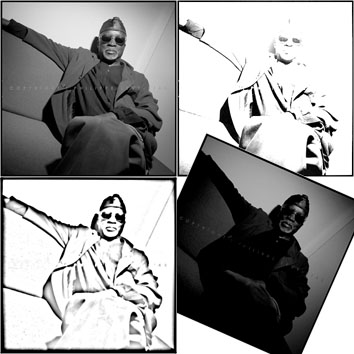
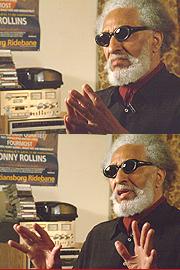
    The week after Thanksgiving came another senior sighting when the Saxophone Colossus Sonny Rollins, also 79, touched down at the Kennedy Center Concert Hall through the auspices of the Washington Performing Arts Society (WPAS).  No longer the road warrior he once was, Sonny picks & chooses his dates and frankly commands a fee (God bless him!) that is beyond the reach of many jazz presenters.  So when Rollins comes around it is event programming, and this evening was no exception.  The huge KC Concert Hall was jam packed with anticipation and one sensed that the audience was there in appreciation of royalty; a fact substantiated by the standing ovation when Sonny ambled onstage, before he’d even played a note.  And his 90-minute+ performance did not disappoint.  Years ago critic Ira Gitler famously characterized John Coltrane’s tenor improvisations as "sheets of sound".  In Rollins’ case that would be torrents of sound, a different approach to tenor mastery than his old friend Trane, but no less potent.  The closing de riguer "Don’t Stop The Carnival" (one of only two calypsos on this evening, for those who keep score and look askance when in their estimation Sonny dips in the calypsonian well once too often), was truly ecstatic, with many in the audience dancing at their seats.  Sonny was perhaps more gregarious and expansive with his audience, eliciting shouts of recognition when he reminisced about his boyhood times in nearby Annapolis, MD and his unrequited 12-year old crush on a 19-year old.  One piece I’d not heard previously was an original he wrote in tribute to J.J. Johnson, at the end of which he raised his arms and sang a vocal coda!


    These two rich experiences simply served to bolster the sense that in the right hands, and given the right life circumstances, the jazz crusade is a lifetime quest for the persevering practitioner — and thank goodness the jazz audience is not about throwing away the flavors of yesteryear!  So to all of you young musicians struggling with your music, and struggling even harder to attain jobs and a healthy audience, remember… perseverance can pay off in jazz music, and indeed have its rewards.

Posted in General Discussion | Leave a comment

Ain’t But a Few of Us: Black jazz writers tell their story #12

Like most of the participants in our ongoing dialogue with African American music writers, Gregory Thomas, has both feet and hands in several camps.  Greg’s byline has been featured in numerous publications, including Salon.com., Guardian Observer (London), American Legacy, Africana.com, BlackAmericaWeb.com, Daily News (NY, NY), TBWT.com, Callaloo and others.  He was the founding editor-in-chief of Harlem World magazine. 


Additionally Gregory Thomas has taught jazz education at the Brooklyn Academy of Music, the Thurgood Marshall Academy, and the Frederick Doublass Academy for the Jazz Museum in Harlem’s Harlem Speaks Education Initiative.


As an electronic journalist Greg details his web-television exploits below.  He has hosted radio specials on WBAI (99.5 FM, Pacifica Radio in New York City), where he hosts a regular jazz show the first Monday each month from 9:00-11:00 p.m.


Writer-Producer-Broadcaster

Gregory Thomas


What motivated you to write about this music?


The foundation was the music my parents listened to which included jazz, and my deep study and enjoyment of the giants of jazz I’d been listening to very intently since high school.  Inspired by a high school stage band concert, I began to play the alto sax at 15 years old.  I took lessons with a local Staten Island legend, Caesar DiMauro; studied music theory and saxophone method books; played in various classical and jazz ensembles; tuned in regularly to WRVR and WBGO; and minored in music at Hamilton College, where I also hosted a jazz radio show for three years.  Sharing a melody line with trumpet icon Clark Terry there, on April 17, 1984 in the college chapel, was an epiphany, a mystical experience of musical ecstasy.


    A few years after graduating from Hamilton I met Keith Clinkscales and Leonard Burnett, later of Vibe and Savoy, who launched their first publication, Urban Profile, in the late ’80s.  I was more troubled by how relatively few black folk attend live jazz performances than by the dearth of black writers about jazz.  So Keith and Len published my very first professional piece: "Why Black Folks Should Listen to Jazz."  I became a staff writer for the Brooklyn-based City Sun a few years later, and wrote about jazz and other subjects.  Since then I’ve free-lanced for many publications.


    My initial goals as a jazz journalist were to report accurately, and educate readers gently, while describing a recording or a concert so the reader felt that he or she had experienced it too.  Usually if I don’t like a performance, live or on record, I just don’t write about it.  I’m not into bashing artists to feed my ego or further my career.  My major objective now is to share my knowledge and adoration of the music on as many platforms to as many people as possible — in print, on radio, on stage at the National Jazz Museum in Harlem, and on the internet and mobile through the TV series I host, Jazz It Up!


When you started covering the music were you aware of the dearth of African Americans writing about serious music?


Well it wasn’t as bad then as it seems to me now.  I’d read pieces on jazz by Stanley Crouch and Greg Tate in the Village Voice, Gene Seymour in the Nation and New York Newsday, as well as jazz writings by Harlemite Herb Boyd, and a contemporary of mine, Eugene Holley, in various publications.  Playthell Benjamin wrote about jazz (and a whole lot more) for the Voice and other periodicals.  All of these guys were in New York in my early years as a writer, as were the ever-looming presence of the elder grand masters — Ralph Ellison and Albert Murray.


Why do you suppose that’s still such a glaring disparity — where you have a significant number of black musicians playing this music but so few black jazz media commentators?


I suppose that most black commentators who focus on music generally deal with more popular genres.  And in 2009, there are less and less publications that even cover "serious music" anymore.  The glaring disparity has to do with black musicians being acculturated early on to the cultural power and appeal of jazz expression, particularly since their ancestors founded and innovated the blues idom vernacular called jazz, versus black media commentators who privilege popular forms (and the career benefits that could bring) over jazz, a fine art that they may not even like or feel qualified to write about.


      Pop and youth culture hold a powerful sway.  You have to go deep in the woodshed to write about jazz with substance.  Most black commentators, even those in the academy, apparently aren’t ready, willing or able to go that deep in the shed about the musical form at the very pinnacle of their culture, as developed in the United States.  With some notable exceptions, this has been the case through the entire history of the music.


{Editor’s note: on that academy tip, one wonders if we will ever see the likes of such leading black scholar-intellectuals as Henry Louis Gates, Cornell West, or Michael Eric Dyson write extensively on the subject of jazz music, with the same degree of vigor with which at least West and Dyson have taken up the pen to wax rhapsodic on black pop.  Still waitin’…]


    But hey, on the other hand, perhaps writing about the fine arts, about "serious music," considering our difficult history in this land, was aptly viewed as a luxury until more recent times.


Do you think that disparity or dearth of African American writers contributes to how the music is covered?


    Sure, but I think we can only take that point so far.  Most writers covering jazz readily admit the black American roots of the music, so that’s a commonality.  But there are different views on the value of certain styles or sub-genres, and so different emphases arise based on stylistic preferences.  These and other factors such as those I detail later play an important role in how the music is covered as much or more than race.


    As in politics, where race doesn’t necessarily determine whether one is, say, liberal or conservative, African-American writers won’t share the same opinions about the music based solely on their cultural identification.  Anyway, white and other writers who don’t identify as "black" still share in the values and expressive content of black American culture by a sort of cultural osmosis, because that blues idiom is in the very fabric, the fiber, of American society and culture writ large.  If you consider yourself American… you part black too!


Since you’ve been writing and broadcasting about serious music, have you ever found yourself questioning why some musicians may be elevated over others and is it your sense that has anything to do with the lack of cultural diversity among the writers covering this music?


Yes, I have at times questioned why some musicians may be elevated over others.  And though the back story is usually more complicated than a simple "race" analysis, race being an omnipresent cancer in the body politic, does play a role.  It’s important to note that race and cultural diversity are actually two different things — the confusion between race and culture has been deadly — but I think it better to confront race in jazz to best move beyond it.  Race is ultimately trivial and stupid but to transcend it we must face the illusion/delusion of race squarely; this is especially true in the era of Obama.


    Record label and public relations support factor in such elevations, as does a need for some writers to find the "next hot artist."  So many good jazz artists labor in relative obscurity that when they get some attention, I usually don’t have a problem with it.  Cultural diversity among writers will flower more perspectives, but not a consensus on which artists deserve to be elevated over others.


    However, I don’t agree with certain musicians being called "jazz" artists when they themselves will say, for instance, that they play "instrumental R&B."  The way the term "jazz" has been marketed is problematic too, especially by festival promoters and the radio industry (i.e. "smooth jazz").  They endeavor to profit from the veneer and sophisticated brand of jazz while pulling in other genres to make more money than they could with jazz proper.  That’s business.  Kenny G, for instance, is a popular pop/R&B instrumentalists, but when he is elevated by the mainstream press as a "jazz" artist due to record sales and radio play over, say, Kenny Garrett, the most influential jazz alto of his generation, that’s hype, not an accurate evaluation of genre or of artistic weight and authority.


    Furthermore, I think there is an undercurrent of race in why artists such as Diana Krall, Chris Botti, and Norah Jones become popular performing a mellow, soothing, less-experimental style of music.  They fill a niche in the music and radio industries and for certain market segments.  But I don’t criticize those artists for that, it’s not their fault as individuals that the dumb idea of race is so entrenched that they benefit from white privilege as well as their musical style and talent as artists.


What’s your sense of the indifference of so many African American-oriented publications towards this music, despite the fact that so many African American artists continue to creat serious music?


Jazz is a fine art and most black publications focus on popular music.  As Albert Murray says, the quality and range of aesthetic statement can be grouped into folk, pop, and fine art categories, for pedagogical purposes.  Our celebrity and profit-driven society overall doesn’t value fine art based on intrinsic or long-term value.  If it doesn’t have a big audience, then it won’t be considered relevant to most black publications because they compete in a media field where popularity and celebrity trumps all.


    This is especially sad and tragic because elder masters such as Hank Jones, Roy Haynes, Clark Terry, Wayne Shorter, Sonny Rollins, Phil Woods, Barry Harris, Charles McPherson, Jimmy Heath, Reggie Workman, Louis Hayes, Jimmy Cobb, Ben Riley, Benny Golson, Buster Williams, Jon Hendricks, Melba Joyce, Gloria Lynne, Ahmad Jamal, and Grady Tate are still on the scene.  I could easily name 20 more living legends unknown to a wider black audience, or to the general public.  The audiences consuming black publications are aware of Quincy Jones and Herbie Hancock, and even Wynton Marsalis, but they usually aren’t hip to the just-mentioned senior giants.  To re-phrase Carter G. Woodson, this is the mis-education of the black American.  These artists should be revered and honored by black publications and media outlets as a cultural and ancestral imperative.


    American Legacy magazine, for which I’ve written features on Ralph Ellison and Albert Murray, is one of the few African American periodicals I can point to that delves into the historical and cultural depths beyond pop culture and contemporary hype.


    Oprah’s fame and world-wide celebrity is larger than just a black audience, so she could reach that demographic and more.  I wrote an open letter to Oprah in All About Jazz inspiring her to have more jazz musicians on her show, not just as performers, but as commentators.  Jazz musicians are some of the most worldly, sophisticated and smart people I know.  Exposing wider audiences to jazz musicians as artists and as thinkers is one way to address the low cultural moment in which we find ourselves.


    The public education system and the music industry are largely at fault for the current state of affairs, where a vicious cycle of mediocrity predominates.


    It’s incumbent upon those of us who love and value this music’s contribution to this nation and the world to be more entrepreneurial.  [The Independent Ear] is an exampole of this.  My online jazz news and entertainment series Jazz It Up! is another.


How would you react to the contention that the way and tone of how serious music is covered has something to do with who is writing about it?


How serious music is covered is a matter of individual taste, depth of historical, aesthetic, literary and musical knowledge. native talent and disciplined application of all the above.  These factors fluctuate, of course, among writers of varying backgrounds.  How the music is covered also has to do with how the writer views his or her social and cultural function.  I recently produced and moderated a panel discussion at the National Jazz Museum in Harlem that brought together jazz critics and scholars (Gary Giddins, Howard Mandel, John Gennari) and jazz musicians (Steve Coleman, Lewis Nash, Jon Gordon and Vijay Iyer) for a dialogue.  I ventured a definition of the role of jazz criticism: to be a bridge between the artists, the art form and the public for the sake of publicity, education, and aesthetic evaluation.  That’s how I see my role, so that orientation grounds the tone and approach I take when I write about the music.


In your experience writing about serious music what have been some of your most rewarding encounters?


Getting to meet, interview and even become friends with musicians who play the music that most moves my soul has been extremely rewarding.  Of course hearing great music live that I otherwise may not have been able to afford is another.  When a reader says to me "I felt like I was there," I say to myself: "mission accomplished"!  There is also a community of academics and scholars with whom I’ve interacted as a member of the Jazz Study Group at Columbia University.  I’m grateful to Robert O’Meally for asking me to join in 1999, as I worked towards a doctorate in American Studies at NYU.  (I decided not to pursue academia as a career.)


    Last, but far from least are friendships and mentor relationships I’ve nurtured over the years that have jazz, and an abiding appreciation of black American culture, at the root.


What obstacles have you run up against — besides difficult editors and indifferent publications — in your efforts at covering jazz?


The main obstacle, other than those you’ve mentioned, is making a living covering jazz.  So, like many others, I’ve had to supplement coverage of jazz with other work to support my family.  Another obstacle has been getting due recognition in the jazz press about Jazz it Up!  Though we had a little coverage in Downbeat and JazzTimes when we launched in 2007, since then the coverage hasn’t been commensurate with what we’ve accomplished.  Jazz it Up! is the only online TV series devoted to this music, and over the course of 18 half hour episodes we’ve garnered close to 3 million viewers online.  That’s jazz news that warrants coverage.


    Ironically, the organization that produces and presents the Emmy Awards has recognized Jazz it Up! in fall 2008, the National Academy of Recording Arts and Sciences nominated Jazz it Up! for a Global Media Award in the Long Form Entertainment category.  Not one jazz publication — online or otherwise — covered this achievement.


If you were pressed to list several musicians who may be somewhat bubbling under the surface or just about to break through as far as wider spread public consciousness, why might they be and why?


Jonathan Batiste, a young pianist from New Orleans, is a charismatic, fresh voice on jazz piano.  I’m also excited about pianist Gerald Clayton, who comes from a great family of musicians; his touch, taste and technique are superb.  Dominick Farinacci and Theo Croker (Doc Cheatham’s grandson) are two young trumpeters who deserve wider recognition for their fidelity to the tradition while attempting to forge new pathways.  Vibraphonist Warren Wolf plays jazz andd other genres of music with deep integrity and verve.  He’s a favorite of Christian McBride, so that speaks for itself.  Edmar Castaneda is an incredible harpist on the verge too; he plays the harp with a percussive virtuosity that is a wonder to hear and see.


What have been the most intriguing new records you’ve heard this year so far?


Benny Golson, New Time, New ‘Tet

Bobby Broom, Boby Broom Plays for Monk

Christian McBride & Inside Straight, Kind of Brown

Cyrus Chestnut, Spirit

Roy Hargrove Big Band, Emergence

Vijay Iyer, Historicity

Take 6, The Standard


You can check out Greg Thomas’ Jazz it Up! internet TV series and catch up with his latest exploits at www.jazzituptv.com.

Posted in General Discussion | 1 Comment

What Amiri Baraka taught me about Thelonious Monk

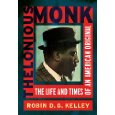
Robin D.G. Kelley, author of the exhaustively-researched and superb new Thelonious Monk biography Thelonious Monk: The Life and Times of An American Original (Free Press, an imprint of Simon & Schuster), contributed the following piece to the recent 75th birthday commemoration for Amiri Baraka.  He granted re-print permission to The Independent Ear.  Read Robin’s contribution to our ongoing dialogue between African American music writers Ain’t But a Few of Us by clicking on the month of October.


Author & USC Professor Robin D.G. Kelley


                   What Amiri Baraka Taught Me About Thelonious Monk

                       by Robin D.G. Kelley


"Monk was my main man."

            — Amiri Baraka


    I just spent the past fourteen years of my life researching and writing a biography of pianist/composer Thelonious Monk, and over thirty years attempting to play his music.  My obsession with Monk can be traced back to many things and many people, but paramount among them is Amiri Baraka.  Let me explain.


    My path to "jazz" began like so many others of my generation who came of age in the late 1970s — with the funky commercial fusions of Grover Washington, Jr., Bob James, Patrice Rushen, Earl Klugh, Ronnie Laws, through Stanley Clarke and Chick Corea.  But inexplicably, at the tender age of seventeen or eighteen I took a giant leap directly into the so-called "avant-garde", or the New Thing.  By 1980, the New Thing wasn’t so new (and as Baraka and others have shown us, it wasn’t so new in the 1960s), but the music appealed to my rebellious attitude, my faux sense of sophistication, and to the way I heard the piano.  As a young neophyte piano player and sometimes bassist, my heroes became Cecil Taylor, Eric Dolphy, Ornette Coleman, Don Cherry, Archie Shepp, late ‘Trane, the Art Ensemble of Chicago, those cats.  I knew almost nothing about bebop, nor could I name anyone in Ellington’s orchestra except for Duke.  I just thought free jazz was the beginning and end of all "real" music.  My stepfather introduced me to Charlie Parker, Monk, Bud Powell, Dexter Gordon, but I wasn’t yet ready to fully appreciate bebop.  Then in one of my many excursions to "Acres and Acres of Books" in Long Beach, California, I picked up two used paperbacks by one LeRoi Jones: Blues People and Black Music.


    I dove into Black Music first.  Imagine my surprise when I discovered a thoughtful piece on Monk in a book that I understood then to be a collection of essays primarily about the "New Thing."  Don’t get me wrong; I dug Monk from the first listen.  I had heard an LP recorded live at the Five Spot Cafe with Monk and tenor saxophonist Johnny Griffin.  I wore it out, especially their rendition of Monk’s "Evidence".  But Monk wasn’t part of the jazz avant-garde.  He was already an old man when Ornette Coleman made his debut, or so I thought.  Baraka’s Black Music corrected me, schooling me on the roots and branches of free jazz.  Between his piece on "Recent Monk," his brilliant treatise, "The Changing Same (R&B and the New Black Music)," and several other pieces on white critics and the jazz avant-garde, I began to hear Monk and "free jazz" quite differently.  It was Baraka who dubbed the jazz avant-garde the "New Black Music," insisting that it emerged directly out of a Black tradition, bebop, as opposed to the Third Stream experiements of Gunther Schuller, Lee Konitz, and Lennie Tristano.  While Black musicians might have milked Western classical traditions for definitions and solutions to the "engineering" problems of contemporary jazz, Europe is not the source.  "[J]azz and blues," he writes, "are Western musics; products of an Afro-American culture."


    Of the few hundred times I listened to Monk, Johnny Griffin, drummer Roy Haynes, and bassist Ahmed Abdul-Malik tear the roof off the Five Spot, I probably heard Baraka, shouting his approval and urging them on from his table near the bandstand.  It was August of 1958 and Baraka (when he was still LeRoi Jones) had been an East Village resident for the past year.  He became a Five Spot regular when Coltrane was with Monk in the summer and fall of 1957.  His constant presence gave him unique insights into Monk’s music and the challenges it created for the musicians who played with him.  Indeed, Baraka was one of the few critics to admit that "opening night [Coltrane] was struggling with all the tunes."  Baraka just didn’t come to dig the music, he studied Monk.


    In fact, he was arguably the first American critic, along with Martin Williams, to really understand what Monk was doing and why a new generation of self-described avant-garde musicians was drawn to Monk’s music and his ideas.  By the time Baraka entered the fray, most critics had either dismissed Monk for having no technique or formal training as a pianist, or they praised him for his eccentricity and inventiveness precisely for his lack of technique or formal training.  For Baraka, the whole issue of Monk’s technique was nonsense:  "I want to explain technical so as not to be confused with people who think that Thelonious Monk is ‘a fine pianist, but limited technically.’  But by technical, I mean more specifically being able to use what important ideas are contained in the residue of history or in the now-swell of living.  For instance, to be able to double time Liszt piano pieces might help one become a musician, but it will not make a man aware of the fact that Monk was a greater composer than Liszt.  And it is the consciousness, on whatever level, of facts, ideas, etc., like this that are the most important parts of technique."


    While Baraka’s fellow Beat generation writers embraced Monk because they heard spontaneous, instinctual feeling and emotion as opposed to intellect, Baraka saw no such opposition; he was careful not to divorce consciousness and intellect from emotion.  He writes, "The roots, blues and bop, are emotion.  The technique, the ideas, the way of handling the emotion.  And this does not leave out the consideration that certainly there is pure intellect that can come out of the emotional experience and the rawest emotions that can proceed from the ideal apprehension of any hypothesis."  Like his insights about Monk’s technique, the point underscored Baraka’s general claim that bebop was roots music, no matter how deep the imperative for experimentation, because it carries deep emotions, historical and personal.  The music of the Blues People.


    And if Thelonious Monk was anything, he was Blues People.  Born in Rocky Mount, North Carolina, the grandson of enslaved Africans, delivered by a midwife who was thirteen when Emancipation Day came, Monk was raised by parents who grew up picking cotton and survived on odd jobs and cleaning white folks’ homes.  His mother brought Thelonious and his two siblings to New York in search of a better life, and while they enjoyed more opportunities the Monks settled in the poor, predominantly black neighborhood of San Juan Hill (West 63rd Street, Manhattan).  Thelonious grew up listening to the blues, jazz, the rhythms of calypso and merengue, hymns and gospel music (he spent two years traveling through the Midwest with an evangelist).  His mother Barbara, scrubbed floors to pay for his classical piano lessons, and Monk continued his studies under the tutelage of the great Harlem stride pianists of the day.  Monk told pianist Billy Taylor "that Willie "The Lion’ and those guys that had shown him respect had… ’empowered’ him… to do his own thing.  That he could do it and that his thing is worth doing.  It doesn’t sound like Tatum.  It doesn’t sound like Willie ‘The Lion’.  It doesn’t sound like anybody but Monk and this is what he wanted to do.  He had the confidence.  The way that he does those things is the way he wanted to do them."


    Willie ‘The Lion’ never mentions Thelonious in his memoirs, but he described the all-night cutting sessions which sharpened Monk’s piano skills:  "Sometimes we got carving battles going that would last for four or five hours.  Here’s how these bashes worked: the Lion would pound the keys for a mess of choruses and then shout to the next in line, ‘Well, all right, take it from there,’ and each tickler would take his turn, trying to improve on a melody…  We would embroider the melodies with our own original ideas and try to develop patterns that had more originality than those played before us.  Sometimes it was just a question as to who could think up the most patterns within a given tune.  It was pure improvisation."  A later generation of bebop pianists would often be accused of one-handedness; their right hands flew along with melodies and improvisations, while their "weak" left hands just plunked chords.  A weak left hand was one of Smith’s pet peeves among the younger bebop piano players.  "Today the big problem is no one wants to work their left hand — modern jazz is full of single-handed piano players.  It takes long hours of practice and concentration to perfect a good bass moving with the left hand and it seems as though the younger cats have figured they can reach their destination without paying their dues."


    Teddy Wilson, though only five years older than Monk but considered a master tickler of the swing generation, had nothing but praise for Thelonious’s piano playing.  "Thelonious Monk knew my playing very well, as well as that of Tatum, [Earl] Hines, and [Fats] Waller.  He was exceedingly well-grounded in the piano players who preceded him, adding his own originality to a very sound foundation."  Indeed, it was this very foundation that exposed him to techniques and aesthetic principles that would become essential qualities of his own music.  He heard players "bend" nots on the piano, or turn the beat around (the bass note on the one and three might be reversed to two and four, either accidentally or deliberately), or create dissonant harmonies with "splattered notes" and chord clusters.  He heard things in those parlor rooms and basement joints that, to modern ears, sounded avant-garde.  They loved to disorient listeners, to displace the rhythm by playing in front or behind the beat, to produce surprising sounds that can throw listeners momentarily off track.  Monk embraced these elements in his own playing and exaggerated them.


    Finally, Baraka was one of the first critics to predict that Monk’s long awaited success in the early 1960s might negatively impact his music.  Indeed, this was the point of his essay, "Recent Monk."  Thelonious’s fan base had expanded considerably after he signed with Columbia Records, made a couple of international tours, and appeared on the cover of Time Magazine in 1964.  But Baraka noted that Monk’s quartet, like so many successful groups, began to fall into a routine that sometimes dulled the band’s sense of adventure.  Baraka warned, "once [an artist] had made it safely to the ‘top,’ [he] either stopped putting out or began to imitate himself so dreadfully that early records began to have more value than new records or in-person appearances…  So Monk, someone might think taking a quick glance, has really been set up for something bad to happen to his playing."  To some degree, Baraka thought this was already happening and he placed much of the blame on his sidemen.  Of course, Monk hired great musicians during this period — Charlie Rouse (tenor sax), bassists Butch Warren and Larry Gales, and drummers Frankie Dunlap and Ben Riley.  But the repertoire remained pretty much the same, and the fire slowly dissipated.  Monk himself continued to play remarkably, but there was an element of predictability that overrode all the amazing things he was doing.  "{S}ometimes," Baraka lamented, "one wishes Monk’s group wasn’t so polished and impeccable, and that he had some musicians with him who would be willing to extend themselves a little further, dig a little deeper into the music and get out there somewhere near where Monk is, and where his compositions always point to."


    Baraka never gave up on Monk, and while I can’t prove it I suspect Monk’s music continues to have a strong philosophical and aesthetic influence on both his literary and political work.  But more than anything, I will always be grateful to Baraka for helping me discover Monk, for revealing that Monk’s rootedness in this history, in family, in tradition explains why his music, as modern as it is, can sound like it’s a century old.  It explains why he always remained a stride pianist; why his repertoire was peppered with sacred classics like "Blessed Assurance" and "We’ll Understand it Better, By and By"; and why the careful listeners can hear in Monk’s whole-tone runs, forearm clusters, unusual tempos and spaces, shouts, field hollers, the rhythm of a slow moving train, rent parties, mourners, children playing stickball and marbles, and the Good Humor or Mr. Softee truck on a summer evening.


    Like most scholars and other voyeurs, we are always listening for, and looking at, art for personal tragedy rather than collective memory, collective histories.  Amiri Baraka understood the fallacy of this approach.   Perhaps this is why he writes in the poem "Funk Lore" (one of several associated with Monk):


                    That’s why we are the blues

                                Ourselves

                                That’s why we

                                 Are the

                                 Actual

                                 song


It should be noted that the source of the various passages from Baraka’s writings on Monk, as well as the interview segments and book passages Mr. Kelley quotes in this appreciation of Amiri Baraka are meticulously footnoted — as they are in Kelley’s exhaustively-researched book.  For the sake of webzine brevity we elected not to include Robin’s footnotes and source materials… and also to urge you to run out and purchase your copy of Thelonious Monk: The Life and Times of An American Originaland do that with a quickness!


Referencing this special book, here’s a passage on Ellington’s sense of Thelonious (chapter 10, p. 138) during a time when Monk and his music were widely misunderstood, or dismissed as some sort of hopeless eccentric by musicians, critics, and the listening public:

"During the summer of 1948, while Duke Ellington’s band was traveling by train in the southern coast of England, trumpter Ray Nance decided to pass the time away by listening to records on a little portable phonography he had picked up.  "I put on one of my Thelonious Monk records.  Duke was passing by in the corridor, and he stopped and asked ‘Who’s that playing?’  I told him.  ‘Sounds like he’s stealing some of my stuff,’ he said.  So he sat down and listened to my records, and he was very interested.  He understood what Monk was doing."


Posted in General Discussion | 18 Comments

Ain’t But a Few of Us: Black jazz writers tell their story #11

Our ongoing series of conversations with black jazz writers continues with one who doubles as an active musician-bandleader, Greg Tate, leader of the burning, probing, inquisitive, boundary-free ensemble known as Burnt Sugar.  Greg has contributed to a variety of publications, becoming most widely-read from his days as a frequent commentator for the Village Voice, where he was a staff writer from 1987-2003.  A steadfast chronicler of many forms of black music, Greg Tate is a journalist-provocateur.


Writer-musician-producer-conceptualist Greg Tate


What motivated you to write about serious music?


Reading Amiri Baraka’s book Black Music and Rolling Stone magazine when I was about 14 made me want to become a vinyl collector and a music journalist.


When you started on this writing quest were you aware of the dearth of African Americans writing about serious music?


I was very aware of it because in my teens I came to know who all the Black journalists who had ever written for Downbeat were — Baraka, A.B. Spellman, Bill Quinn, W.A. Brower.  Being a DC native I know about The Washington Post’s Hollie West, and I knew Phyl Garland had done some things at Ebony.  But even on the R&B/hiphop side outside of the Black Press there are few Black music writers being published.  To this day I think Rolling Stone hasn’t published more than 5 Black writers in its history — Nelson George, myself, Cheo Coker, Toure, Kris Ex.  The NYT has never had a regular Black jazz writer.


Why do you suppose that’s still such a glaring disparity — where you have a significant number of black musicians making serious music, but so few black jazz media commentators?


Because by and large, music editors aren’t interested in diversifying their rosters.  Hiphop music, when it was younger and fresher, marked the first time in African American history where the majority of writers covering it for the Voice, The Source, and VIBE were Black.  The ratio there flipped once corporate interests took control over the creative aspects of that music — so that now at many major hiphop publications the writers are non-Black. 


The cultural ignorance of non-Blacks about Black culture and hiphop created openings and opportunities for Black writers at the birth of hiphop when the fanbase was largely Black.  Once that changed and the music became more predictable and redundant, the most talented, most thoughtful Black hiphop writers became less interested in writing about it.  Of course with jazz the problem is that so few educated African Americans even support it — preferring black pop over jazz — somewhat analagously to Ivy League-educated Euro-Americans who would consider themselves stupid for not knowing what Richard Serra or Gerhard Richter are up to, but yet feel no shame in not keeping up with the symphonic tradition.


Do you think that disparity or dearth of African American writers contributes to how the music is covered?


To some extent, though I think that about all aspects of the news!  But the real problem with jazz is that it’s no longer a form of expression where what Black musicians do or don’t do matters to most Black Americans.  Jazz has more meaning for Black Americans as a history lesson than as a living, breathing cultural experience.  It’s not on Black radio or TV programs, or in Black schools, neighborhoods or churches, so it’s pretty irrelevant as far as the modern Black experience goes.  The question is how much longer will contemporary jazz even be considered a ‘Black’ art form in America.  The notion of Black Jazz actually has more weight in London now than in all 50 states of the Union.


Since you’ve been writing about serious music, have you ever found yourself questioning why some musicians may be elevated over others and is it your sense that has anything to do with the lack of cultural diversity among writers covering this music?


Not really — the lack of cultural diversity is an editorial politics problem.  And I’d need you to be more specific about the ‘elevation of some over others’ issue — like who do you mean — and to what effect?  Because Wynton and the JALC guys make all the real money in American jazz — I don’t know any jazz musicians of any color not in that band will ever make what those cats make, not even if they had 3 lifetimes. 


[Editor’s note: Lest we forget… Sonny Rollins, Ornette Coleman, Keith Jarrett, Herbie Hancock, Wayne Shorter, Branford Marsalis… and that’s not taking into account certain singers, like Diana Krall whose fee is in the relative stratosphere for someone performing acoustically who is jazz-identified… are examples of uncompromising jazz musicians making relatively good money — take it from someone who books and presents jazz concerts & festivals.]


What’s your sense of the indifference of so many African American-oriented publications towards serious music, despite the fact that so many African American artists continue to create serious music?


Jazz might as well be dead as far as the majority of Black Americans at every class level are concerned.  If Culture is defined as what people do, then we can say that in significant numbers Black people don’t do jazz anymore.


How would you react to the contention that the way and tone of how serious music is covered has something to do with who is writing about it?


Not to be vague, but I’d say this to be true of writing about anything. If you’re asking whether a black or a white writer is covering the music I’d say look to the individual before the ethnicity.


In your experience writing about serious music what have been some of your most rewarding encounters?


My interviews with Miles Davis, Ornette Coleman, Wayne Shorter, Marion Brown, Henry Threadgill, Dexter Gordon, and Betty Carter.  Pulling together a tribute page to Lester Bowie after he passed that involved many of his generational cronies, like Don Moye, Oliver Lake, Henry Threadgill, and Butch Morris, respected elders such as Max Roach, as well as [Lester’s] wife Deborah, and his good friend Thulani Davis.


What obstacles have you run up against — besides difficult editors and indifferent publications — in your efforts at covering serious music?


None worth speaking of.  Been pretty blessed since I spent most of my music writing career at a publication that for years had two of America’s best jazz journalists on staff — i.e. [Stanley] Crouch and [Gary] Giddins — the good olde school version of the Village Voice.


If you were pressed to list several musicians who may be somewhat bubbling under the surface or just about to break through as far as wider spread public consciousness, who might they be and why?


Arne Henriksen, Taylor Ho Bynum, Matana Roberts [editor’s note: look for a forthcoming I.E. contribution from her] — all adventurous players and major free-thinking conceptualists with their own distinct sounds and ideas.  Even though he’s in his 80s, Bill Dixon, a man who many jazz people are still mystified by — is certainly the most influential voice on trumpet since Miles.


What have been the most intriguing new records you’ve heard this year so far?


Arne Henriksen’s Cartography

VIjay Iyer’s Historicity

ECM’s reissues of Bennie Maupin’s The Jewel in the Lotus; Marion Brown’s Afternoon of a Georgia Faun; Dewey Redman’s The Struggle Continues


The latest from Greg Tate’s blistering ensemble Burnt Sugar

Posted in General Discussion | 5 Comments

Labor activist fires another salvo & advises jazz musicians

You Don’t Have to be a Weatherman to Know Which Way the Wind is Blowing!  Another Look at the "Jazz is Dead" Controversy; Part One

By Ron "Slim" Washington

Black Telephone Workers for Justice


"Slim" suggests the development of a jazz club circuit to include such venues as Cecil’s in West Orange, NJ…


I recently wrote a piece "How Can a Music of the Spirit Die?" [published in The Independent Ear, September ’09] (contact blacktel4justice@gmail.com for a copy), in response to the Wall Street Journal article, written by Terry Teachout, basically promoting the view that "jazz is dead and/or dying."  Upon further reflection, I’d like to admit that the attack by Teachout on the music is more dangerous and insidious than I first realized.  How naive of me!  Though certainly not a "consipracy" buff I’d advise all the jazz lovers and artists to wake up to what amounts to a stepped up attempt by very powerful forces to not necessarily kill jazz, but to further "gentrify" it.  The bulb in my head went off when I received an email from trombonist Steve Turre, thanking me for the article and reminding me that the WSJ was owned by Rubert Murdoch.  Rupert Murdoch, the big time right wing owner of much of the world’s media and creator of right wing public opinion… one of the real vampires of the world!  How could I have missed that?


Critic Terry Teachout

    I also received an email from Willard Jenkins, who so graciously reprinted my article on [The Independent Ear].  Willard advised me that Teachout was not some WSJ "go for coffee" intern whom they made do an article on the death of jazz.  In my article I had implied that Teachout was a "gofer", not knowing anything of Teachout’s history.  Upon further investigation I discovered that Teachout has a long, sordid history as a drama critic and political contributor to many right wing publications.  He is part of a well-known right wing intelligentsia for hire.  Check it out: Rupert Murdoch’s WSJ hired Terry Teachout to do an article proclaiming the illness and death of jazz?  You don’t have to be a weatherman to know which way the wind is blowing.  The attack on "the music" is coming from the highest right wing levels of power.


    Let’s look back in order to look forward.  According to the 2009 Forbes 400, Murdoch is the 132nd richest person in the world, with a net worth of $4 billion.  The Australian born media mogul built his base in Australia but soon moved to Britain.  Acquiring "The Sun" in 1969, Murdoch acquired the "Times" in 1981.  HIs right wing influence and thinking allowed him to become a friend and supporter of the British Prime Minister, Margaret Thatcher.  Imperialist media mogul that he is, he also made moves on the U.S. market.  In 1973 he bought the "San Antonio Express News", founded the supermarket tabliod "Star", and in 1976 he bought the New York Post.


    Many of us are familiar with the right wing politics and "sensationalism" of the infamous "Post".  Its all around attack on the people’s struggles, support for police brutality and other notorious right wing causes, caused many in the Black, Latino, and progressive communities to call for annual boycotts of the newsrag.  in 1996 Murdoch created the "Fox News Channel," the most influential promulgator of right wing politics on the landscape, with the express purpose of competing against Ted Turner’s CNN.  In August, 2007 Murdoch officially acquired Dow Jones, owner of the Wall Street Journal.  What’s crucial to understand is that Murdoch has a reputation for being a "hands on" owner.  He is notorious for meddling in the affairs of his newspapers, making sure that they reflect his right wing politics, and firing employees who do not tow the line.  The "music" has a formidable enemy.  For example:


    In a statement, Ben Jealous of the NAACP said:

"The New York Post and Fox News have a history of racially insensitive reporting.  With the support of the editor-in-chief, the cartoonist Sean Delonas has published numerous vile cartoons tinged with racism.  Fox News was widely criticized during the elections for calling Michelle Obama ‘Obama’s baby mama" and terming the affectionate and common fist bump between then-candidate Obama and his wife, ‘a terrorist fist jab’ at a time when death threats against the candidate were at an all-time high for any presidential candidate.  The New York Post stands alone from most daily newspapers in refusing to report its diversity numbers to the American Society of Newspaper Editors.  One has to wonder how many Hispanic or African American reporters and editors are working at the New York Post?  Clearly, with more diversity in its newsrooms, it’s likely the paper would have been able to understand the deeply offensive nature of the cartoon.  Our guess is that the numbers are abysmally low for a newspaper serving a city with a population as diverse as New York."


    So the WSJ hires Terry Teachout to do its "jazz is dead" article, accompanied by one of the most infamous (racist) cartoons in the history of journalism:  a "black" musician being rolled out to pasture in a wheelbarrow.  Teachout is an established cultural and drama critic, in addition to being an accomplished commentator from the right.  A former jazz bassist [editor’s note: do we have here yet another example of the ‘failed jazz musician’ syndrome where a flop musician takes up the critic’s pen?], he has written a book on Louis Armstrong and contributed to the Oxford Companion to Jazz.  In 2004 he was appointed by President Bush to the National Council on the Arts.  More importantly he has been a house writer for the right wing publications National Review and Commentary.  Supported by the reactionary Cato Institute, Heritage Foundation, and the American Enterprise Institute, the Review is part of the "commanding heights" of the right wing superstructure in the U.S.


    I also noticed that Teachout has done liner notes for jazz musicians Karrin Allyson, Gene Bertoncini, Ruby Braff, Ellis Larkin, Julia Dollison, Jim Ferguson, Roger Kellaway, Diana Krall, Joe Mooney, Marian McPartland, Mike Metheny, Maria Schneider, Kendra Shank, and Luciana Souza.  I only cIte this list because there are a not a lot of "Black" musicians on it!


    The WSJ, Rupert Murdoch, and Terry Teachout ganging up on jazz…  What’s up with this?  You don’t have to be a weatherman to know which way the wind is blowing!  Are they floating a trial balloon or are they like Martin Luther, proclaiming a new reformation.  Jazz, "the Music of the Spirit," like all cultural forms is closely connected to and created by the struggles, dreams, fears, hopes and aspirations of the Afro-American people.  Enslaved by white supremacist capitalism, and later monopoly capitalism, the Afro-American people have always been a source of cheap labor for capitalism and monopoly capitalism, a source of super profits for the voracious capitalist machine.  In order to carry out the most monstrous crimes against the Afro-American people it was necessary to denigrate not only the people themselves, but also their cultural expressions.  This allowed the enemies of the Afro-American people to build an edifice of white supremacist myths and an "American" philosophical, cultural, and political superstructure that prevented black workers from uniting with their class allies, white workers.  Hence the struggle for equality, self-determination, and respect for the Afro-American people has been one that has manifested itself in every sphere of social, political and cultural life.


    It’s no accident that in a country where jazz has been declared a "national treasure," it gets more respect in Europe than it does in the country of its origin.  The reasons are not debatable… the continuing struggle against white supremacist logic to define and control the music, purging it of its Afro-American influence.  At its lowest level the music during the "swing era" faced a period that effaced the great black musicians from the scene, redefined it as the music of Benny Goodman.  Black musicians only re-established some creative control with the bebop era. 


    Jazz has always faced this dilemma.  The people were never able to control their labor power, the music was never under the control of the producers of the product.  The musical expressions of black people in America have always been under attack: they separate the music from its creators, re-package the music (purge it of its blackness), and then re-sell the music to a popular audience, often without the creators of the music getting a "dime" for their creative efforts.  The problem is that the musical expressions of the Afro-American people, who are a distinct oppressed nationality, with a common psychological and cultural make-up — while being American at the same time — reflects this duality in the music.  Hence this particular historical development of the U.S. has given rise to a situation in which the only original musical art forms are heavily informed by the Afro-American people on the one hand and savagely attacked for being such, on the other hand.


    We are living in a time in which jazz is between two worlds.  On the one hand it has finally achieved a certain bourgeois and academic respectability and acceptance due only to the victories of the black freedom struggle.  I submit again, the respectability that jazz has achieved has not come from the good graces of the enemies of the black freedom struggle, nor even its friends.  The new found respectability is the result of the great and glorious struggle of the Afro-American people against all forms of discrimination and in all spheres of social activity. 


    Numerous university and college [music] progams now have jazz departments and offer degrees in such, and are hiring jazz musicians to head the programs or teach in them.  We have Jazz at Lincoln Center located in the NYC citadel of bourgeois culture and art.  International and domestic jazz festivals are proliferating, while many institutions are partnering up with high school departments to advance the subject matter.  At the same time, the situation is not too bright for many of the younger black and struggling artists.  Many of the major jazz clubs only hire the black "jazz masters," while many of the baddest cats on the block don’t get any play.  Of course this is not to hate on the black masters that paid their dues and created the music, but to point out the rigid "hierarchy" on display in the "major" jazz venues, in effect producing a situation in which the black jazz masters are subsidizing new, younger white musicians, while again, some of the baddest cats don’t get gigs.


    What is the socially conscious jazz artist to do in this "two world" situation?  Of course I don’t have all the answers, but just a few suggestions that I think may help to push the struggle forward.


    As a full-time labor activist, I’d advise that jazz musicians are no different than the rest of us.  YOU [jazz artists] first and foremost must overcome your selfish individualism and get organized.  Jazz musicians are always talking about searching for the "spirit" in the music.  What about finding the "spirit" to unite with your fellow artist comrades?  You are no different than telephone workers, steel workers, teachers, etc.  No matter where we are, we cannot fight the powers that be in an un-organized status.  There needs to be the creation of an organization for musicians dedicated to taking control of all aspects of the music at a maximum and at a minimum to putting yourselves in a better bargaining position versus the club and record owners.  Whether this means joining an already existing organization (Jazz Artists for Justice?) or creating a new one is obviously your decision.  No jazz artist should be without an organization, just as no one in the black community should not be in some organization.


    Black musicians should build and participate in the broadest organization possible, but at the same time reserving their right to organize in formations that are necessary for their survival.  For example, as black telephone workers, we belong to a broader organization that is composed of all telephone workers, our union, the IBEW.  On the other hand we have our own thing, the "Black Telephone Workers for Justice," because there are some tasks that we have to carry out in our communities and issues that we have to directly take up.  This is not a contradiction, but a social reality that should be part of the principles of unity of any broad artists’ organization: the rights of minorities to their own caucuses or other formations.


    The organizations and clubs in the "community" that are struggling to "keep jazz alive," need more support from the musicians "that have made it."  Whatever happened to the Cosby/Denzel principle?  That is, making your money where you must so that you are in a position to do things independently for yourself and your constituency.  Denzel makes big bucks from the powers that be so that he can make a "Great Debaters" movie that reflects his sensibility.  Cosby, a well known philanthropist, performed a number of gigs for free for Cecil’s jazz club [West Orange, NJ; operated by jazz drummer-producer Cecil Brooks lll].  Herbie Hancock will hang out at Cecil’s for a moment, "sign the piano," but not play there!  What’s up with that?


    There are many great musicians that live in the Oranges in close proximity to Cecil’s and other clubs, but never get off the horse and smell the flowers.  Whle on the other hand great artistic neighbors like Dave Stryker and Bob Devos play at Cecil’s all the time.  This is of course not to single out Cecil’s, but to use the club as an example.  This applies to all the local clubs in the area trying to keep the music alive.  We know the musicians are tired of always being asked to "play for free," or cut-rates, but we are at war to save the music, and now is the time to lend more support.  Don’t the musicians know how much influence they have or can have?  When they play at the local venues they add buzz, word of mouth, and create interest in the neighborhood that "jazz is alive and well and must be supported."  This is what counteracts the treachery of the WSJ and the Murdochs of the world [who say] that no one is listening to jazz.  This ain’t abstract, this is concrete.


"Slim" Washington wants to know why if musicians like guitarists Dave Stryker (above) and Bob DeVos (below) can actively support a grassroots, musician-operated jazz club like Cecil’s…


…why can’t a Master like Herbie Hancock?


    Jacc activists, promoters, club owners and artists must build a modern day "jazz circuit."  While not turning down a gig at the Blue Note, we cannot wait on their recognition.  We must build our own thing.  Somehow we must string together the various local venues from NY to California to produce great jazz programs in our communities.  For example, because of the Black Telephone Workers unique relationship with Sista’s Place [Brooklyn], the Black Workers Pub series at Cecil’s would string together at least two hits for the artists…  Thursday night at Cecil’s and Saturday night at Sista’s Place.

 Eventually we brought Creole’s in Harlem into the mix.  This of course allows the musicians a "tour" and could be cost effective for all.  At a minimum, the jazz clubs in NYC, NJ, Philly, DC, and Baltimore [editor’s note: such a "circuit" could include BMore Jazz in Baltimore, and the Bohemian Caverns in DC] could put together some consortium that would allow for such to take place.  This could amount to a modern "Motown Review," with a jazz focus.  How else are some of the young cats going to get work?


    Jazz artists that have taken over or been given the reigns of some of the university and college [jazz] programs should reach back and use their positions to hire their peers for their big time college programs and productions.  They should be bringing in their peers to speak (get paid!) on all aspects of the music, and follow with live programs.  Those whom have already carved themselves an "international" niche need to do more in bringing others into the mix.  It’s time to circle up the wagons!


    These are just a few suggestions.  I’m sure the enlightened artists can come up proposals that reflect their reality.  Make no mistake about it, it’s time to wake up!  The Murdochs are on the march and they intend to "gentrify" the music.  They obviously don’t want to see jazz "die" but to be its "saviors" as they re-package the medium and sell its homogenized version back to the masses, as music created by "others."  This ain’t the first time that this has happened.  As Malcolm said, now that we are more politically mature, we can do something about it.  Let history be our guide.  The struggle is on!


You can reach Ron "Slim" Washington at blacktel4justice@gmail.com

Posted in General Discussion | 2 Comments