You Don’t Have to be a Weatherman to Know Which Way the Wind is Blowing! Another Look at the "Jazz is Dead" Controversy; Part One
By Ron "Slim" Washington
Black Telephone Workers for Justice
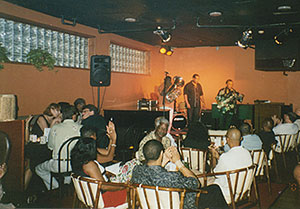
"Slim" suggests the development of a jazz club circuit to include such venues as Cecil’s in West Orange, NJ…
I recently wrote a piece "How Can a Music of the Spirit Die?" [published in The Independent Ear, September ’09] (contact blacktel4justice@gmail.com for a copy), in response to the Wall Street Journal article, written by Terry Teachout, basically promoting the view that "jazz is dead and/or dying." Upon further reflection, I’d like to admit that the attack by Teachout on the music is more dangerous and insidious than I first realized. How naive of me! Though certainly not a "consipracy" buff I’d advise all the jazz lovers and artists to wake up to what amounts to a stepped up attempt by very powerful forces to not necessarily kill jazz, but to further "gentrify" it. The bulb in my head went off when I received an email from trombonist Steve Turre, thanking me for the article and reminding me that the WSJ was owned by Rubert Murdoch. Rupert Murdoch, the big time right wing owner of much of the world’s media and creator of right wing public opinion… one of the real vampires of the world! How could I have missed that?

Critic Terry Teachout
I also received an email from Willard Jenkins, who so graciously reprinted my article on [The Independent Ear]. Willard advised me that Teachout was not some WSJ "go for coffee" intern whom they made do an article on the death of jazz. In my article I had implied that Teachout was a "gofer", not knowing anything of Teachout’s history. Upon further investigation I discovered that Teachout has a long, sordid history as a drama critic and political contributor to many right wing publications. He is part of a well-known right wing intelligentsia for hire. Check it out: Rupert Murdoch’s WSJ hired Terry Teachout to do an article proclaiming the illness and death of jazz? You don’t have to be a weatherman to know which way the wind is blowing. The attack on "the music" is coming from the highest right wing levels of power.
Let’s look back in order to look forward. According to the 2009 Forbes 400, Murdoch is the 132nd richest person in the world, with a net worth of $4 billion. The Australian born media mogul built his base in Australia but soon moved to Britain. Acquiring "The Sun" in 1969, Murdoch acquired the "Times" in 1981. HIs right wing influence and thinking allowed him to become a friend and supporter of the British Prime Minister, Margaret Thatcher. Imperialist media mogul that he is, he also made moves on the U.S. market. In 1973 he bought the "San Antonio Express News", founded the supermarket tabliod "Star", and in 1976 he bought the New York Post.
Many of us are familiar with the right wing politics and "sensationalism" of the infamous "Post". Its all around attack on the people’s struggles, support for police brutality and other notorious right wing causes, caused many in the Black, Latino, and progressive communities to call for annual boycotts of the newsrag. in 1996 Murdoch created the "Fox News Channel," the most influential promulgator of right wing politics on the landscape, with the express purpose of competing against Ted Turner’s CNN. In August, 2007 Murdoch officially acquired Dow Jones, owner of the Wall Street Journal. What’s crucial to understand is that Murdoch has a reputation for being a "hands on" owner. He is notorious for meddling in the affairs of his newspapers, making sure that they reflect his right wing politics, and firing employees who do not tow the line. The "music" has a formidable enemy. For example:
In a statement, Ben Jealous of the NAACP said:
"The New York Post and Fox News have a history of racially insensitive reporting. With the support of the editor-in-chief, the cartoonist Sean Delonas has published numerous vile cartoons tinged with racism. Fox News was widely criticized during the elections for calling Michelle Obama ‘Obama’s baby mama" and terming the affectionate and common fist bump between then-candidate Obama and his wife, ‘a terrorist fist jab’ at a time when death threats against the candidate were at an all-time high for any presidential candidate. The New York Post stands alone from most daily newspapers in refusing to report its diversity numbers to the American Society of Newspaper Editors. One has to wonder how many Hispanic or African American reporters and editors are working at the New York Post? Clearly, with more diversity in its newsrooms, it’s likely the paper would have been able to understand the deeply offensive nature of the cartoon. Our guess is that the numbers are abysmally low for a newspaper serving a city with a population as diverse as New York."
So the WSJ hires Terry Teachout to do its "jazz is dead" article, accompanied by one of the most infamous (racist) cartoons in the history of journalism: a "black" musician being rolled out to pasture in a wheelbarrow. Teachout is an established cultural and drama critic, in addition to being an accomplished commentator from the right. A former jazz bassist [editor’s note: do we have here yet another example of the ‘failed jazz musician’ syndrome where a flop musician takes up the critic’s pen?], he has written a book on Louis Armstrong and contributed to the Oxford Companion to Jazz. In 2004 he was appointed by President Bush to the National Council on the Arts. More importantly he has been a house writer for the right wing publications National Review and Commentary. Supported by the reactionary Cato Institute, Heritage Foundation, and the American Enterprise Institute, the Review is part of the "commanding heights" of the right wing superstructure in the U.S.
I also noticed that Teachout has done liner notes for jazz musicians Karrin Allyson, Gene Bertoncini, Ruby Braff, Ellis Larkin, Julia Dollison, Jim Ferguson, Roger Kellaway, Diana Krall, Joe Mooney, Marian McPartland, Mike Metheny, Maria Schneider, Kendra Shank, and Luciana Souza. I only cIte this list because there are a not a lot of "Black" musicians on it!
The WSJ, Rupert Murdoch, and Terry Teachout ganging up on jazz… What’s up with this? You don’t have to be a weatherman to know which way the wind is blowing! Are they floating a trial balloon or are they like Martin Luther, proclaiming a new reformation. Jazz, "the Music of the Spirit," like all cultural forms is closely connected to and created by the struggles, dreams, fears, hopes and aspirations of the Afro-American people. Enslaved by white supremacist capitalism, and later monopoly capitalism, the Afro-American people have always been a source of cheap labor for capitalism and monopoly capitalism, a source of super profits for the voracious capitalist machine. In order to carry out the most monstrous crimes against the Afro-American people it was necessary to denigrate not only the people themselves, but also their cultural expressions. This allowed the enemies of the Afro-American people to build an edifice of white supremacist myths and an "American" philosophical, cultural, and political superstructure that prevented black workers from uniting with their class allies, white workers. Hence the struggle for equality, self-determination, and respect for the Afro-American people has been one that has manifested itself in every sphere of social, political and cultural life.
It’s no accident that in a country where jazz has been declared a "national treasure," it gets more respect in Europe than it does in the country of its origin. The reasons are not debatable… the continuing struggle against white supremacist logic to define and control the music, purging it of its Afro-American influence. At its lowest level the music during the "swing era" faced a period that effaced the great black musicians from the scene, redefined it as the music of Benny Goodman. Black musicians only re-established some creative control with the bebop era.
Jazz has always faced this dilemma. The people were never able to control their labor power, the music was never under the control of the producers of the product. The musical expressions of black people in America have always been under attack: they separate the music from its creators, re-package the music (purge it of its blackness), and then re-sell the music to a popular audience, often without the creators of the music getting a "dime" for their creative efforts. The problem is that the musical expressions of the Afro-American people, who are a distinct oppressed nationality, with a common psychological and cultural make-up — while being American at the same time — reflects this duality in the music. Hence this particular historical development of the U.S. has given rise to a situation in which the only original musical art forms are heavily informed by the Afro-American people on the one hand and savagely attacked for being such, on the other hand.
We are living in a time in which jazz is between two worlds. On the one hand it has finally achieved a certain bourgeois and academic respectability and acceptance due only to the victories of the black freedom struggle. I submit again, the respectability that jazz has achieved has not come from the good graces of the enemies of the black freedom struggle, nor even its friends. The new found respectability is the result of the great and glorious struggle of the Afro-American people against all forms of discrimination and in all spheres of social activity.
Numerous university and college [music] progams now have jazz departments and offer degrees in such, and are hiring jazz musicians to head the programs or teach in them. We have Jazz at Lincoln Center located in the NYC citadel of bourgeois culture and art. International and domestic jazz festivals are proliferating, while many institutions are partnering up with high school departments to advance the subject matter. At the same time, the situation is not too bright for many of the younger black and struggling artists. Many of the major jazz clubs only hire the black "jazz masters," while many of the baddest cats on the block don’t get any play. Of course this is not to hate on the black masters that paid their dues and created the music, but to point out the rigid "hierarchy" on display in the "major" jazz venues, in effect producing a situation in which the black jazz masters are subsidizing new, younger white musicians, while again, some of the baddest cats don’t get gigs.
What is the socially conscious jazz artist to do in this "two world" situation? Of course I don’t have all the answers, but just a few suggestions that I think may help to push the struggle forward.
As a full-time labor activist, I’d advise that jazz musicians are no different than the rest of us. YOU [jazz artists] first and foremost must overcome your selfish individualism and get organized. Jazz musicians are always talking about searching for the "spirit" in the music. What about finding the "spirit" to unite with your fellow artist comrades? You are no different than telephone workers, steel workers, teachers, etc. No matter where we are, we cannot fight the powers that be in an un-organized status. There needs to be the creation of an organization for musicians dedicated to taking control of all aspects of the music at a maximum and at a minimum to putting yourselves in a better bargaining position versus the club and record owners. Whether this means joining an already existing organization (Jazz Artists for Justice?) or creating a new one is obviously your decision. No jazz artist should be without an organization, just as no one in the black community should not be in some organization.
Black musicians should build and participate in the broadest organization possible, but at the same time reserving their right to organize in formations that are necessary for their survival. For example, as black telephone workers, we belong to a broader organization that is composed of all telephone workers, our union, the IBEW. On the other hand we have our own thing, the "Black Telephone Workers for Justice," because there are some tasks that we have to carry out in our communities and issues that we have to directly take up. This is not a contradiction, but a social reality that should be part of the principles of unity of any broad artists’ organization: the rights of minorities to their own caucuses or other formations.
The organizations and clubs in the "community" that are struggling to "keep jazz alive," need more support from the musicians "that have made it." Whatever happened to the Cosby/Denzel principle? That is, making your money where you must so that you are in a position to do things independently for yourself and your constituency. Denzel makes big bucks from the powers that be so that he can make a "Great Debaters" movie that reflects his sensibility. Cosby, a well known philanthropist, performed a number of gigs for free for Cecil’s jazz club [West Orange, NJ; operated by jazz drummer-producer Cecil Brooks lll]. Herbie Hancock will hang out at Cecil’s for a moment, "sign the piano," but not play there! What’s up with that?
There are many great musicians that live in the Oranges in close proximity to Cecil’s and other clubs, but never get off the horse and smell the flowers. Whle on the other hand great artistic neighbors like Dave Stryker and Bob Devos play at Cecil’s all the time. This is of course not to single out Cecil’s, but to use the club as an example. This applies to all the local clubs in the area trying to keep the music alive. We know the musicians are tired of always being asked to "play for free," or cut-rates, but we are at war to save the music, and now is the time to lend more support. Don’t the musicians know how much influence they have or can have? When they play at the local venues they add buzz, word of mouth, and create interest in the neighborhood that "jazz is alive and well and must be supported." This is what counteracts the treachery of the WSJ and the Murdochs of the world [who say] that no one is listening to jazz. This ain’t abstract, this is concrete.
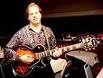
"Slim" Washington wants to know why if musicians like guitarists Dave Stryker (above) and Bob DeVos (below) can actively support a grassroots, musician-operated jazz club like Cecil’s…
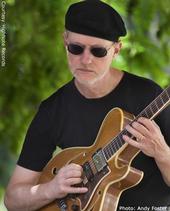

…why can’t a Master like Herbie Hancock?
Jacc activists, promoters, club owners and artists must build a modern day "jazz circuit." While not turning down a gig at the Blue Note, we cannot wait on their recognition. We must build our own thing. Somehow we must string together the various local venues from NY to California to produce great jazz programs in our communities. For example, because of the Black Telephone Workers unique relationship with Sista’s Place [Brooklyn], the Black Workers Pub series at Cecil’s would string together at least two hits for the artists… Thursday night at Cecil’s and Saturday night at Sista’s Place.

Eventually we brought Creole’s in Harlem into the mix. This of course allows the musicians a "tour" and could be cost effective for all. At a minimum, the jazz clubs in NYC, NJ, Philly, DC, and Baltimore [editor’s note: such a "circuit" could include BMore Jazz in Baltimore, and the Bohemian Caverns in DC] could put together some consortium that would allow for such to take place. This could amount to a modern "Motown Review," with a jazz focus. How else are some of the young cats going to get work?
Jazz artists that have taken over or been given the reigns of some of the university and college [jazz] programs should reach back and use their positions to hire their peers for their big time college programs and productions. They should be bringing in their peers to speak (get paid!) on all aspects of the music, and follow with live programs. Those whom have already carved themselves an "international" niche need to do more in bringing others into the mix. It’s time to circle up the wagons!
These are just a few suggestions. I’m sure the enlightened artists can come up proposals that reflect their reality. Make no mistake about it, it’s time to wake up! The Murdochs are on the march and they intend to "gentrify" the music. They obviously don’t want to see jazz "die" but to be its "saviors" as they re-package the medium and sell its homogenized version back to the masses, as music created by "others." This ain’t the first time that this has happened. As Malcolm said, now that we are more politically mature, we can do something about it. Let history be our guide. The struggle is on!
You can reach Ron "Slim" Washington at blacktel4justice@gmail.com…