The Independent Ear

Finding a line between Maryland’s Eastern Shore and the Pacific

The Monty Alexander Jazz Festival
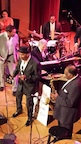
Monty Alexander JF '15
Monty with his Jilly’s crew: vocalists Clint Holmes, Allan Harris and Caterina Zapponi (in background), w/Obed Calvaire on drums, Houston Person on tenor

Visiting the annual Monty Alexander Jazz Festival on Labor Day weekend threatens to become a tradition. Last year was our first and this year’s return was a no-brainer. Held in one of those classic old downtown movie houses, the Avalon Theatre in very agreeable Easton, MD (several nice restaurants – including the BBQ Joint; don’t sleep that one! – and the nearby Chesapeake shoreline beckon). The centerpiece of the festival is Monty Alexander’s Saturday night concert, however this year two of the satellite concerts out-shone the namesake. On Friday evening Rene Marie proved once again to be among the most engaging and wholly satisfying vocalists on the scene. She sang one half her vivacious Eartha Kitt tribute (cannily preceded by a pre-concert screening of some Eartha footage), delivering a sumptuous “C’es Si Bon” and kittenish “My Heart Belongs To Daddy”, which though the height of 21st century political incorrectness, was a blast nonetheless. After intermission it was all about Marie’s original songs from her forthcoming album. These included a deeply touching piece on homelessness, prefaced by her personal story of learning her brother had been homeless for a time unbeknownst to the family, and his subsequently conveying that touching experience, which his sister has now conveyed very touchingly in song.

The Saturday matinee brought to the stage one of the biggest, most mellifluous sounds in tenor saxdom – Eric Alexander and his longtime crew of the vastly underrated Harold Mabern on piano, Joe Farnsworth on drums, and John Webber on bass. Alexander traveled to the heart of soul and swing, his huge sound engulfing the old theater, very much in the spirit of his mentor George Coleman, but at this point purely Eric Alexander.

Saturday evening’s centerpiece was largely a reprise of the chief’s Monty Alexander & Friends program, with yet another gorgeous tenor sound courtesy of Houston Person, the adroit young guitarist Graham Decter, and the engaging vocalists Allan Harris and Clint Holmes. The first set concentrated on Nat Cole, with Harris representing the “King” and Decter on hand to bring the authenticity of the original drummer-less Cole Trio. Harris, who has a lot of experience with the Cole oeuvre was a wise choice. The second half represented Monty’s Sinatra program, with Holmes in the Chairman’s seat, including a lovely essay of “Angel Eyes” replete with Person’s buttery obligatos. “Where or When” elicited a smooth essay by Holmes, and we were transported to the legendary Jilly’s, where a young Monty Alexander got his start as house pianist at Sinatra’s favorite watering hole. But therein lies the rub – with the exception of Holmes and the guitarist, this was nearly a tone-for-tone reprise of Monty’s 2014 Festival performance – the Jilly’s stories and schtick in place, even reprising some of the same jokes and asides as last year, and including another interlude from Alexander’s vocalist-wife Caterina Zapponi. Hopefully namesake will refresh for the 2016 edition.

…………………………………………………………………………………………………………………………………………………………………………………………..

Finding a Line

Skateboarding
Discovering common ground between a skate board park magically morphing onto the front plaza of the Kennedy Center, to Maryland’s lovely Eastern Shore country and the majestic Pacific Ocean’s mid-California coastline might seem like quite the stretch, but let’s give it a shot. Last spring at the Kennedy Center’s annual press event to announce its forthcoming season, one event particularly piqued the curiosity. Though something similar had been presented at SF Jazz as part of a Jason Moran residency, it remained a bit difficult at that point to wrap one’s arms around the Kennedy Center actually staging a collaboration between Moran’s musicians and skateboarders. Let’s start with the most obvious question: where on earth in the Kennedy Center might that happen? Surely not in one of those pristine concert halls; nor could the jazz program-inspired KC Jazz Club (a legacy of Billy Taylor’s tenure) or the Crossroads Club (product of Moran’s tenure) conceivably accommodate such an undertaking.

As the skateboard cum jazz performance weekend of September 11-12 approached, coincidentally I had a DC Jazz Festival meeting at the KC (stay tuned for that collaboration). Arriving via the KC’s convenient shuttle from the nearest Metro station, the bus maneuvered around a rapidly developing wooden structure abutting the entry plaza, construction workers busily going about their charge. Hmm, might this be the venue for the collaboration the KC dubbed Finding A Line (I suppose as in finding a line between skateboarding and improvised music, or is that a skateboarding term that somehow eluded my boomer mentality)? Part of that line and the seed of inspiration stemmed from Moran’s vivid memories of skateboarding as a kid growing up in Houston, an obsession that included watching skateboard videos. Seems some of that video footage was accompanied by jazz music, including Video Days, which chronicled skateboard champion Mark Gonzales skating to John Coltrane! Who knew?

Arriving at the September 11 premier we grabbed spots in the bleachers as close to the top as we could, the better to scope out the skaters from an elevated viewpoint as our ticket taker cannily suggested. Gazing to our left we could see assorted skaters warming up on a nearby track just beyond the standees area. The bleachers quickly filled up and as expected – and clearly this was central to Jason bringing this idea to the KC – this was decidedly not the usual jazz audience. There were parents with kids, plenty of millennials, and more than a few of the curious… like us.

As Moran and his Bandwagon – bassist Taurus Mateen and drummer Jamire Williams commenced improvising, the skaters ramped it up, including various local crews (such as The DC Wheels, and Dads Skateboards!) as well as a crew from Cuba Skate, a non-profit DC-based initiative developed to support and grow the burgeoning Cuban skateboarding community – ambassadors of the boards as it were.

…………………………………………………………………………………………………………………………………………………………………………………………..

58th annual Monterey Jazz Festival
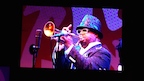
Nicholas Payton @ MJF
Nicholas Payton blown’ strong on the Jimmy Lyons Stage

This one is an annual Cali pilgrimage, its no longer even necessary to check the lineup in advance; such is the nature of Tim Jackson’s superb artistic direction of this world’s longest continuously running jazz festival. The big stage highlight was opening night’s Erroll Garner Project: Concert By the Sea. This year marked the 50th anniversary of Garner’s Concert By The Sea, captured for posterity by Columbia Records on September 19, 1955 in nearby Carmel, CA. In conjunction Columbia has reissued the famed recording of the same name in complete form, with eleven additional tracks from the concert restored in a 3-disc package that also includes a remastered version of the original recording. Growing up Concert By the Sea was a record found in every discerning home in the black community, including that of Mount V. Allen Jr., Geri Allen‘s dad, who was on hand for this tribute. One could not help but wonder what this might mean for a 2015 concert reprise. However this was decidedly no reprise of the original Garner trio classic. Instead MJF recruited Geri Allen as music director. Three pianos were arrayed across the expansive Jimmy Lyons Stage (MJF founder Lyons had produced the original Concert By The Sea), Allen at the helm joined by Jason Moran and young Christian Sands. They were supported beautifully throughout the night in solo, duo and piano trio expositions by bassist Darek Oles and drummer Victor Lewis. The Chick Corea Trio followed the Garner program with more piano majesty, with the peerless rhythm section of Christian McBride and Brian Blade.

Saturday evening, after the kinetic Trombone Shorty had incinerated the Lyons Stage and energized the throng to close the Saturday matinee, trumpeter Ambrose Akinmusire‘s quartet was followed by this year’s Monterey Jazz Festival on Tour unit. Its core was essentially the Gerald Clayton Trio – with Joe Sanders on bass and the ferocious Justin Brown on drums, which certainly makes sense as far as assembling a requisite all-star ensemble for touring – along with the horns of Ravi Coltrane and Nicholas Payton, who unburdened by band leading responsibilities was in particularly fine form, blowing some mighty trumpet. The MJF on Tour unit was preceded by the Caribbean funk & folkloric enterprise of trumpeter Etienne Charles & Creole Soul, appropriately on the Garden Stage whose more open spaced environment is the best place on the grounds to get your dance on, and the trumpeter’s island grooves proved irresistible to more than a few. Doing the familiar Monterey fairgrounds stroll mid-MJF on Tour enabled some time with a very potent band led by guitarist David Gilmore at the Night Club. Gilmore had Marcus Strickland on saxophones, Luis Perdomo on piano, Ben Williams on bass and the ubiquitous in-demand drummer Rudy Royston on hand for a distinguished set of his originals. Once Gilmore had concluded it was out the door and across the lawn to Dizzy’s Den for Bay Area hand drumming ace John Santos, who showcased a veteran Cuban sonero for a sublime set of boleros mid-program. Justin Brown was one of the busiest players all weekend, his incendiary drums proving a fine foil for trumpeter Ambrose Akinmusire‘s fat toned trumpet closing the Night Club with his second set. Such is the nature of MJF that certain artists play multiple venues during the weekend.

This year’s residency at the Coffee House Gallery featured a reunion of one of Monty Alexander‘s most successful trios, with bassist John Clayton and drummer Jeff Hamilton for six sets throughout the weekend, highlighting yet another strong MJF curatorial touch.

Sunday evening was a veritable potpourri of easing from venue to venue to catch healthy portions of sets, including two parts of this year’s Jazz at Lincoln Center Orchestra residency (which included a full orchestra performance on the Arena stage), starting with saxophonist Walter Blanding‘s Sextet and concluding the evening with the JALCO jam session, both at Dizzy’s. Caught a taste of Dianne Reeves‘ customary majesty on the Jimmy Lyons/Arena stage, and more of Monty’s elegant swing personified trio at the Coffee House. Alas the day was a bit truncated personally by a thoroughly freakish accident, though all’s well at this point; the day just further pointing out that missing the Monterey Jazz Festival is simply not an option!

Shorty's peeps
Trombone Shorty’s peeps shakin’ a tail feather at the Arena
Posted in General Discussion | Leave a comment

Crate Digging with DJ Soul Sister

CRATE DIGGING with DJ Soul Sister
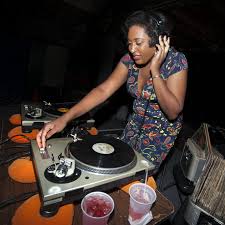
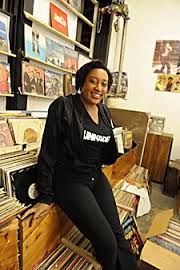
One of the absolute hippest DJs I know is New Orleans’ DJ Soul Sister. When not spinning at joints around the Crescent City, you’re liable to find her spinning records at diverse outposts around the globe. But you needn’t venture further than your computer to get a nice taste of this sister’s broad range of music interests. Known in her civilian life as Melissa Weber, DJ Soul Sister can be easily accessed every Saturday evening 8:00-10:00pm on New Orleans legendary Jazz & Heritage station WWOZ, which is one of the world’s most actively streamed radio stations at www.wwoz.org.

On a lovely Saturday evening when New Orleans was as always buzzing with one social event or another at seemingly every corner, I was down there doing a site visit for the NEA Jazz Masters program and visited the Contemporary Arts Center. They’d received a grant to support a project involving native son and NEA Jazz Master Ellis Marsalis and on that particular evening the festivities were in high gear at the CAC. The Center was celebrating an anniversary and Ellis played a set on one floor while on another DJ Soul Sister was ruling the dance floor. After Ellis’ set I eased as close as I could to her DJ set-up to spy what vinyl goodies she had in store for the high-spirited crowd on hand. I was truly impressed at the range of vinyl she had on hand and coupled with my admiration for her Saturday evening radio shows, I was determined to pin her down for one of our occasional Crate Digging dialogues.
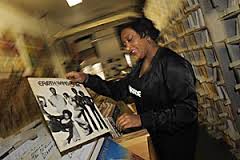
DJ Soul Sister
Back in the mid-1980s when CDs began their market domination, some hasty music lovers liquidated their vinyl collections. I’m sure you know such misguided individuals. Considering that you may have been a happy beneficiary of such haste – likely through some local old-vinyl purveyor or other – was that folly or prescient move?

For me, it’s about the music more than the format. I’ve been DJing for 20 years, and that includes my radio work on WWOZ and my performances as a live DJ artist on tons of stages, playing only the music I love. For both of those, I use 100% vinyl (actually 99% vinyl on my radio show, because I always play my theme song off a CD). But I’m not a vinyl purist at all. I happen to love vinyl, and that’s my thing. If someone else wants their music on a CD or a computer, as long as the music is good to them, that’s all that’s important. With that said, I love to take vinyl off of folks’ hands. When I was a senior in high school, I actually passed out a flyer to all of my classmates, asking them to give them to their parents. The flyer said that I’d pay “$$$$$$s” for their old albums. I wonder what $$$$$s I was talking about or where it would have come from! Some of the parents must have took pity on me cause they wound up giving me lots of nice LPs for free.

When you search for vinyl recordings, what have been some of your most useful outlets (used record stores, flea markets, yard sales, private sales, etc.)? Are there any particular genres f music you find yourself search for more readily?

When I was younger, I was all about the danger hunt – climbing in weird attics and entering dark garages – just for the adventure of finding something rare and amazing. Today, I’m really happy just going to used record stores as much as I can. My favorite local stores in New Orleans, listed in no particular order, are Louisiana Music Factory, Domino Sound Record Shack, Euclid Records, Peaches Records, and Disko Obscura. I’ll also give a special shout to Jim Russell Rare Records though, lately, every time I pass there, it seems to be closed. My favorite record store outside of NOLA is A-1 Records in the Lower East Side of New York City. Here in New Orleans post-Katrina, there aren’t nearly as many yard sales as there used to be. But yard sales are what I lived by back in the day. As for genres, I’m always looking for soulful music: soul, disco, funk, jazz, Latin, Brazilian, true school hip hop, DC go-go, gospel, post-punk, electro, you name it.

What is it about vinyl recordings that continue to hold such fascination for you?

I like to be able to pick up this massive piece of wax and hold the grooves in my hand, and look at them on the turntable. Like many others, I’m also into album artwork and liner notes. And, as we know, the sound is much better in analog format. People ask all the time why I don’t just switch to digital and CDs when I’m performing. I’ve always called myself a crate digger first before calling myself a DJ (or “dj artist,” as I prefer). I’m into the hunt for those records, and have been since I was very young. It’s just a personal thing with me, and I don’t look down on others if they don’t feel the same way. But I have to have that vinyl.

DJ Soul Sister 1f

Now that MP3 is dominant – not to mention whatever formats the technocrats may cook up in the future – has vinyl receded even further in the rearview mirror, ala the 78 RPM format?

According to the studies, people are buying more and more vinyl. I hope it’s because they realize it’s better, but I’m scared it may be because there’s a sort of “hipness” associated with it now. Trust me, I don’t use vinyl because it’s hip. It takes real devotion and dedication to choose to haul crates or flight cases of LPs wherever you go. I lift weights just so I can do it right. Nothing hip about that. It might break your hip. LOL.

As you go about merrily crate diving for old vinyl recordings, what kinds of things attract your attention?

The same things that attract other people: interesting record covers, musician lineup, producer, liner notes, things I’ve read about, things I’ve never heard of before, etc.

Bluebook and other ratings systems in terms of the “book” value of supposed rarities aside, what in your gaze truly constitutes a “rare” vinyl record find from your collector’s perspective?

A rare album is something that people really want and something that’s hard to find. I would like to add, however, that just because a record is rare does not necessarily make it great or even good to listen to. I only collect and play albums that I love. If it’s rare, but does nothing for me personally, it’s staying in the store or with the seller. It’s got to move me in some way, make me smile or wanna dance or something. I could care less how rare it is. On the other hand, if it does move me and it’s rare – watch out. I’m scared to admit how much I’ve paid for some of these records that have both qualities for me. Crate digger illness.

Besides the rare items, when you hit the stacks do you generally have a “wish list” in mind or are you so intrepid that you simply delight in the process purely in hopes of uncovering some useful nugget or another?
DJ Soul Sister 2
I never go crate digging with a wish list. I just like to discover. That’s what makes it fun.

Talk about some of your recent vinyl “finds” and what it is about that/those record(s) that attracted your interest sufficiently enough to cop a purchase?

I can’t remember specifically what I bought, but I recently went shopping at A-1 Records during a trip to NYC. When I go there, I plan to stay all day, like, 4-5 hours. I go through everything and I pull stuff that looks interesting on 12” and LP. (45s are very popular with collectors lately, but I’m more of a 12”/LP collector.) Then I’ll listen to everything and buy what I like. The end. No science about it. Just fun and discovery, and staying true to what I like instead of what someone else thinks I should like.

What would you recommend to those with an interest in seeking out rare vinyl recordings?

I’d say, “Don’t look for records just cause they’re rare. Look for stuff you like. With that said, don’t look for records just cause you’ve already heard of ‘em before. Take a chance and try something new to enjoy. That’s what music is all about.

Posted in General Discussion | Leave a comment

Crate Digging with Reuben Jackson

CRATE DIGGING with Reuben Jackson
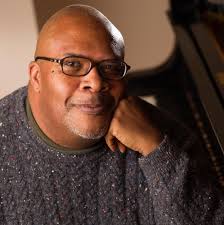
Reuben Jackson

Reuben Jackson is a music scholar, poet, broadcaster, journalist and an all-around very thoughtful man. Long a resident of DC currently residing in the lush greenery of the Burlington, Vermont area, Reuben spent over 20 years as curator of the massive Duke Ellington collection at the Smithsonian Institution’s American History Museum. His patient assistance proved invaluable to this writer on numerous occasion when a writing or other assignment demanded extensive research, whether through the Ellington collection or other of the Smithsonian Archives Center’s incredible holdings, including the collection of the family that owned and operated the Apollo Theatre during the height of its legendary existence. It was through Reuben that I spent many hours marveling at Frank Schiffman’s meticulous boxes of index cards, where he hand wrote his nightly impressions of various Apollo performers, including how they did at the box office, how they performed, their onstage and backstage demeanor, and whether it would be a good idea to book them again.

Reuben has contributed music reportage and criticism to the Washington Post, Washington City Paper, All About Jazz, Jazziz, and NPR’s All Things Considered. Since relocating to Vermont he has been host of Vermont Public Radio’s “Friday Night Jazz” show. Throughout all of this experience Reuben has maintained his great curiosity for recordings of great variety, making him an ideal contributor to our occasional series on Crate Digging – the intrepid hunt for desired vinyl recordings that still befalls many of us, this writer included.

Back in the mid-1980s when CDs began their market domination, some hasty music lovers liquidated their vinyl collections. I’m sure you know such misguided individuals. Considering that you may have been a happy beneficiary of such haste – likely through some local old-vinyl purveyor or other – was that folly or prescient move?

I’ve always been a bit suspicious where record companies are concerned. Maybe that is a result of being such a jazz lover. What I mean is that I’ve never assumed that a particular beloved recording or recordings would be reissued in the format of the moment-especially if it wasn’t exactly a zillion seller . Of course there are classics which people get rid of for many reasons. I feel for them, but I’ve been more than thrilled to give them a happy home. You know, mine…

What is it about vinyl recordings that continue to hold such fascination for you?

What do I love about vinyl? First an AARP answer: I am middle aged, and farsighted. It’s easier to read the liner notes! Surely there is a nostalgic element to this as well. I learned so much about music in my parents’ basement. We had 45s, but mostly vinyl. Finally, I still feel that more than a few vinyl incarnations of –well, fill in the blank, sound better. Simple as that.

Now that MP3 is a reality – not to mention whatever formats the technocrats may cook up in the future – has vinyl receded even further in the rearview mirror, ala the 78 RPM format?

Reuben Jackson 2
Has the Mp3 been relegated to the cheap seats? I don’t think so .. If you live long enough, you see the carousel come around again. A lot of my younger music-loving friends crave vinyl. It’s –well, cool.
Like Cuban cigars. It seems to have become radical-ancient to the future. I walked into a bookstore the other day, and saw a few racks of Vinyl. I felt both young and old.

As you go about merrily crate diving for old vinyl recordings, what kinds of things attract your attention?

Truth be told, I sometimes buy albums I have no interest in-musically speaking. I love kitschy, sometimes politically incorrect covers. Shots of, say, 1940’s New York, stuff like that. I have more than a few of these in my music room. Then, of course, there is the endless search for titles I keep in my internal bucket list. I don’t usually find them, but I love the hunt. Oh,the hunt.

Bluebook and other ratings systems in terms of the “book” value of supposed rarities aside, what in your gaze truly constitutes a “rare” vinyl record find from your collector’s perspective?

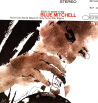
For me, the value is generally always musical/historic. There is nothing like finally getting hold of some gorgeous Blue Mitchell recording, say-
after years of searching and pining…
Blue Mitchell

Besides the rare items, when you hit the stacks do you generally have a “wish list” in mind or are you so intrepid that you simply delight in the process purely in hopes of uncovering some useful nugget or another?

I tend to be a dive in the water and swim kind of collector. I do have stuff I’d love to find in mind when attending vinyl conventions, but I never let that drive me to the point of anxiety or despair. (If you don’t find whatever it is …) To quote Tom Waits- “the pursuit and never the arrest.”

What have been some of your recent vinyl “finds” and what it is about that/those record(s) that attracted your interest sufficiently enough to cop a purchase?

The last thing I found wasn’t (or isn’t) especially rare, but it is a collection I’ve wanted for my show. Cannonball Adderley’s “Lovers.” It wasn’t finished by Cannon. He had a stroke and died before the sessions were completed. But I love the music . The stuff on which he is featured, and –well, the whole collection.

What have been your favorite sources or retail outlets for vinyl record crate diving – whether that be store(s), private collection(s), garage sale(s), record convention(s), or some other source?

I really love record conventions, but I’ve also found a great deal of joy combing through yard sales here in Vermont and across the lake in New York State. That’s really about it for me. I remain an ardent collector, but not the rabid young collector I once was.

What would you recommend to those with an interest in seeking out rare vinyl recordings?

Seek help immediately! Just kidding. I’d say cultivate a network of fellow travelers- even if it’s just one. I find it’s more fun when you can share the hunt/capture with a bud. Most importantly, have fun… Music is a damn wonderful thing. I think of collecting the way I think of walking through a dark, foliage-laden forest: a truly wonderful thing. An aural smile. This was fun….

Posted in General Discussion | Leave a comment

Playboy & the Music

Playboy Swings

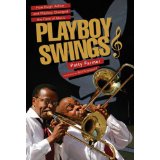
There is no more relaxing activity than laying out under the sun with the inviting surf mere feet away, absolutely chilling with a good book. Just in time for family beach week, arrived an informative, page-turning new read on the legacy of Playboy magazine’s once expansive enterprises and its rich music legacy. Playboy Swings (pub: Beaufort Books), by Patty Farmer with jazz vocal specialist Will Friedwald, is ostensibly about the considerable contributions of Hugh Hefner and his Playboy enterprises to the music scene, with robust coverage of Playboy’s important stake in jazz. Though the book provides many fine details on how Hefner and his cohorts love of specifically jazz morphed into the former Playboy Magazine Jazz Polls (including some resulting “all-star” recording sessions and a less-than-successful record company venture), the now-annual Playboy Jazz Festival, and the once far-flung Playboy Clubs, this is not purely about jazz… or music. Some of this book’s finest revelations and insights are about the vast booking and presenting policy of the Playboy Club chain, not only as it pertains to musicians (with an emphasis on singers), but also numerous insights and revelations about the role and work of comedians and what might best be dubbed variety entertainers on the Playboy Club circuit. Playboy Swings also offers a definitive insider look at the development and execution of Hefner’s two television shows – Playboy’s Penthouse and Playboy After Dark, each of which had a kind of hang-fly, informal quality that was trailblazing in their own right. Not least of Hefner’s efforts was his dismissal of the color barrier that plagued much of 20th century America (still does). He willfully provided platforms for many African American performers of the day, clearly a well-earned arrow in his quiver.

Apropos one of the book’s forwards is contributed by NEA Jazz Master George Wein, the dean of jazz festival presenters. As ongoing producer – via one of his ace right hands Darlene Chan – of the annual Hollywood Bowl weekend known as the Playboy Jazz Festival, the signature such event in Southern California, Wein was right there when Hefner determined to present this keynote event annually. But first came an extravaganza that the late critic Leonard Feather once dubbed the “greatest three days in the history of jazz” – the original Playboy Jazz Festival. Each of these enterprises is balanced by the prevailing social mores of their day, mores which often found certain parts of the country looking askance at Playboy’s unique juggling act balancing its high class skin mag proclivities, including its loosey-goosey promotion of a supposed “playboy lifestyle”, with its promotion and presentation of some of the finest music and comic artists of primarily the 50s, 60s, and 70s.

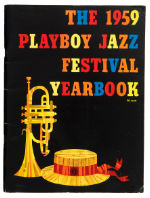
Ms. Farmer paints a fascinatingly detailed portrait of the first-ever Playboy Jazz Festival. Held in the magazine’s original headquarters city of Chicago, Hefner & company’s first festival faced down several obstacles, in addition to the ongoing theme of certain conservative perceptions of the parent magazine. The odyssey of its chosen venue is detailed, ranging from Hef and company’s original intent to present at Soldier Field, which was shot down by the looming specter of the Third Pan-American Games, to be staged later that summer at that very stadium. Eventually the event landed at what was then known as the old Chicago Stadium, the city’s indoor basketball and hockey palace. The event ran the weekend of August 7, 1959 featuring a virtual who’s who of the music: Louis Armstrong, Duke Ellington, Count Basie, Ella Fitzgerald, Dizzy Gillespie, Miles Davis, Dave Brubeck, Oscar Peterson, Coleman Hawkins, Jack Teagarden, Sonny Rollins, Pee Wee Russell and a host of others. One funny anecdote about that festival concerns Frank Sinatra.d
Playboy Jazz Festival 1959

Seems the Chairman was too busy in Hollywood at the time to play the festival, though history has many of the fans believing they’d actually seen Sinatra perform among the incredible array of talent. One thing led to another and a Sinatra impersonator was casually dropped into the middle of the festival, strolled onstage and sang “Come Fly With Me” with the Basie band, to wild response! The emcee for that day was the comic Mort Sahl, who informed the author that “…the crowd went crazy cheering” for what they thought was Sinatra. “They booed me when I took the mic and let them know it wasn’t Sinatra they’d just heard!” Despite Sahl’s disclaimer, many left the stadium that day glowing from what they thought was a Sinatra sighting. This book is loaded with such rich anecdotes and remembrances.

Later in the book, during the extensive and finely detailed chapters on the development of what became a vast network of Playboy Clubs literally across the globe, Farmer details a hilarious scat singing jam between Jon Hendricks and Sammy Davis, Jr., who’d dropped by the London club after finishing his evening performance of Golden Boy. “He challenged me to a scat exchange. And of course, I accepted!,” said Hendricks. “He gave me a trip du challenge!”

Equally fascinating is Farmer’s detailed chronicle of how, ironically given the company’s male-centric composition built on its highly successful magazine platform, one woman who’d been featured in a Playboy pictorial in October 1970, became a key Playboy Club performer and actually took over management of the L.A. Playboy Club at a time when much of the Club enterprise had begun floundering with the changing entertainment mores in America. The story of singer-actress Lainie Kazan‘s Playboy Club trajectory is textbook stuff in a sort of serendipitous marriage of talent and enterprise, much of it larded with good jazz.

Subtitled “How Hugh Hefner and Playboy changed the face of Music” this book certainly has the goods to back up that lofty contention. And through it all Hefner remains a steadfast jazz enthusiast who frequently put his money where his artistic interests lay. On the clubs, development of which are detailed in this book from soup to nuts, this passage is particularly definitive:
The Playboy Clubs were at the center of an iconic period of our cultural history and they helped define it as a carefree, liberated time when boundaries were pushed – and sometimes broken. Over nearly three decades, the impact of the clubs on musical taste and entertainment standards is undeniable. They provided a home, a school, and a livelihood for a multitude of musicians, singers, comics, and restaurant personnel – all the while helping to topple the color barrier in entertainment. You could say that they trained a generation of audiences from around the world to appreciate good music, good food, and good company.”

Posted in General Discussion | 1 Comment

Is improvisation intimidating?

One of the central music tenets that distinguishes jazz music is the art of improvisation – though we must emphasize here that improvisation is not a practice exclusive to jazz music. And make no mistake about it, the ability to create, to “make up” cogent statements and variations on a theme on the spot can indeed be intimidating to some, mysterious to most. What of the student musician, how does he or she gain a comfort level with the art of improvising, of seemingly making coherent statements on the spot. And of course there’s the notion of some who may be new to jazz music, that skilled practitioners somehow manage to “make it up” on the spot, to seemingly seize lines of music out of thin air as they go about their craft. It does take a special mind and years of arduous work before a musician can evolve to being an exceptional improviser; then once that skill has been achieved to varying degrees, the improviser must acquire the confidence to figuratively throw away the preconceived rules and allow improvisation to flow naturally from their chosen instrument. Indeed this can be a source of great frustration, even downright intimidation for some.

Recently, via Jazzcorner.com (the parent or host of this site) we discovered the ongoing efforts of a young musician seeking to bring a new improvisation teaching tool to the music education marketplace. Scott Hughes says he has the Tonic. We recently sought out Mr. Hughes to learn more about he and his motivation to simplify the improviser’s education; clearly a few questions were in order.

Scott Hughes

Give Independent Ear readers some background on Scott Hughes
I’m a musician and entrepreneur based in Philadelphia, originally from Pittsburgh. All my life I’ve been interested in improvisation, but have had trouble finding teachers who could help me.

I started playing piano as soon as I was tall enough to reach the keys, and became obsessed with the blues and jazz from an early age. In college I studied music and while I loved the fact that I was able to spend so much time playing, I felt out of place. Music school was a competitive atmosphere, and while it drove me to work harder at times, it ultimately was an anxiety-inducing experience.

I often felt overwhelmed by the amount of information that I was taking in. Every teacher was talented and well-meaning, but everyone was telling me to practice something different. One might say I should be transcribing Charlie Parker solos, while another would suggest I transpose Real Book tunes into every key. And yet other teachers were trying to expose me to 20th century classical music

Talk your new project Tonic.
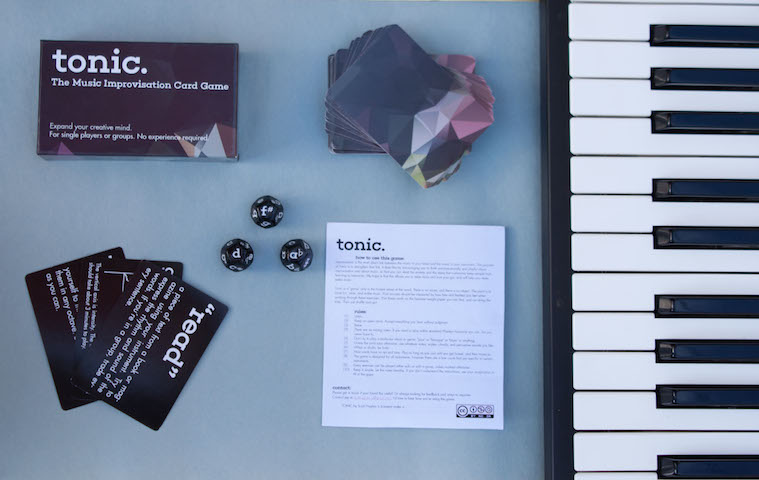
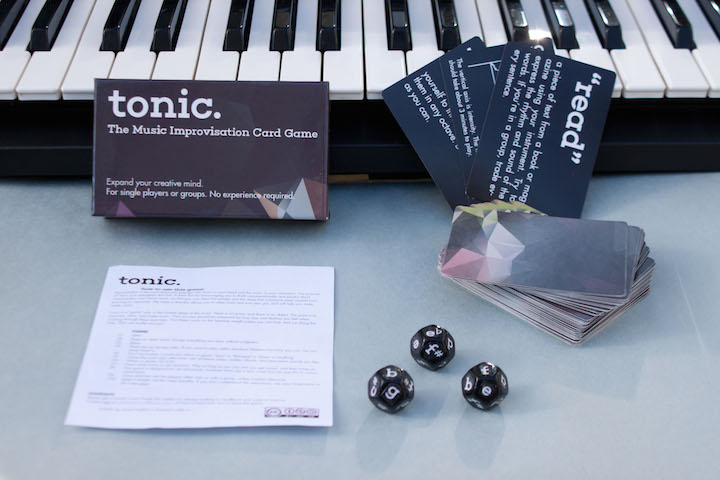
Tonic is a game that helps musicians practice improvisation. Using cards and dice, it’s a stress free way to experiment with improvisation. Each card has a clear but open-ended instruction that asks you to create a short piece of music on the spot.

It’s not a traditional game, since there is no score and the rules are relaxed. But Tonic will challenge you to rethink your approach and gently push you out of your comfort zone, which will help you grow as an artist and musician. The entire game is available for free at tonicgame.com, but I’m also running a Kickstarter campaign to produce a professional version with high-quality cards and dice.

Tonic is based on the idea that improvisation should not be a serious endeavor — that improv should be playful and fun. For many people, myself included, the idea of making up music on the spot is difficult. It can be a source of stress and anxiety: “What do I play? Does it sound good enough?” And so on.

Tonic

But when you look at the most masterful improvisers of all time, you don’t see that. You see easy, unbridled expression and confidence.

My goal is to bridge that gap and bring an element of playfulness to a subject that can be intimidating to beginners and experienced players alike.

What disparities in jazz education, and the way people learn to play jazz, did you detect that inspired your development of Tonic?
When you think about it, all musicians are improvisers. All composed pieces of music in history — every song, symphony, or solo– began as in improvisation. They must have been; because when you’re creating something new, there is nothing written down!

Somewhere along the way, we got lost. We started teaching students that in order to play jazz, you need to learn scales and chords. You need to study the Real Book. You need to listen to Charlie Parker and John Coltrane.

These things are all important, but they are intimidating to the beginner. The learning curve is too steep. A beginning musician needs to focus on simpler ideas: How do I create a piece of music from beginning to end, no matter how simple? How do I express myself? How do I make it fun?

Tonic addresses these questions head-on.

What would you say are the most practical applications of Tonic, and who/what is your target constituency?
Tonic is for any musician who wants to become a more creative and confident player. It’s deliberately designed so that musicians of every background and instrument can play and challenge themselves as artists.

The original version is available now on Kickstarter, and can be downloaded for free as a file which you can print at www.tonicgame.com.

Musicians who are high-school aged or older will get the most out of it, because they have enough experience with music to understand some of the concepts and terminology. But I have made an effort to keep everything accessible to even complete beginners. There are detailed instructions and a glossary included.

Tonic is not intended as a comprehensive solution. If your goal is to learn to improvise at the organ or at a jazz club, you will most certainly need a more structured and detailed approach. But Tonic is something that can be used in conjunction with these methods to encourage a more carefree and unconventional approach that will help them retain the spirit of “play” as they work through a more rigorous training program.

Ultimately what do you envision as the evolution of Tonic?
I envision Tonic developing into a community of individuals and educators who recognize that improvisation is something that all musicians, even if they aren’t doing it in a performance setting. Improvisation cultivates a fearlessness and a boldness that cannot be attained any other way.

The rewards go far beyond the actual practice — even if you’re a classical player and you never once play a note that isn’t written on the page, you will grow as an artist and as a person if you feel comfortable with improvising and expressing yourself through structured improvisation.

The beauty of Kickstarter is that it allows a creator like me to get feedback and test a new idea and see how people in the real world are using it. I have already begun to develop extra add-ons for Tonic, and will continue to refine and develop new ways to help students and educators, in hopes that Tonic will encourage improvisation to play a larger part in music education everywhere.

Tonic 1

Posted in General Discussion | Leave a comment