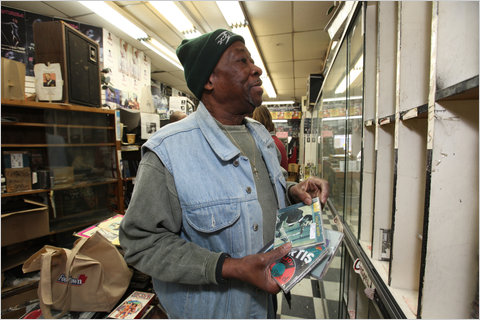
Last spring after reading a New York Times account of the demise of one of the last of a dying breed, the retail record store, I knew the proprietor of this Brooklyn record outlet was someone we should interview as part of a series of oral history interviews for the Weeksville Heritage Center in Brooklyn. So last April my Weeksville colleagues Jennifer Scott, Kaitlyn Greenidge, and I toted our equipment to the modest home of Mr. Joe Long, legendary proprietor of what had been a Bed-Stuy institution – Birdel’s Record Store.
Birdel’s, as you’ll learn from our interview, besides being a listening post, community and budding artist hangout, and site for countless artist record signings, is the place where nascent hip hop artists like the late Biggie Smalls did their initial crate digging and samples mining. Reading the New York Times account of the sad demise of Birdel’s put me in mind of the record stores of my youth, the places I frequented in Cleveland to search for the latest recordings, have a listen to those records I was speculating on, and pore through liner notes and personnel listings to learn more about who was who in the music. The following is part one of our interview with the gregarious Joe Long.
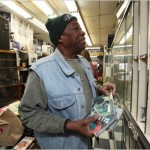
Joe Long plying his trade at the late, lamented Birdel’s
When I read that New York Times piece it reminded me of record stores I used to frequent as a kid, before there was any Tower Records; the kind of record store in the neighborhood where the records would be behind the counter on the walls. Talk about the history of Birdel’s.
Joe Long: I came to New York from North Carolina in 1954. The reason I came to New York was to better myself with a decent job to help my mother prolong the education of my sister that was in North Carolina College in Durham. She had won a 2-year scholarship, she was valedictorian. I came out of high school at the tender age of 16 and I said I would work to help her to get through her junior and senior year of college. That’s what prompted me to leave North Carolina to come to New York.
In 1954 my sister that lived here worked at Rands Dry Cleaners and she had a position for me when I left North Carolina. I came straight to Brooklyn and we lived on Quincy Street in Bedford-Stuyvesant at that time. I worked at Rands on the line sorting clothes and I learned that quickly, and then I did maintenance [work] with them. I was always an enthusiastic person for music, I really loved music. In my sophomore year at home I bought a Victrola called Airline from Montgomery Ward. Remember those big boxes with AM and FM radio, shortwave and everything? Airline was the brand.
I bought that radio so we would have music in the house and in the community. Victrola, they called them at that time, cost me close to $200 and I paid down like $25 then $5 a week until I was able to pay for it; back then they wouldn’t give it to you until you finished paying for it.
Everybody would come to my house and we would party on the weekends because I had the only Victrola in the community. I was working at the 5 & 10 cent store H.H. Kress, and by me working there I had access to the music – it was 78s during those days and I would bring home these 78s and we would have our little thing. My father was a janitor and after his [work] day finished they would always give us the popcorn and we would distribute it in the community… the cookies and things… So we used to have a good time.
When I came to Rand Dry Cleaners, they had 155 stores across the metropolitan area – Brooklyn, Long Island, Queens, and Staten Island. I would always come down to Birdel’s and buy my music. During that time they were located on Fulton and Throop next to the Apollo Theatre; we had an Apollo Theatre here in Brooklyn too that had acts and music and things. During those days I would come in evenings after work and buy music. Birdel’s relocated down on Fulton & Nostrand.
During those days – this was in 1956-57 – the groups were making records and the entertainers that were a part of those groups would come by the store. The bass singer from the Heartbeats, Wally Roker, we became close. Wally used to say to me “Joe you know music, why don’t you ask Birdel for a job.” I would tell him I already have a job, why do I need another job? During those days the record stores were open until midnight. You had the junkies out there and the drugs and all, but it wasn’t like today, you could feel more safe.
We had the Bickfords during those days, something like Chock Full ‘o’ Nuts [coffee shop]… We had a Bickfords two doors down from Birdel’s on Fulton Street and I used to go down there. Wally would say come on down there and we would talk and he would say ‘I’m gonna tell Birdel to hire you and maybe you’ll like it…’ I said ‘well ok, I’ll give it a try.’ So I spoke with Benjamin Steiner, the owner, and his wife was named Birdie Steiner and they had a guy named Lefty and another fella named Shorty that used to work full time. So I would come in the evenings, and I started to work there and I liked it.
So then I went to Rand after two years and I tell them I’m gonna quit. They didn’t want me to quit because I had learned all the locations of the stores throughout Brooklyn, Queens, Long Island and Staten Island, so they really needed someone with the trucks to help get around. So I told them I’ll give you a coupla weeks notice and then I’m going to leave you, and then I told Birdel’s that I would come with him full-time. I really liked the [Birdel’s] job. I worked part-time at Birdel’s in the evening and that gave me an idea of whether I would want to get into the music business. I liked it so much I told him I would work with him and I would give him ten years; I’m a young man, I said I’ll give you ten years.
He was talking about retiring so I said if you don’t want to sell me the store in ten years I’ll go ahead and get my own business. So he says ‘ok, we’ll see.’ I worked with him and I really liked it. He saw the head I had on me… during those days you bought records by numbers. Once I saw a number I was just like a computer, the number would stick. Right now I can call off numbers from 1954-55 on record labels that we ordered by, and he liked that.
So he would say to me ‘you’re gonna get this store, I’m gonna sell you this store…’ In 1963 I told him I was ready [to buy the store]. In ’64 blacks at that time were a little more on the edge of wanting to do things for self; you had the Black Panther party, the radical Brooklyn guys that really would do things to get attention. God rest Sonny Carson’s soul, he was one of the guys that really was out front. So Birdel’s got a little leery during that time and he was saying that he might have to sell before.
So when the time came and Martin Luther King got killed and the riots came, that really was the icing on the cake; he said I’m gonna sell and get out. During those days SBA small business loan was loaning minority people money and it wasn’t that you had to have a good foundation or background or good bankroll… if they saw the potential in you and you were able to take the business they didn’t mind loaning. That was one of the reasons I was able to get a loan for the business. Birdel had quoted me a price and I went to SBA and they offered me the money so quickly that when I went back and told [Birdel] I had the money that’s when he wanted to up the price $10,000.
I told him ‘Ben you promised me the store and you promised me a price. I worked for you over ten years and never stole a penny from you because my mother didn’t raise no thieves in North Carolina, and I’ve been honest. I had a tendency of working with fellas that would always be stealing and I used to tell them ‘man, you don’t steal the man’s money because one day you might need the man for reference, but if he fires you for stealing you won’t get good references.’ So I said I’m gonna tell you to quit stealing and if you don’t stop stealing I’m going to the boss because I don’t want to work around thieves and I don’t want him to think that I’m part of what you’re doing.’
So at that time he says to me ‘ok I’ll talk to my wife and see if we want to stick to the original price.’ The drugs are flourishing in Bedford-Stuyvesant, especially on Fulton Street and there was a guy who had a store on Fulton Street who was dealing drugs and he wanted the location on Nostrand Avenue and he was the one who offered [Steiner] the $10,000 more than I would pay – because I knew what he wanted to do.
I told Ben, you go home and talk to Birdie because I’ve worked with you all these years and I’m not looking to just walk away; I put my blood, sweat and tears here and if you don’t sell me this store I’m gonna burn it down. Its just that simple, I said I’ll burn it down, you won’t have it and I won’t have it, you’ll get the little money from your insurance or whatever, but I will burn it down. He went back and talked to his wife; he knew that I was serious. He knew that I wasn’t playing.
During those days I had two fellas – a guy named Mitch and a guy named Jeff, we had a little social club together. I told them once I buy the store I’ll bring you all in. During those days when black folks were on the other side of Fulton Street you didn’t have the idea of coming across Atlantic Avenue to say that you wanted to be a part of Crown Heights.
After he went back and talked to his wife they finally made the deal to sell me the business. When I took on Mitch I said my whole vision was to have a chain of independent retail [record] stores. One of the reasons I saw that change I knew that during those days music was popular with the blacks and you had good radio stations that played this music and it wasn’t a thing of wherein you were selling tickets for different programs – gospel programs… all these programs were a help to build Birdel’s up. So when I finally bought the store and we closed the deal, Birdel said to me ‘Joe, you’ll make a lot of money here.’ I said to him ‘Ben, I might not make no money because you made the money, I worked for you and I know you made good money and when we as a race of people find out that one of us own it they tend to not purchase and support like they should.’ I told him that but I wasn’t worried about survival out here because I knew what it took to survive.
When I took on Mitch I said ‘Mitch I want to do a chain and we got as far as three stores. The only people that were competitive to independent [record] retail at that time was E.J. Corvettes, Mays Department store, and Sam Goodies; but Goodies was a part of the record clan that could sell records out of town, so they could sell [at] list prices, they didn’t have to give you a discount.
So as I would build up a store I would put my partner Mitch in there and he had a head and wanted to be Mr. Big Stuff and he didn’t want to work and every time he would go out and hang out, I’d put the workers to work and he’s gone. I told him ‘we can’t achieve a good business if you’re not there, because these people we’re putting in here are gonna be stealing.’ I knew they weren’t gonna take it all, but at least give me the majority, don’t take 60/40 – give me 70/30 or 80/20, but they weren’t doing that so I kept him on, I told him I would give him five years to learn the business, but I kept him on another three years and he still didn’t learn the business.
So then I sat down with him and I said ‘look, we’re gonna have to [end] our partnership. He didn’t want to give it up because now he didn’t have nowhere to go. We had three stores so I told him, I’ll keep Birdel’s on Nostrand Avenue, I’ll give you the tape center on Fulton Street, and we had another store on Flatbush and Prospect, and I said we’ll sell that to my brothers, because I had two brothers working here. That way we’ll all have a store, you can do what you want and I’ll do what I want. But if you want to keep the Birdel’s name for the Birdel’s Tape Center you’ll have to pay me because the name was incorporated, and I told my brothers the same.
My brothers didn’t want to give up their jobs; one worked for the transit authority, the other one worked for an insurance company. They didn’t want to quit their jobs and they put their wives in there to run [the store] and I knew it was gonna be a failure. Women have come a long way from those days, but during that time I could see they weren’t the people to have in your business to carry the load – and I’m being honest, this is what I saw. They hung on for about 3 years and I said [to his brothers] ‘if you don’t want to give up your jobs I’m gonna have to take the store back. If you don’t want to give up your jobs I’ll sell it.’ Eventually I took it back.
I was trying to let Mitch know that I carried him for eight years – I promised you five – and now I want out. I’m divorced now, but during that time my wife said to me to get rid of him and pay him, so I paid him. When I finished paying him [his store] lasted about a year then he went out [of business]. We had a rider in the contract that said if he was to go out, he head to come back to me and see if I wanted to buy the business back. He didn’t do that, but it was alright with me.
Right then and there I started building Birdel’s internationally because I knew the Japanese clientele liked vinyl, people from Germany liked vinyl, and all these people were tourists that would be coming into New York. Harlem was a little more well-known than Bedford-Stuyvesant and they would go up to Harlem – they had the Record Shack, Bobby Robinson with Bobby’s Happy House, and then Rainbow; we all worked together, we were like a network. So when they would come up to Harlem they would tell [record tourists] ‘you need to go over to Birdel’s in Brooklyn.’ And all you had to do is get one [tourist] to see what you do and what you had, and it became like wildfire and [tourists] started to come into Brooklyn. And then we became internationally known because the Japanese would come and they would tell somebody, and England would tell somebody… and they’d say ‘go to Birdel’s’, they forgot about Harlem [laughs].
That’s how I became really popular. It took years to do this, it didn’t happen overnight because vinyl took a decline; when I came into the business it was vinyl, then it became mono/stereo with records and stereo was an elevation of the sound that was better, then it was 8-tracks, then cassettes. All of these trends I grew up in with the different modifications in the music business.
All of that modification with vinyl (mono-stereo), the record manufacturers felt as though now there was a decline in the music as vinyl. They would put out a vinyl album and they would tell the public that it was going gold. During that time gold was if you sold 10,000 units; 100,000 units would be platinum. They weren’t really selling that amount because it was all a number game; they would ship the amount to these stores and in essence if they didn’t sell them they would get them back in return.
So we had a cutout house in Philadelphia that I would go to and buy this product on vinyl. I could buy that same album for $1 from the cutout house and I could in turn sell it for $1.98 or $2.98 – most of the time I would put $2.98 on it – and this is how I built it up, because now the record is only 6 months or a year old and people still want it. So that’s how I started building up the vinyl trade, and this is how the word got around to go to Birdel’s, get the music in vinyl because one thing about it was if I didn’t have it, nobody had it because I would order for people all over… You have to build a customer relationship and it wasn’t about the money with me, it was about the commitment that I had to my customers. Our motto would be “if Birdel’s don’t have it, ain’t nobody got it…’ They would depend on me because I was like their bible. But it took a lot of work.
When we would have those big conferences, like Jack The Rapper and the Urban Network, I would go because we got record companies to support us and the independent stores were always the foundation of the record business. If we didn’t build the music during those days – when you had the disc jockeys… before Frankie Crocker you had Eddie O’Jay, you had the Jack Walkers, WLIB, WNJR in Newark, Jocko… These guys were disc jockeys, they made the music… That was before the Frankie Crockers came along and the Gary Byrds… [Deejays] would make the music and we would have them, wherein the big boys wouldn’t carry it because they didn’t know nothin’ about it. They [big chains] would only carry it after we broke the record, so the manufacturers and these companies knew that the independent store was the foundation of the business to build it up, so they had to support us.
We had corporations together; we had Mirror, independent stores coalitions throughout the country and we would meet at these conventions and we would voice our choice. So then they said ‘we gotta do something else now’ and they came up with digital tapes and that was taking away from cassettes, so then they said they had to come up with another configuration, which brought in the CD. They didn’t know that the CD would really be a thorn in their side to the music business. Because what happened was everybody that had a CD could copy it. At these big conferences when the presidents of all these companies would come in they would always call me the troublemaker because I would always be on their ass. You couldn’t butter me up… a lot of these presidents of these coalitions would come in and say I’ll take care of you, but you don’t have to take care of your group. But they couldn’t say that to me, I would say to them ‘you know what, if you all continue to make CDs and worry about bootlegs and get the RIAA and the FBI to work with you to combat this you all will have to quit making the [CD burner] machines. Now if you’re making the machine and these people are buying the machine, what did you expect them to do? This was one of the downfalls – the copying of product.
Then they tried to put labels about $10,000 fines for CD burning… people didn’t pay that no mind and it became widespread. I told them when you come to us about a bootleg we are only the ones who can sell it, you’ve gotta hit the manufacturers where these people are making 100,000 units at a time. So they busted a couple of them – one in Philadelphia, one in Florida and they took 100,000 records, but that didn’t stop it.
One day we were talking at one of those meetings, I said ‘you know what, ya’ll let the horse out of the barn now and you’re trying to get him back in. You have destroyed independent music labels because now everything is geared to the big boys, the artists are going along with them now. You’ve got Burger King, McDonalds and all these companies telling these artists we can give you X amount of dollars and we will book you about ten cities and you’ll be able to make more money, so that cut out the independent.
Then the same thing when the radio stations combined; they got rid of all the little radio stations and they made a big network, and KISS went all over the country and bought up all these stations – forgot about the independent disc jockeys they had, brought in artists that don’t know nothing about the record business and they put them in position that they shouldn’t have been, and the disc jockey that went to school to learn the business was no longer a part of that. Through it all [Birdel’s was] were surviving and they couldn’t understand it. They used to tell me all the time, ‘you know, you don’t ask for nothin’, how you makin’ it’? I said ‘with the master upstairs’, I used to quote scriptures on them in a minute. As long as I’ve got my health, got my strength, I’m gonna make a dollar – and this is what I’d tell them all the time. All of this time that we worked as a coalition to build the [record] manufacturers up, they were always looking to tear us down.
Then they began to like me and they started doing things for me all the time. I was reading an article from 1973 that Nelson George wrote for Billboard; I knew his mother, his mother’s best friend was one of my bookkeepers. I watched Nelson grow up and every time he’d write an article he’d mention Birdel’s.