The Independent Ear

Omar Sosa… sublime!

Omar
There are certain musicians who are a breed apart; such is the case with the Cubano pianist Omar Sosa. Born in Camaguey, Cuba’s largest inland city, Omar Sosa is a true world citizen. When he left Camaguey, he spent significant time in the Esmeraldas region of Ecuador, immersing himself in Afro-Ecuadorian culture, which musically-speaking is in part based on the woody tones of the marimba, an instrument Omar had studied in conservatory in Havana. Later on he spent a rich period living in the San Francisco Bay Area, interacting with such like-minded griots as John Santos and numerous other musicians around the SF/Oakland area. Currently living in Barcelona with his wife and children, Omar continues to record prolifically in a seemingly unlimited stylistic universe. A few days ago Omar’s tireless touring cycle landed at Blues Alley in DC to further explore one of his more recent recorded collaborations, with Italian trumpet-flugelhorn man Paolo Fresu. Their recording “Alma” on Omar and his equally tireless manager Scott Price’s OTA label, is on several tracks a trio effort in the good company of Brazilian cellist Jaques Morelebaum.
Omar & Paolo
“Alma” is the recorded evidence of this superb partnership between Omar Sosa & Paolo Fresu

When Omar eased down the Blues Alley stairs on his way to the piano he bore a lit candle cupped in his outstretched hands, swathed in a red robe, wrapped in his customary white scarf and hat. Suzan and I were joined by NEA program director Michael Orlove and his lovely wife Rebecca, and upon spotting Omar wending his way to the keyboard we nodded in unison “Omar is a mystic!” That’s the effect he brings, that of a sufi, a man who brings not only prodigious skill to his instruments (in this case piano, keyboard and sampler), but also a profound sense of peace and tranquility – even when he is at his most vigorous points of musical expression. Omar Sosa is always prepared to drop some science on his audience.
Omar 1

In Paolo Fresu’s warm, rounded brass tones it’s clear that Omar has found yet another fellow traveler with whom to richly dialogue. They unfurled an entrancing series of winding arabesques and dances. On a day when Barack Obama unveiled his latest immigration reform plans to an eager audience in Nevada, I couldn’t help but reflect on the irony of this packed, often hushed, deeply appreciative Blues Alley audience experiencing this wonderful partnership between a Cuban pianist with tentacles across the globe, and his Italian brass partner. Their linkage is the soul of diverse simpatico. After the set we caught up with Omar, who excitedly encouraged us to join him – as we had several years ago – for another journey to the peerless Gnawa Festival in Essaouira, Morocco in June; doubtless Omar’s connection with the Gnawa will be a certain highlight of that amazing event.

Omar Eggun
An artist of seemingly unlimited ideas, Omar’s newest project is “Eggun”, a brilliant homage to the spirit of Miles Davis‘ landmark “Kind of Blue”

Here’s Omar Sosa and Paulo Fresu in performance… http://www.youtube.com/watch?v=HzBShhNUtqs&feature=youtu.be

Posted in General Discussion | Leave a comment

Attention Jazz Educators…

Greetings Band Directors,

As you may know, in January 2012 the Jazz Education Network launched a Mentor Program unique to the jazz field. This program, which is designed to provide one-on-one consultation between an experienced professional and a jazz student in the student’s desired field of pursuit, was developed as a means of giving students expert advice beyond the classroom from those who have years of practical experience in the field.

JEN has assembled a brilliant team of experienced professionals who have made themselves available for consultations in the areas of performance, education, music publishing, studio tech, composition, journalism, music production, conference production, and concert/festivals presenting. Our consultants have made themselves available to act as advisers, sounding boards, and Mentors for applicable students interested in those areas of professional pursuit. Our JEN Mentors are available to work in concert with your students and your program to assist those students who have shown an aptitude and interest in professional music industry development.

The JEN Mentor Program has an open-ended application process which is available at the JEN website – www.jazzednet.org – by going to our Advancing Education icon on the site. We ask that you encourage your students who have shown a proclivity towards serious professional pursuit in the music industry to apply to this free program; their experience working with a JEN Mentor will prove quite successful in providing them with practical advice from first class professionals in the music industry. High School jazz educators are also encouraged to visit our site for our unique, discreet high school component. Thank you for your consideration and student referrals to the JEN Mentor Program.

Peace,
Willard Jenkins
JEN Mentor Program
This email was sent to: muzikmuse@comcast.net

Posted in General Discussion | 1 Comment

January with the Masters

What a whirlwind month of January! It started literally right after 2013 dawned, with a January 2 crack-of-dawn flight to Atlanta for the Jazz Education Network Conference (full disclosure: I serve on the JEN board). Among that conference’s highlights was the great bassist and conference honoree (along with NEA Jazz Master Dave Liebman) Rufus Reid conducting an Atlanta big band through their successful channeling of Reid’s “Quiet Pride,” a commissioned work in homage to the late visionary artist-activist Elizabeth Catlett (whose son, drummer Francisco Mora Catlett‘s “Afro Horn MX” release coincidentally made our list of top 2012 releases – scroll down). As successful conferences will, this one produced more than its share of rewarding panel discussions, masterclasses, clinics and research presentations – including daily sessions on different vibrant topics produced by the Jazz Audience Initiative. Among the sessions I enjoyed were Chicago saxman Geoff Bradfield‘s revealing discussion of the overlooked legacy of NEA Jazz Master Melba Liston; an aforementioned session (scroll down) with Matt Wilson, and John Clayton-Bob Mintzer-Don Braden-Javon Jackson (again, scroll down) as the Four Wise Tenors on subjects related to career development; and a simple listening session with saxophonist Jeff Coffin that had a full house vibing anew and group-analyzing such saxophone classics as Coleman Hawkins‘ peerless rendition of “Body & Soul” and by contrast Lester Young in the evergreen tenor department. Onstage at JEN, catching up with the kinetic violinist Christian Howes in performance and conversation; Howes, no longer the excitable boy, now a very mature artist, was a treat; as was the Berklee Global Jazz Institute, and Larry Rosen’s Jazz Roots keynote address. Just generally the positive buzz throughout the JEN Conference was palpable; clearly the jazz community had missed these annual networking gatherings since the demise of IAJE. Like its predecessor organization once did successfully, for the time being the JEN Conference will rotate annual host sites around the country; the succeeding four January conferences will be in Dallas, San Diego, Louisville, and New Orleans.

Got back from Atlanta on a Monday night, leaving a one day turnaround before taking Amtrak up to NYC for a day at the nascent – and seemingly on a nice success track towards annual presentation – the industry-based Jazz Connect Conference (this year with over 1K registrants) at the Hilton. Presented in conjunction with the major annual Association for Performing Arts Presenters (APAP) conference at the same hotel, on the first of the two Jazz Connect days I had the great pleasure of moderating a lively panel discussion on the need for jazz artist mentoring efforts. The panel was coincidentally a drum-heavy assemblage of clear-eyed thinkers and musicians, including trapsmen Carl Allen, Matt Wilson, and wiseman Michael Carvin, plus saxman Greg Osby and New School jazz program director Martin Mueller. Carvin dropped plenty of mother-wit science and all agreed that the generations of musicians now arriving from the academy – as opposed to the “streets” – could use some measure of mentoring from experienced musicians to skillfully navigate the speed bumps of a successful jazz career; speed bumps that no amount of mastering pedagogy can surmount.
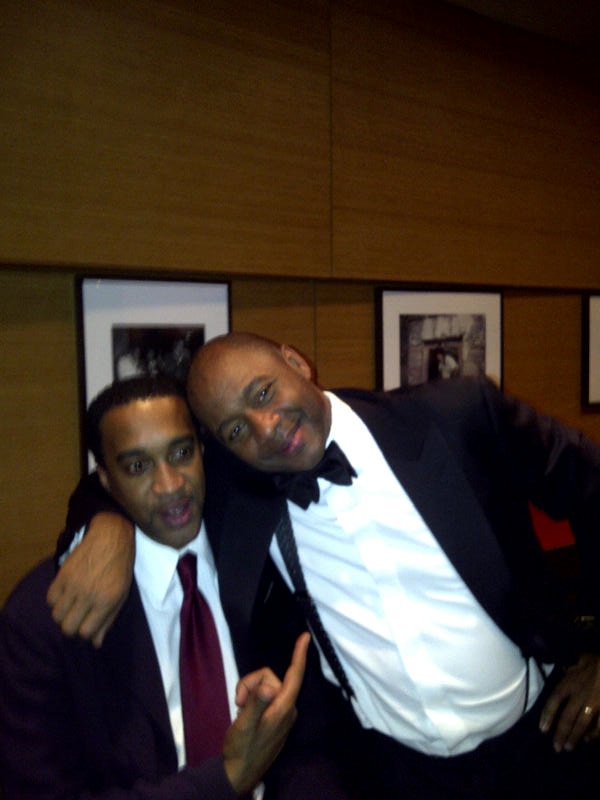
Javon & Branford
Tenor men Javon Jackson (left) and Branford Marsalis hamming it up at the NEA Jazz Masters 2013 event

Amtrak back up to NYC on Sunday, the following Monday evening was high times at the NEA Jazz Masters awards event at Jazz at Lincoln Center. Presented the last few years in grand style at JALC’s classy Rose Hall (more on that venue later), budget constraints and more modest programming shifted the NEAJM event down the hallway to JALC’s club space Dizzy’s. From the moment of the 5:30pm annual group photo shoot of the assembled Masters in an adjacent room, this NEAJM event felt more intimate; an impression which was confirmed by more than one Master post-event. Randy Weston declared himself particularly pleased by the closeness and camaraderie the Masters enjoyed in the smaller confines of Dizzy’s. Consequently the mood was more about fun than honorific reverence, and this time the music was provided entirely by the Masters themselves; with a house rhythm section of NEAJMs Kenny Barron, Ron Carter and Jimmy Cobb.

The humorous highlight of the program was Lou Donaldson‘s acceptance speech, prefaced with an (as Jon Hendricks once remarked) “I’m only serious…” kidding aside of “What took you so long” for him to gain entry into jazz’s highest honor. Donaldson proceeded to break up the house with tales of his potent senior cocktails of Viagra, Levitra and assorted other supposedly life-renewing drugs. Musical highlights included Jimmy Heath‘s lovely turn on “Sweet Lorraine,” ironically part of the tribute to the frequently salty proprietress of the Village Vanguard, Lorraine Gordon, the 2013 NEAJM Advocate recipient who was unable to join the proceedings; the stellar trio of Randy Weston, Ron Carter, and Jimmy Cobb breathed great life into three or four shades of Weston’s classic “Hi Fly,” played in homage to those NEAJMs who inevitably left the planet in 2012, and Paquito D’Rivera teamed up with Dave Liebman for a burning benediction.
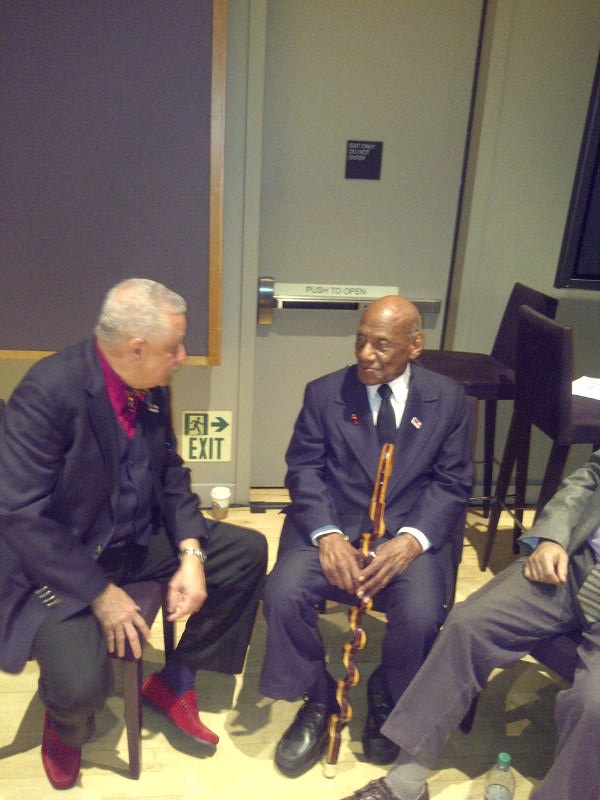
Paquito & Candido
NEA Jazz Masters Paquito D’Rivera and Candido enjoyed the hang

Later that week, on Friday it was Amtrak back up to NYC to moderate a Saturday morning panel discussion at the request of the great bassist-educator Reggie Workman. Friday night afforded another A-train trip to the 59th Street station and Jazz at Lincoln Center. Fact is, at least until we get a look at what Randall Kline has cooked up with the new multi-million dollar SF Jazz home base in San Francisco (which just launched this week), JALC’s facility is top of the food chain where jazz-dedicated performance facilities are concerned. JALC’s venues prove once and for all that jazz music is as adaptable to its environment as any music on the planet.

The lamp was lit at JALC that Friday evening as all three venues – Rose Hall, the Allen Room (with its dramatic stage backdrop bay window view of Central Park), and Dizzy’s – were in high activity mode, each with some measure of the cool 50s advancement on the bop aesthetic. Rose hall featured the Music of Gerry Mulligan and John Lewis. The Lewis portion of the program began promisingly when the young & restless, old soul New Orleans pianist Jonathan Batiste strolled out in a slim suit and high top sneakers as the evening’s featured pianist. This proved to be a prescient artistic choice to navigate Lewis’ music from the piano seat, though on the surface one might not associate such an excitable cat as Batiste with the uber-dignified countenance that was John Lewis and his classic-leaning essays of the blues. But from the moment Batiste laid into Lewis’ standard “Django,” the wisdom of seating him at the piano for this program was evident. And what a marvelous acoustic environment Rose Hall is for jazz! Once Batiste concluded his opener, out strolled an estimable small ensemble consisting of Wynton Marsalis, trombonist Chris Crenshaw, alto saxophonist Ted Nash, drummer Ali Jackson, and bassist Carlos Henriquez to play Lewis’ “Delaunay’s Dilemma” with gusto. Zeroing in on Henriquez’ robust bass tones the mind drifted to what must have been one of the acoustic engineering team’s focus in the design of this hall – proper reproduction of the ever-tricky acoustic bass.

Next on the program was a Victor Goines-featured rendition of Lewis’ memorable line “Two Degrees East, Three Degrees West”; this one proved once and for all that the clarinet is Victor’s most distinctive horn; he consistently brings a full measure of his New Orleans tradition to that often tricky straight horn. The remainder of the Lewis portion of the program was delivered in high style by the venue’s signature ensemble, the Jazz at Lincoln Center Orchestra. Throughout the program Marsalis played truly remarkable trumpet. Its been a minute since I’ve heard Wynton sounding as engaged by his horn as he was that night; juggling so many hats and responsibilities with JALC’s operation, the Artistic Director just sounded more dedicated to great trumpet, and the good house was duly rewarded. The second half of the program was the music of Gerry Mulligan, but a quick decision was made during intermission to head over to Dizzy’s because by that time the last (9:30) set was about to begin.

It was a John Lewis kind of night as Dizzy’s featured an elegant ensemble fully up to the task of small group interpretations of the John Lewis legacy. Led by the high class young pianist from Columbus, OH, Aaron Diehl, the quartet was rounded out by drummer Rodney Green, bassist David Wong, and the prodigiously talented Baltimore vibraphonist Warren Wolf, who is also quite the facile multi-instrumentalist. Shades of MJQ you say? For certain that was the prevailing mood, but these young musicians breathed their own contemporary life into that rich legacy and John Lewis’ most potent exponent. And what a fine contrast Diehl’s approach proved to be following his contemporary Jonathan Batiste’s successful efforts at Rose Hall. Diehl, who also proved to be an informative host, introduced a string quartet which provided further elegance to the closing two pieces of their set. Great Monday/Friday bookends that week at JALC!

Reggie Workman invited me to moderate a panel on the subject of “Improvised Music: The Business and Art” that next Saturday morning as part of the Chamber Music America Conference. I’d be remiss if I didn’t also mention that my CMA conference experience actually began with a (pre-JALC trip) cocktail hour showcase performance that Friday at 5:30 with a performance by one of the CMA jazz composition grant-funded artists, saxophonist Patrick Cornelius, whose supple alto was joined by bassist Peter Slavov, pianist Taylor Eigsti, and the potent, resourceful drummer Kendrick Scott. Our panelists that next Saturday morning included Workman, pianist Marilyn Crispell, tabla master Tapan Modak, and poet-dancer-choreographer-arts presenter Patricia Nicholson Parker (read more about her efforts right after this piece). In addition to some lively conversation on developing business paradigms for various streams of creative music (in this case streams of the jazz-related aesthetic), a recording of Workman’s piece “Cerebral Caverns” welcomed panel attendees into our discussion and Modak brought peace and purpose with a warm invocation on tabla. Following our discussion, Reggie Workman and Marilyn Crispell improvised a lovely bass-piano duet that brought heaps of additional meaning to our subject matter.

What a great couple of weeks of arts conferences, jazz and arts community camaraderie, good conversation, serious networking, and wonderful music this proved to be to kick off the New Year! Hopefully we’re off to a good start in 2013.
CMA Marilyn & Reggie
Marilyn Crispell & Reggie Workman weaving magic at the Chamber Music America conference

Posted in General Discussion | Leave a comment

The vision behind the Vision Festival

Patricia Nicholson Parker resembles the wise university professor, pleasant of disposition but iron-willed when it comes to ensuring students do the right thing in her classroom. It would appear that blend of wisdom and tough-mindedness has served her well in developing Arts for Art, the not-for-profit she started in 1995 principally to present the renowned Vision Festival. That annual gathering and collection of some of the freer thinkers identified with jazz and improvised music expressions has become such a strong haven of successful collaborations and vibrant performances that Ms. Parker has produced several spin-offs, including the Vision Collaboration Festival (for dance & music collaborations), and the weekly series known as Evolving Music.

In a 21st century kind of way, Arts for Art’s grassroots, DIY approach harkens back to earlier musician’s collectives, and particularly to the early 70s when such restless explorers as Sam Rivers, Rashied Ali and other Lower Manhattan-based artists grew the loft scene. A multiple recipient of the Jazz Journalists Association “Producer of the Year” award, as an artist Ms. Parker is a dancer-choreographer and poet. At last week’s Chamber Music America conference panel I moderated (see preceding piece), as pianist Marilyn Crispell and bassist Reggie Workman spun out a lovely, medium tempo piece I caught a glimpse of a restless Patricia Parker doing what comes naturally – dancing in her seat to the music. Oh yeah, coincidentally she’s also the spouse of bassist-composer and Vision Festival fixture William Parker. I’ve been curious about the whole development and mission of Arts for Art, so some questions for Patricia Nicholson Parker were clearly in order.

OLYMPUS DIGITAL CAMERA

What came first, the Vision Festival or your overall operation known as Arts for Art Inc.?
The Vision Festival came first – It came out of the Improvisors Collective that I began in 1993 and ran through June 1995. In ’93 there was nothing happening – nowhere to play improvised or edgy music – the Knit was mostly booking John Zorn‘s scene and the indie music scene while the more improvised and high energy school was under-represented. So I began the Improvisors Collective to bring people back together and support each other. After 2 years of the collective, the energy was not building. In 1996 I organized the first Vision Festival. The idea was to make visible the high energy music that had been inspired by Ayler, Cecil Taylor, Ornette, etc. and that had hither to been overlooked. We saw these initiatives as part of the continuum of the movement of self-determination, as I was working closely with other artists. The festival takes the musicians/artists’ point of view in the way that the business is conducted – the artist comes first. To ensure ‘visibility and embrace some kind of diversity we included artists from other genres and at different points in their careers. We booked people who were well known and others who were coming up and some who were new or emerging. The Festival embraced the idea of bringing arts together and including ideas of social justice. We applied for non profit status in 1996 as it became clear that we would continue and make the festival an annual event.

How has the Vision Festival grown through the years, to the point where it is arguably one of the signature creative music events in this country?
When we began it was about making the NY high energy music available to a larger audience. We were a niche festival. Now we seem to be the only game in town and this has put new responsibilities upon us. There is a young group of musicians emerging with a different aesthetic whom we are including . But we still fight for the original aesthetic because we think that it is a very important part of the story which is still being left out of music education/history – However, we will also need to include more and more aesthetics and a greater diversity of artists.

As a year-round arts presenter what have been some of your biggest challenges?
Arts for Art has always responded to the needs of its community, so we have tried to present concerts year round and have education programs that teach the under-served about non western music and improvisation. However since we don’t have our own venue yet, it is a struggle to raise sufficient funds for all of our programming, It is particularly difficult without our own venue to present the music and art in the way and with the frequency that is needed. Also without our own venue it is difficult to build the loyalty necessary to optimize audience development. Thus we have just launched a new project. We are building consensus and raising support for The Under_LIne, a new venue that we wish to build on the lower east side in a city owned building. If seems like the right idea and this is about time.

How do you balance your career as a dancer/choreographer with your work as a presenter?
I struggle always with this, all the time. But one way that I deal with it is based on the understanding that I am one being and everything that I do is dance, is movement, is art, is prayer.

What are some of the highs & lows of having two creative artists, both with a wealth of ideas, living under the same roof?
We have very different personalities but we believe basically in the same things and then we keep loving each other and respecting ourselves and our art.

Posted in General Discussion | Leave a comment

More wisdom from Matt Wilson

ON THE SUBJECT OF MUSICIAN’S RESPONSIBILITY TO HIS/HER AUDIENCE. Dig this…

CREATE RELATIONSHIPS PLEASE EMPOWER
CREATE TRUST CREATE COMMUNITY CREATE LEGACY
YOUR LOCAL SCENE. THIS IS WHAT WE NEED.
JAZZ IS NOT JUST NEW YORK!
offer present
receive include
convince the audience that they are cool and groovy!
Will the intent of entertaining diminish
the art form? NOPE! The lack of imagination will though.
welcome the sound of
Present
Include
Be Nice! Be Happy! Be Grateful! BE!
entertain: To hold attention by amusing and diverting. To show hospitality to guests. To hold in the mind.
I HEREBY DECREE, TAKE AWAY
My kind manager, Amy Cervini, and I have launched a new venture that we believe will greatly benefit you awesome hard working cats out there in field providing a solid music educational experience for our youth.
It is called VITA — Very Inspiring Teaching Artists. We have assembled quite a roster of folks who can come in and really fire up your students. We also offer talented writers/arrangers for your needs as well as presentation consultation and other services. check us out at jazzvita.com jazzvita@gmail.com Thank you! My children, who want to go to college, thank you also!
“Clarity & Honesty!”
Entertain
MMmmmm…pie! Homer Simpson
have fun, smile & laugh. repeat over & over.
Two simple words of wisdom from my friend John Clayton.

Posted in General Discussion | Leave a comment