The Independent Ear

Jazz Radio Commentaries Pt. 3: Rusty Hassan

Rusty Hassan is one of the more venerable and hippest enthusiasts on the DC-area jazz scene.  Dial up most any worthwhile jazz performance in the Washington-Baltimore area and you’re more than likely to find Rusty on the scene, sometimes with his eager young grandson in tow.  Friend and confidante of many musicians, and one of the warmest, most knowledgeable interviewers in jazz radio, Rusty Hassan is one of those cornerstones of the jazz cognoscenti in the DC area.  Rusty has also taught jazz history courses, at Georgetown University and American University, for many years; during the school year some evenings when you tune in his program Rusty will be playing selections that serve as quiz or test subjects for his students.  So its safe to say that many in DC have been educated by Rusty Hassan’s broadcasts, whether they were part of his formal classes, or part of his jazz university of the streets.

After WDCU, the former radio outlet of the University of the District of Columbia and a bastion of jazz radio, was hastily sold in the mid-90s by the university to CSpan Radio, leaving the once relatively jazz radio-rich nation’s capital region with WPFW as its sole jazz beacon, Rusty Hassan was the first of ‘DCU’s fine raft of programmers to land a show on ‘PFW.  He can currently be heard at 89.3 FM (or on wpfw.org) on Monday evenings 7-9pm, where he serves up scrumptious portions of classics and new releases and welcomes all manner of artist interview subjects onto the airways. 

The Independent Ear posed a simple question to Rusty about the whys & wherefores of his jazz broadcasting philosophy.  As you’ll read, it didn’t take much…

Before I get into how I program my show, I think some background would be appropriate.  I started broadcasting as a student at Georgetown University on WGTB-FM in the 1960s.  I became very involved with avant garde jazz, or as it was called then, The New Thing.  Noah Howard was one of the first artists that I interviewed.  I recently dug up the test pressing of his “Live at Judson Hall” Lp that he gave me to play, in tribute to his passing. 

I would play John Coltrane’s Ascension and Ornette Coleman’s Free Jazz without hesitation [on-air].  I was an early and ardent supporter of the AACM.  Joseph Jarman’s “As If It Were The Seasons” was something I played on WGTB before I went to Paris in 1969.  There I met a lot of cutting edge musicians, such as Anthony Braxton, Lester Bowie, Leroy Jenkins, and took their recordings back to the States to play on the air.

In the 1970s when I was on WAMU-FM I was part of a dramatic shift in music programming on radio from AM to FM.  I grew up listening to top 40 radio where there was talk and commercials between each song.  Jazz programmers such as Symphony Sid and Mort Fega in New York, and Felix Grant in DC, worked in this format.  On non-commercial FM stations we were allowed to play long pieces and blend sets of music in ways that could be very creative.  The so-called underground radio format worked as well for jazz as it did for rock.

When Duke Ellington passed, the program director asked me to do a four-hour special tribute.  I mixed in interviews with Duke that Jack Towers provided.  When Martin Williams called in to complement the show I knew I was doing something right. 

In the latter part of the decade WAMU asked me to submit program listings for the monthly guide.  Primarily using [artists’] birthdays I did a series of musical biographies of major artists; some, like Miles, would get two shows.  Then I did a parallel or contrasting careers of artists such as Gigi Gryce and Ernie Henry.  The one I did on James Moody and Sonny Stitt was aired just days before Stitt’s passing.  I gave Pam Stitt the tape of that show.  [Editor’s note: Sonny & Pam Stitt’s daughter Katea Stitt is Music Director at WPFW and a longtime station programmer.]

Interviews have been an important part of my programming.  On my show on WAMU in the 70s and 80s I interviewed Art Blakey, Dexter Gordon, Sun Ra, Kenny Burrell, Bobby Hutcherson, Red Rodney and Ira Sullivan among numerous others.  Although I started interviewing jazz greats before Fresh Air came on the air, I consider Terry Gross as a good role model on how to conduct an on-air interview, recognizing that hers are edited before they’re aired.  She knows how to elicit information that is masterful.  Check out her discussion with Sonny Rollins as an example.

One of the more memorable interviews I had on WAMU was with John Malachi, the pianist with Billy Eckstine in 1944/45.  He had a great story about jamming with Charlie Parker on “Cherokee” after a performance with the band as he was leaving the studio.  I thought I have to get more of these great stories from my close friend, but he died of a heart attack two days later.

WAMU dropped my show in 1987.  The next decade was a wonderful ten years on WDCU Jazz90.  The license for the station had been given to the University of the District of Columbia by Georgetown University when the Jesuits were upset with the radicals running WGTB.  So here I was broadcasting on the same spot on the dial, 90.1 FM, that I had been on in the 1960s.  Again I had complete freedom in choosing music and how I programmed it.

When WDCU went off the air in 1967 I was the first programmer to come over to WPFW.  I have had a strong connection with the station from the beginning.  I attended planning meetings before [WPFW] came on the air [33 years ago].  I was a frequent guest on the air and hosted fundraising concerts (WAMU management never made an issue of it).  Legendary WPFW programmers such as Jerry “The Bama” Washington and Nap Turner were friends of mine beforee they got shows on the station.  So WPFW has been an important part of my life for 33 years.

Next time: Rusty Hassan talks about how he programs his shows.

Posted in General Discussion | 1 Comment

Chasing the African Rhythms

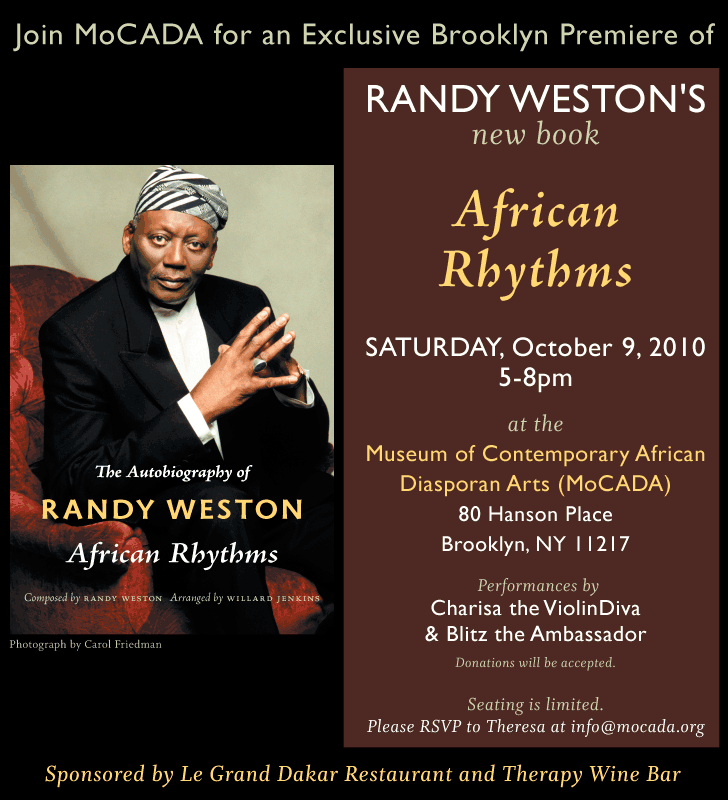
African Rhythms, the as-told-to autobiography of the NEA Jazz Master Randy Weston (composed by Randy Weston, arranged by Willard Jenkins; Duke University Press) is set for October release to the retail marketplace.  In the meantime we have embarked on the first in a series of forthcoming book signings and other book-related events coupled with Weston performances.  The series kicked-off on September 17 at the beautiful Rubin Museum in Manhattan, where Randy performed a trio concert followed by a book signing.  The Rubin quickly sold out of its allotment of books, cheerfully autographed by Weston following the concert.

Last weekend marked our first joint book signings as the arranger joined the composer at Eso Won Books in the Leimert Park neighborhood of Los Angeles on September 25.  For those of you not familiar with the area, Eso Won Books is located directly across the street from the World Stage, the late drummer and NEA Jazz Master Billy Higgins legendary venue on Degnan Blvd.  When Randy and I arrived we were greeted by an array of his entire vinyl discography lined across the tops of the stacks — including several rarities even he hadn’t seen in ages.  Having artists like the great flutist James Newton, saxophonist (and bass clarinetist supremo) Bennie Maupin, and performance poet Kamau Daaood bellying up to the table with books in hand and kudos on lips was quite gratifying.

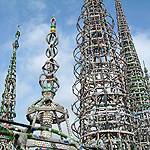
The store soon filled to an SRO audience that sat in rapt and appreciative attention as Randy detailed anecdotes from his journey, with the arranger interjecting questions and observations here and there.  Following our talk  book purchasers lined up nearly out the door into the sidewalk and we joyously signed about 100 books.  Later that afternoon we went over to the Watts Towers for the Watts Tower Arts Center’s annual day of the drum, the highlight of which was the trio of Ndugu, Munyungo Jackson, and Babatunde Lea calling the spirits in improvised ensemble.  Hypnosis came when all three sat down to essay on cajon, the Peruvian box drum.

The following day, back at Watts Tower (and what an amazing arts installation that series of Simon Rodia constructs is — smack dab in the middle of the ‘hood; pretty unprecedented and a real cultural treasure), it was the 34th annual Watts Tower Jazz Festival.

Hearing artists like pianist Harold Land Jr. with bassist Henry “The Skipper” Franklin, the burning Watts Tower Arts Center’s jazz mentors ensemble with Patrice Rushen, Bennie Maupin, Bobby Rodriguez, Munyungo and Ndugu, reprising Maupin’s “Butterfly”.   Babatunde Lea’s spiritual Umbo Weti with vocalist Dwight Tribble successfully channeling Leon Thomas, Ernie Watts on tenor, Patrice, and bassist Jeff Littleton was  uplifting, giving one greater appreciation for the brilliance and abundant fruits of SoCal’s jazz artist community.  Randy closed the festival in duo with the great hand drummer, and his long time cohort, Big Black — another rare sighting for those of us east of the Mississippi.  And what a treat it was to hear the youth of the UC-Berkeley Jazz Ensemble, under the tutelage of Patrice Rushen and Ndugu.

Earlier that day, through the good graces of Watts Tower Arts Center director Rosie Lee Hooks, we were set up at a shaded table — L.A. was in the midst of an unusual fall heat wave — signing more books and greeting well-wishers.  I couldn’t think of a better kick-off to our series of book events.  Our next book signing event takes place Saturday, October 9 in Brooklyn (details below).  Stay tuned to The Independent Ear for other upcoming book events, including New York, Chicago, Washington, DC and more.

Posted in General Discussion | 1 Comment

Jazz & self-determination in Brooklyn – Pt. 2

Our series of conversations with African American jazz presenters and entrepreneurs last time took us to Brooklyn, NY, via our ongoing research project for the Weeksville Heritage Center (718/756-5250; www.weeksvillesociety.org for more information). In part two of our dialogue with the Brooklyn sage Jitu Weusi we examine the development of the East cultural center, a sadly defunct font of African American culture, education,  jazz music, and pure black energy & spirit.  In part the East grew out of the notorious Brooklyn empowerment struggle of the Oceanhill-Brownsville incident in which African Americans sought to take more control over schools and education curriculum content in the community, which resulted in a bitter teacher’s union strike.  Major cornerstones of the East were the Uhuru Sasa school, a forerunner of the so-called charter schools movement of today, and a jazz concert series. 

How did you and your cohorts arrive at the develoment of The East?

Jitu Weusi

By 1968 we had founded a group called the African American Student Association.  The African American Student Association was comprised of young people 14-18.  I was the adult advisor to this group, I was about 28-29.  These young people were raising new stuff every day; raising new issues, new horizons, new visions, etc., every day.  In 1968 we had the Oceanhill-Brownsville controversy and I was in the middle of that, and that tended to stigmatize me: ‘he’s a troublemaker, he’s a radical, he’s this, he’s that…’  So I knew that my time in public education was not going to be too much longer.

In 1969 I was banned from the campus of Pratt Institute.  We were supposed to have a program there and the president banned me from the campus.  The man didn’t even know me!  He just issued an edict that if I set foot on the campus, the program would not be held.  So the young people said ‘we want to establish our own cultural center.’  So that summer and fall we had gotten ahold of this building at 10 Claver Place.  We cleaned out this building and began to restructure it as a cultural center.  We had a couple of meetings and we came up with the name East.  Basically that was a philosophical thing because we were dealing with Eastern values, as opposed to Western values.  That’s where the name came from, it came from our attraction to Eastern values that we felt were values that dealt with internal values, spiritual values.

What was the mission of the East?

The mission was to bring enlightenment to our people — recreational, philosophical…

So how did you work to achieve that mission?

Through a number of different things; one was through the entertainment that we provided.  Our opening performance was Leon Thomas, and from the very beginning our music was always radical.  HGary Bartz, Freddie Hubbard, Rahsaan Roland Kirk… our music was always out there.  Then one of the first things that we brought into the East was the bookstore.  We pushed reading, understanding, books, studying, and upliftment.  And then the next thing we brought in was a school: the Uhuru Sasa school became a vehicle for us educating young people and adults as well.  The East thing was always an upliftment of a mind, forging of a higher objective, a higher goal, a better person, and self-improvement.

Did you pretty much have seven days of activities at the East?

Seven days — almost 24 hours, because we did everything, and we learned everything.  We did everything on our own; we had a kitchen where we prepared food; we learned how to go to the market and deal with the market — vegetables, fruits, fish markets, meat markets… all those things.  That was part of the enlightenment that people learned was how to deal with all that.  People would come and tell us ‘man, I didn’t know nothin’ about all this stuff until I got involved with you guys…  Now I’m running this and I’m running that…’

Hod did people in the community come to be involved with the East?

It was a membership kind of thing and [members] had to make a total commitment.  If you worked at the East you didn’t make any money; we paid salaries like $100-200 a month, so you weren’t there because of money.  You had to live on whatever you made, how to survive, how to advance.  It was uncanny [but] people bought homes off $200 a month!  We provided things like schooling for [employee’s] youngsters, but people had cars…  People used to say ‘…damn, ya’ll don’t pay any money, but everybody around here looks like they’re well-off!’

Were you the director of the East from the start?

 Yes, I quit the [New York Public] school system in November 1969 to devote full time to the East.

I’m aware of at least two recordings related to the East: Pharoah Sanders’ Live at The East (Impulse!), and the Mtume record Al-Ke-Bu-Lan (Strata East).  Were there any other recordings made there?

Not that I can remember.  We had music on [maximum] four nights a week: Thursday, Friday, Saturday, and Sunday.  Some artists only wanted three nights, so we’d go Friday-Saturday-Sunday, or if they only wanted two nights we’d go Friday-Saturday.  We had no official policy, but unofficially the only people who came to the East were black people.  That’s not to say that an individual white person here or there did not come into the East, that would be erroneous.

Initially they didn’t pay us any mind, because [hypothetically-speaking], who was the East?  But after awhile, when the word started getting out that there was this place, that the musicians really played there, and you could hear the music, they [audience] didn’t do no talking, wasn’t no bottles clinking, wasn’t no noise… people were into the music, this was a serious place…  Then people started trying to come, people started coming… and we more or less had to inject that policy.

Was the school at the East — the Uhuru Sasa School — a regular k-12 school?

Yes, it was certified.  One of our elected officials, a state senator, came to the school one day and he said ‘…man, you’d better get this certified, because if you don’t get this [school] certified they’re going to close you down.  So he backed us up with the state Department of Education and he more or less guided us through a number of different situations with the state.

How did the East subsidize the school finanancially?

That was part of what the music did.  The music helped us to pay for running the school.  Take a typical Pharoah Sanders weekend: a Pharoah Sanders weekend meant a $5,000 weekend, which meant we could pay teachers’ salaries, we could buy food, we could do this, do that…

The musicians who played at the East were black musicians, and at least among the musicians you listed who played the East there’s a certain cultural consciousness.  In terms of how the musicians were compensated, is the East a place where the musicians would give you a break, where they might not have given the same fee break to some other venues around New York?

Everybody that played [the East] got paid, nobody played for free.  But they never charged us what they might have charged a Birdland, or the Vanguard…

The food policy at the East was obviously a major component.

Everybody talked about the food at the East; guys couldn’t wait until they had finished their set to send [their food orders] down to the kitchen.  We had chicken dinners, fish dinners, and vegetarian dinners.  We had this vegetarian rice called Kawaida Rice, big green salads, potato salad, collard greens… We used to produce sometimes 300-400 plates of food per night!  That’s a lot of food coming out of one little kitchen a night.  Food became a major way that we earned money through the East to pay for our expenses.

What was the lifespan of the East?

The major duration was from about 1970-1977.  After ’77 was stage two, which went from ’78-’86; in ’86 we closed down.

What was different about stage two of the East?

Stage two was less music; not every weekend, just music every once in awhile.  We moved from 10 Claver Place to an Armory on Sumner; we had a larger venue, but the venue wasn’t as cozy, the sound wasn’t as good, it had a high ceiling which sucked away all the sound.  The venue wasn’t as good so we ended up having music once a month.

The East spurred the development of one of this country’s major black arts street festivals.

It started off as the African Street Festival, later on it became the International African Arts Festival.  In 1970-1971 we noticed a pattern – we would run out of money at mid-end of June, and we’d have debt.  My thing was always pay off debt, don’t accumulate any debt.  So we wanted to figure out a way to make some money to pay our debt at the end of June, because June was the end of the school year and a lot of people would travel.

So the thing was to pay off our debt so we wouldn’t owe anything going into the summer.  We discussed what to do and after awhile we came up with the idea of having this 3-day block party on Friday, Saturday and Sunday on Claver Place, which is a little compact block between Franklin and Clausen, and it’s also where Jefferson Avenue begins, so it’s sorta like a T [configuration].  The idea was to have this block party on this T and invite people to come down, move our whole entertainment thing outdoors, build a stage outside, sell food and have various merchants all up and down the block, sell merchandising space and so on.

The first year we did that, 1972, it started raining on Friday and it rained all night Friday, it rained all day Saturday, it rained all Saturday night.  But when it stopped raining on Sunday morning at about 11:00 and the sun came up about 1:00, people jammed that little block.  There must have been — no exaggeration — 10-15,000 people on that little block, from 1:00 Sunday until midnight, and it was fantastic… music, dancing… it was like something that you dreamed about; nobody had ever seen anything like that in that little space, and outdoors like that.  And everybody made money.  So even though two-thirds of it was rained out, the one-third that survived was enough to tell us that we had hit on something.

The next year, 1973, we cleaned up…  No rain, we ran it for three days, the crowds were enormous… we cleaned up, everybody made money, we paid off our debts, the community was very happy, we were happy…  The only ones unhappy was the Catholic church.  The Catholic church had a yard there and they claimed people were peeing in the yard, different things.  They had some balconies and they claimed photographers would go up there and shoot [photos] from the balconies.

So you had to make peace with the church; how’d that happen?

[African percussionist] Chief Bey — James Hawthorne-Bey — came over to the East one day and he said to me ‘I’m going to take you over to the church and we’re gonna make peace…’  [Laughs]  I’m a warlike kind of person… ‘peace… get outta here…’  But I had a lotta respect for the Chief.  He took me over to the church, we lit candles, prayed, the Father came down and we talked, and when we left there everything was cool, everything was alright.  We reached a compromise that they would let us have the festival that year, at Claver Place, but the next year we would move the festival up to Boys & Girls High School, which had much more space to accommodate what we were doing.

It eventually became the International African Arts Festival.  This is the 39th festival [2010] and the basic tenets are still in place, as far as arts, economics, culture.  It’s very hard to find something that lasts 40 years that is still the same as it was the first year.

(Editor’s note: the new book African Rhythms, the autobiography of Randy Weston (composed by Randy Weston, arranged by Willard Jenkins; Duke University Press) contains a photograph of good friends Randy Weston and the master of afro-beat Fela Anikulapo Kuti when they played the  African Street Festival.  The festival also had a richly-deserved reputation for great black music.)

Next time: Jitu Weusi and several of his cohorts discuss the founding and development of the Central Brooklyn Jazz Coalition.

Posted in General Discussion | 7 Comments

Jazz Radio pt.2

Yes, jazz radio is alive and… perhaps to say ‘well’ would be stretching the point; so let’s suffice to say that jazz radio is alive… and still striving. To prove that we are featuring an occasional series of observations from jazz radio programmers across the country on their experience in the medium and how they program in their particular markets.

This time we reached out to Denver, CO where veteran radio programmer Arturo Gomez holds down the Music Director chair at Denver’s main jazz radio outlet, KUVO. In addition to his radio responsibilities Arturo was called upon to serve as one of his city’s ambassadors of local culture when the mayor appointed him a Commissioner of the Denver Office of Cultural Affairs.

Known as “The Oasis in the City,” KUVO broadcasts at 89.3 FM and serves other sectors of Colorado through local carriage in Breckenridge and Vail. KUVO is Colorado’s first HD FM radio station.

How long have you been programming jazz radio and how did you arrive at your programming position at your current station?

I began as an on-air host in 1989 at WDNA in Miami.  In 1992 I was appointed Music Director at KUVO, after which the station streamlined its format to become a predominantly jazz station.

Do you have a particular programming philosophy that guides your efforts, and during the course of a normal week how do you go about planning your programs?  What dictates the selections you spin on the air?

My personal philosphy mirrors the policy of jazz89/KUVO/KVJZ [Vail] that was written by my Program Director many years ago.  We consider ourselves to be a “full service” jazz station; in other words we cover he entire spectrum of recorded jazz in all of its many splendored variety.  From the 1920s to the latest effort.  We treat Latin, Brazilian, and World jazz as if it was a trio, big band, vocal ensemble… it’s part of the mix.  We include classics as well as the latest releases, though not many of the classic jazzers are doing any more touring.

We have a “pie chart” for our mix; 3 currents  (new releases), a classic at the top of every hour, plus another classic in the second half of the hour, 2 vocals — preferably 1 male and 1 female — spaced out every half hour, either one or two Latin/World/Brazilian tunes if time permits.  The other choices for the hour are left up to the program hosts.  Mostly we fit nine songs in an hour with occasional 10 or eight song houurs.  We also have a daily birthday list that could influence the choice of artists played each hour, though not all hosts honor all birthdays.

So what’s up at your station?  Give us a shout at willard@openskyjazz.com if you’d like to participate in this occasional series of jazz radio observations.

Posted in General Discussion | 2 Comments

Jazz & Self-Determination in Brooklyn

The Independent Ear series of conversations with African American jazz entrepreneurs — classic & contemporary — continues, this time in Brooklyn, NY…

Remembering The East with Jitu Weusi
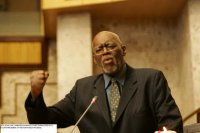
PART ONE: A jazz fan in development…

 One of the revelations of the Lost Jazz Shrines of Brooklyn research project for the Weeksville Heritage Center (see elsewhere on Open Sky Jazz) has been the extensive interviews with key Brooklyn figures. The magnitude of Brooklyn’s mid-20th century jazz history was first brought home in writing African Rhythms, the autobiography of NEA Jazz Master Randy Weston (composed by Randy Weston, arranged by Willard Jenkins; available on Duke University Press in October ’10). Great stories and the light of revealing history has continued to be shed through this ongoing series of Weeksville interviews.

One such saga is that of The East, a pioneering African American cultural institution which rose up in Central Brooklyn in 1969 and was the jazz venue in the borough for several years, among its many extraordinary deeds.  My knowledge of The East had been limited to the recordings Pharoah Sanders Live at The East (which point of fact wasn’t actually recorded at The East, but was a studio date in the spirit of Pharoah at The East), and percussionist Mtume’s Alkebu Lan for Strata East, which was indeed recorded during one of the always-spirited jazz nights at The East.  There were also enriching and delightful personal experiences at the annual African Street Festival (now known as the International African Arts Festival),  which was birthed by The East, but I never had the pleasure of visiting The East’s storied jazz sessions. 

The East, which was so much more than a jazz performance venue, is a classic example of the kind of African American self-determination that flowered in the late 1960s-early 1970s as bright flowers of the civil rights struggle.  To gain insights into the origins and development of The East there was no better place to start than with one of the historic figures of post-60s public education, politics and culture in Brooklyn, Jitu Weusi.  We interviewed Jitu, a tall, gray-haired, unassuming eminence on a warm, late-spring morning at his current office at  The Central Brooklyn Jazz Consortium on Fulton Street, where he serves as chairperson.  This first of two parts will detail Jitu’s early history with jazz; part two will detail the development of The East, just part of our wide-ranging interview which will eventually be available as part of the Weeksville archives.  Like so many of us, Jitu’s interest in jazz grew through the oral tradition.
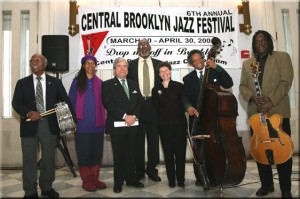
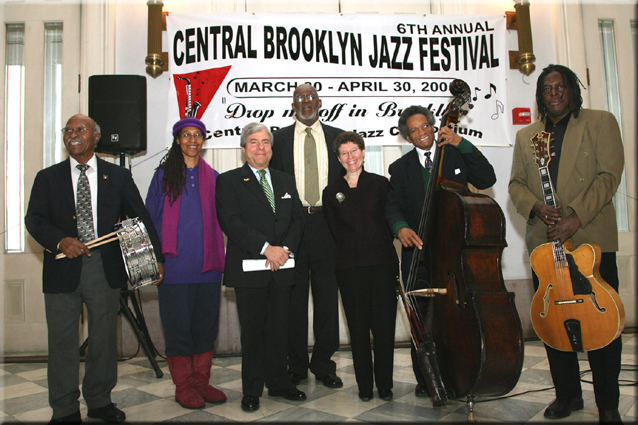
Jitu Weusi (center in tie & glasses) celebrating an event at the 6th annual Central Brooklyn Jazz Festival with among others Brooklyn Borough President Marty Markowitz (to Jitu’s left)

Willard Jenkins: What are your earliest memories of jazz music?

Jitu Weusi: I was about 12 years old and my cousin Charles Morris had a newstand.  I was the first born of my generation and he called my mother and said ‘I want Leslie” — that was my name until I changed it — ‘to work at the newstand on Saturdays.’  So that started a new era in my life, going down to the newstand on Saturdays.

Every Saturday morning I would get up about 7am and be out of the house by 8; by 8:30 I was at the newstand and I would be there until about 6:30-7pm.  I had a number of tasks to do: in those days you prepared your Sunday papers with the various sections on Saturdays; so I would put together the Daily News, the Times, and the Tribune.  The main news section usually came about 8pm on Saturday night and you just inserted them in there and the papers were ready to be sold.  The newstand was located right on the corner of Fulton and Franklin.  Fulton and Franklin at that time was a very, very hot corner.  It was hot for two reasons — Ebbets Field [legendary home of the Brooklyn Dodgers] and Coney Island; you got the train to go to Ebbets Field and Coney Island at Fulton & Franklin.  So people would come out of that subway and make it to the elevated line upstairs and get those trains.  So from March-October there was a lot of traffic.  That was a very trafficked area anyway; blacks had just started to move in that area.

Across from the newsstand, on the southeast corner was a record store called Sam the Record Man.  Now Sam the Record Man, like all good record stores, had this loud outdoor [sound] system and they used to play records all day long.  Many of these records I had never been exposed to before.  It was my first time being exposed to people like Ruth Brown, Fats Domino… a lot of the early progenitors of rhythm & blues; but also he would play jazz: King Pleasure, Charlie Parker, Billie Holiday, Ella Fitzgerald… he played different vocalists as well as instrumentalists.  After awhile I began to know who was who and what their tunes were.  My cousin and his brother — they were the two male figures that operated the newsstand — my cousin Charles Morris was the oldest,, he was a disabled vet and it was under his auspices, his disability, that he was able to get the newsstand.  His brother, Leroy Morris, worked with him.  Leroy’s nickname was Lefty, and he was very athletic, and he knew all the jazz guys; he knew [Brooklyn drummer] Willie Jones, Max [Roach]…

WJ: This is Lefty Morris the basketball player?  He talked Randy Weston into going up to the Berkshires to “escape” Brooklyn.

JW: That’s right, he knew all the jazz guys…  He knew [drummer-dancer] Scoby Stroman, Willie Jones, Max Roach… these guys used to come by the newsstand all the time, even if he wasn’t there.  I was “youngblood”… [it was] ‘hey youngblood, what’s happening man…’  Like I said, I was 12-13 years old.  They were glad to see that I was halfway alive, halfway awake…  I’d always been into reading the newspapers and I knew who was who, like Mao Tse Tung, Stalin…  If they’d given me a current events quiz I could whiz through it because I knew people, I knew figures.  They used to always tease Lefty, ‘yeah man, I came by and youngblood was there and we laid out there and talked about world politics for awhile…’  So that’s when I had my sort of baptism to the music and to the community.

A third thing I remember during that period was, my cousins Lefty and Charles’ sisters, they were like in their early 20s.  At my 13th birthday they took me to the New York Paramount to see a stage show and it was an all-jazz stage show.  I remember it was Count Basie and Joe Williams, Sarah Vaughan and Teddy Wilson, George Shearing… it was about 3 or 4 acts.  I remember that show vividly; it was the first time I’d seen a big band [Basie], they swung pretty heavily.  I remember Joe Williams and his blues singing…  I enjoyed myself and learned a lot about the music.

During my teens I really didn’t get into too much related to jazz.  I guess I was like everybody else, I was into the R&B craze, the stage shows, Frankie Lymon & the Teenagers and all that kind of stuff.  At about 17 I was working in the camps upstate and I started listening to jazz much more often; I started buying a few more records.

 Who were you listening to then and whose records were you buying?

JW: I was buying Art Blakey & the Jazz Messengers; I remember “Blues March,” this was the Messengers where he had Bobby Timmons, Lee Morgan, Wayne Shorter, Jymmie Merrritt…  And I was listening to Horace Silver, “Senor Blues” and his different compositions.  Those were the opening, teenaged years of listening to records.

Then I remember that I had a little girlfriend when I was about 19; she used to live in the Dunbar Houses at 150th Street and 7th Avenue [Harlem], and her mother was very, very strict; like 12 at night you had to go, ‘she gotta go to church in the morning, she gotta do this, gotta do that… 12:00 you gotta hit the road young man.’  I found this place right at 155th and 7th Avenue called Brankers, a music bar.

What was happening at Brankers was really prostitution, but I didn’t know all that.  I couldn’t see all that.  Brankers was like a meeting spot where all these guys would come and hook up with their lady friends and go upstairs.  But in between, they had live music downstairs; they had Kenny Burrell, Grant Green, Shirley Scott… these trios; it usually was an organ player, a guitar player, and a drummer or an organ player, a saxophone player and a drummer.  I’d go to Brankers at 12:30 and I could sit there until 2am listening to music.  I could buy a beer and nobody would bother you; get out there, catch the train and go home.  That became another thing that introduced me to the music.

In the summertime I used to go up to the Catskills area to work in these camps.  When I was about 20 I went to this camp called Wingdale on the lake.  At some point during that summer this guy named Bill Tatum became the entertainment director of the camp and we became friends.  After the summer he told me to keep in touch, he was going to get me some more work.  When I called him he told me he was working at Wells’ upstairs room on 113th & 7th Avenue, home of chicken & waffles.  I had to go down and get my cabaret card and he got me a job working at Wells.  Wells was good to me as a work spot, and I also stayed close to the music.  They played a lot of Dakota Staton, Gloria Lynne, and all that kinda stuff.  But every now and then they’d have a trio, so I heard more live music too.  Of course now I’m getting older and I know the different radio stations, I’m listening to Symphony Sid.  By that time, I was maybe 20-21, I had begun to dabble in Miles Davis, Coltrane, a little Cannonball Adderley, etc.  I got so absorbed I remember on my 20th birthday I took this girl to the Five Spot to see the opening of Ornette Coleman.  Now my musical tastes are broadened and I’m into a wider range of artists.

One particular night we went down to the Village Gate to see somebody.  While I was there I heard this woman manager say ‘I need some waiters…’  I made my way back to her and said I used to work in Wells upstairs room in Harlem.  She asked if I had a cabaret card, I said yeah, she said ‘you’re hired.’  The next day I started working at the Village Gate and that was golden!  I saw everybody: Nina Simone, Thelonious Monk… I not only saw everbody, but I got to meet everybody, guys I had listened to, like Art Blakey…  I found out that some of them lived in Bedford-Stuyvesant, like [bass & oud player] Ahmed Abdul-Malik.  He would play with Herbie Mann and after the set he would say to me ‘youngblood, you goin’ to Brooklyn, come on, I’ll give you a ride’ and he would take me home.  That was a period in which I really became a solid member of the jazz fraternity.
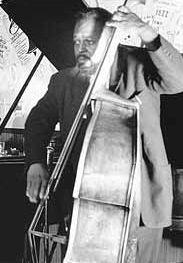
Bassist-oud player Ahmed-Abdul Malik played with Randy Weston, Thelonious Monk and Herbie Mann among many others.

What was happening jazz-wise in Brooklyn at that time?

Brooklyn had a lot of things going on club-wise.  When I worked at the newsstand the Putnam Central Club was hot.  But I was 13; I used to hear Lefty and them talk about the PCC, Tony’s on Grand Avenue… I remember one time I tried to go to The Continental [Brooklyn jazz club], and I looked in there and who did I see but my cousin, a traffic policeman.  Here I am peeping in the door and he’s sitting in the back there, so I got the message: ‘don’t mess around!’  Yes, there was a very active jazz scene in Brooklyn during that period.

When you became of age to frequent the clubs, what was the Brooklyn jazz scene like then?

When I was 21, about 1960, the scene was not bad, there were still some clubs that we could go to, key among them was The Blue Coronet.   I was a frequent visitor there, esepcially when I started teaching — which was about ’62.  We had a little crew of men and women who worked in the schools and we would call each other [and ask] ‘who’s at The Coronet tonight?  Let’s go down there.’  The Blue Coronet was the top [Brooklyn] club at that time.  La Marchal had sort of come and gone.  It wasn’t a prominent club even though Freddie [Hubbard] and [Lee Morgan] made a record [Night of The Cookers] there and gve it some glory.

The Continental had come and gone too, their best years were in the 50s.  Tony’s was there, but the PCC had closed and changed ownership.  Rusty’s Turbo Village had regular music.  You had a lot of bars [in Brooklyn] and every now and then they’d have somebody there: Berry Brothers, Tip Top, Monaco…

So as you evolved as a fan of the music, how did you come to escalate your involvement to the point where you became an activist and even a cultural entrepreneur?

I graduated from Long Island University in June 1962 and I became a teacher in September 1962.  I became interested in the music not only from an enjoyment perspective, now I became interested in it from an educational perspective.  I did experimental things like play different music in my classes and kids would tell me they had never heard any music like that.  I played Olatunji’s Drums of Passion in my class and it was a heavy turn-on; ‘wow, what’s that, where did that come from, who’s that?’

So I saw that the music had a lot of educational value, turning on the youngsters to various sounds, various performers.  Oscar Brown Jr. was another person I used in my classes, different sides that he made: “Dat ‘Dere,” “Signifyin’ Monkey,” “Bid ‘Em In”…  So I now thought of ways to use the music as a motivator in the education of youngsters, especially in the area of social studies.  Now the music became a valuable kind of tool, more than just my listening; now I listened for different purposes and different meanings.

My own repertoire continued to broaden, my collection continued to broaden…  I remember at a certain time I was exposed to the music from “Black Orpheus,” this brought me into contact with the African population of Brazil and their story.  I remember I took a class to see “Black Orpheus” and [the students’] whole reaction to seeing these black people speaking [Portuguese], and having a different kind of culture…  It sparked a whole lot of questions when we got back to school: ‘…How’d they get there, what language were they speaking…?’

[For me] The music now became [sociological] and worldly, universal… not just located in the United States, [but] as a universal commodity, all over the place; I began traveling different places.  I remember my first experience, around 1966, going to Newport to the jazz festival.  I could have never stayed in Newport, because the money to stay in Newport was way up there.  So we ended up staying in a place called Fall River, Massachusetts.  I didn’t know it at the time, but places like Fall River and New Bedford [MA] were places that basically had an African-based population from runaway slaves that intermarried with a lot of the Portuguese that lived in those areas.  And there was a very strong kind of cross-fertilization between those communities and the African community, so when I came up there to stay for Newport [Jazz Festival] I found a lot of people that were very supportive and very glad to have us stay there.  All of that helped to broaden me and broaden my understanding of the music and the people, and the backgrounds and how it fit in.

I began to see this music in a more historical context.  My mother used to listen to people like Louis Jordan, she told me about Chick Webb and different people like that.  Now, by the late 60s all of this begins to tie together, like a historical pattern that’s beginning to develop [for me].  Now I’m beginning to see this [music] in a historical, sociological, philosophical context, and I’m beginning to understand that [jazz] is a revolutionary music, it’s a music of an oppressed people that has sort of guided a movement over the years.

By the mid-60s I became active in political activities: school struggles, around the struggles to decolonize public education.  We used phrases like “community control,” but it basically dealt with the whole question of colonial educational pespectives.  I belonged to an organization then called the African American Teacher’s Association and we put pressure on the board of education to open up the whole school [curriculum] and become more accepting  of different cultural perspectives.  When I came into teaching they gave us some books and some curriculum outlines to follow, and most of that was white.  Like they used to say in the old days, the only two [black folks] they mentioned were George Washington Carver and Booker T. Washington… that was the full extent of our history.

Now I’m beginning to deal with Crispus Attucks, Phyliss Wheatley, the Louisiana Purchase of 1803, Toussaint L’Overture and the Haitian revolution…  I’m dealing with a whole broad kind of struggle of Africans for their freedom and independence.  In the midst of all this is the music.  Now my whole thinking begins to take on new dimensions.

I was part of the group that used to listen to [jazz radio hosts] Ed Williams and Del Shields on WRVR; that was our religion; we had to get home in time to listen to them because of all the information that was dispensed on those two shows.  Our music and our politics now became more toward the same track.

Next: The birth of The East, and how jazz was an integral part of that historic font of black culture and education.

For more information on the Weeksville Heritage Center visit www.weeksvillesociety.org; to learn more about the Lost Jazz Shrines of Brooklyn project email research@weeksvillesociety.org.

Posted in General Discussion, The Presenter's P.O.V. | 10 Comments