The Independent Ear

Wondering Aloud: What’s up with New York Times jazz writers?

Though not a resident of New York City I spend a fair amount of time there — and if you work anywhere in the jazz business a working knowledge of New York is almost essential. I do a fair amount of work there, mainly curating two annual concert series for Tribeca Performing Arts Center. In fact — shameless plug intended: the 3rd and final concert in our annual young artists’ series Jazz in Progress is Saturday, December 19 at 7:00pm featuring what promises to be a killin’ young band under the leadership of bassist Joe Sanders, one of the 3 finalists from the recent Thelonious Monk Competition that we’ve featured. So as one keenly interested in jazz in the New York metro area I subscribe to the Sunday New York Times. The NYT remains one of the few dailies that still pays attention to jazz and the many jazz activities in New York, though in recent years the paper has contracted a severe case of A.D.D. where jazz is concerned and that attention might best be characterized as intermittent. Still the paper employs two very fine writers on the subject of jazz, Nate Chinen and Ben Ratliff. Whenever a performance review or preview, a record review, or a jazz artist profile appears in the NYT you can bet it was written by either Chinen or Ratliff.

The Sunday NYT coverage of jazz in their essential Arts & Leisure section has dwindled down to less than quarterly, though the section’s coverage of other artistic disciplines continues to make it a fairly essential read, particularly for film and theater. Where I’m wondering aloud is where it concerns what has become a weekly Arts & Leisure section feature dubbed Playlist. This is where one supposedly goes to find out what are the most provocative new record releases — or at least those records which have provoked one writer or another to include them in what is essentially an encapsulated record review column. Chinen and Ratliff are two of a rotating cast of writers who contribute the weekly Playlist column and both amply display the broadness of their music interests by reviewing recordings from a variety of music genres… including what often appears to be one or two token jazz releases, and what in some cases amount to a jazz blackout — NO jazz included. For the Sunday, December 6 edition Chinen chose to lead with Beyonce’s latest, followed by Blakroc, the retro-soul compilation Daptone Gold, an item on a Newport Jazz Festival performance download service, and the Norwegian improvisers Supersilent, which only the most lame retailer would include in the jazz or even jazz-related section. Yesterday’s edition of Playlist (12/13), contributed by the estimable Jon Pareles, included not a whiff of anything jazz-related. I needn’t tell any jazz artist or media person out there that despite the new 21st century record paradigm, there continue to be a healthy number of jazz recordings released on a weekly basis. In this DIY era we may even be witnessing a more robust number of jazz record releases than ever! It’s safe to say that dozens of worthy jazz artists are rakin’ and scrapin’ for whatever newspaper ink they can gin up, with a mention in the New York Times being the gold standard of general interest dailies.

Those weeks when it’s not Chinen or Ratliff’s turn in the Playlist rotation one can count on one thing — there will be NO jazz recordings under review in the Playlist column. So one wonders why Chinen and Ratliff are compelled to be so catholic in their music review tastes while their peer contributors to Playlist feel absolutely no compulsion to include jazz releases in their Playlist contributions. Why is there no artistic reciprocation with these Playlist columns? Why are the only two writers who contribute the paper’s jazz commentary and reportage so open to other forms, while completely overlooking 99% of the jazz recordings being released. Given their respective writing skills and potential for such enormous influence… just wondering aloud…

Posted in Wondering Aloud | 3 Comments

Ancient Future radio: 12/10/09

 The Ancient Future radio program is produced & hosted by Willard Jenkins for WPFW 89.3 FM, Pacifica Radio in Washington, DC.


Theme: Randy Weston "Route of the Nile"


Randy Weston

The Seventh Queen

Spirits of Our Ancestors

Antilles


Cannonball Adderley

Hi Fly

Live in San Francisco

Milestone


Jelly Roll Morton

I Thought I Heard Buddy Bolden Say

The Big Ol’ Box of New Orleans

Shout Factory


Keith Jarrett-Jack DeJohnette-Gary Peacock

On Green Dolphin Street

My Foolish Heard – Live at Montreux

ECM


Bunky Green

Another Place

Another Place

Bleu Jazz


Duke Ellington Orchestra

How High the Moon

Live in Zurich

TCB


Charles Mingus

Pedal Point Blues

Ah Um

Columbia


Quincy Troupe

(poem) Root Doctor

Root Doctor

New Alliance


Charles Mingus

Three or Four Shades of Blues

Three or Four Shades of Blues

Atlantic


Soundviews (weekly new release focus)

Clyde Kerr Jr.

Treme

This is Now!

JFA


Clyde Kerr Jr.

Psalm for a King

This is Now!

JFA


What’s New (the new release hour)

Wayne Wallace

Africa

Bien Bien!

Patois


Buika

Las Ciudades

El Ultimo Traho

Warner Latina


Ralph Bowen

Mr. Bebop

Dedicated

Positone


Jim Snidero

One Finger Snap

Crossfire

Savant


Mon David

Footprints

Coming Thru

Free


The Aggregation (dir. by Eddie Allen)

The Soulful Mr. Timmons

Groove’s Mood

DBCD


Roberta Gambarini

Get Out of Town

So in Love

Emarcy


contact:

Willard Jenkins

Open Sky

5268-G Nicholson Lane

#281

Kensington, MD 20895

Posted in Playlists | 1 Comment

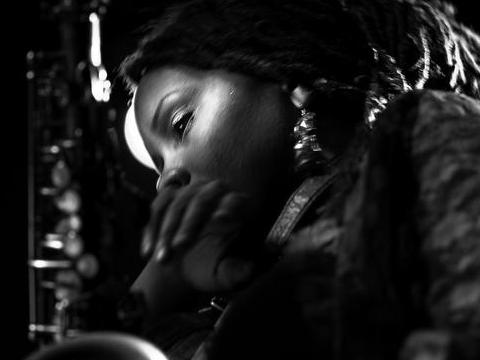
An evolving, intrepid Artist: MATANA ROBERTS


             Fiercely independent aptly describes MATANA ROBERTS 


 One of the more compelling young artists to have arrived on the scene the last few years is saxophonist-composer and AACM member Matana Roberts.  She wrote recently to express her appreciation for the Ain’t But a Few of Us Independent Ear series conversations with journalist-author-educator Robin D.G. Kelly, he of the monumental and much-discussed recent book Thelonious Monk: An American OriginalMatana’s remarks at the time begged further inquisition, particularly regarding music writers she’s encountered along the way and her sense of the black audience for her music.


In your comments you say that you "rarely get interviewed by a music journalist who focuses on creative music exclusively that is female of any color."  Is that a suggestion that you’ve indeed been interviewed by female music writers of color in the past, though they have not specifically been writers who cover music in the more "creative" vein?  Or are you saying that your encounters with female music writers of color in general have been few and far between?  I ask that because clearly female music writers of any color — be they identified as critics or journalists — are in short supply, unless you’ve had other experiences.


I have been interviewed by female music writers, journalists and scholars on more than one occasion but I can count only being interviewed by a female writer of color twice within the last 8 year period, and that would be most recently — by Carolle Trolle of the New York Examiner and recently abroad by Sylvia Arthur of the UK’s Lucid Magazine.  You can read both of those articles online.


Let’s say in a more balanced world you were to be interviewed by a female music writer of color — a female creative music writer — how do you suppose that would ultimately affect reader perceptions of you and your music?  Are you implying that perhaps a female creative music writer of color might more thoroughly get it as far as why you choose to express your music in the ways you do?


Well, the only thing I would say about a female music writer of any color is that I think inappropriate questions related directly to my biology might possibly be avoided(?).  Though that’s a generalization as ignorance does not have a sex-specific identity and I have experienced this both from writers and journalists of all colors regardless of gender, but the nice thing about working with a writer of color is that sometimes (not all of the time) they will understand certain cultural nuances, in terms of references, etc. that other folks might not get. 


    Sometimes working with some female writers, regardless of the color line, there have been situations where I felt like they were really trying to lock me into a corner — just to get an overly staunch feminist soundbite from me.  Have I been mistreated by men in my profession?  Yes.  Have I experienced discriminatory and lecherous behavior by men in my development as a musician — a very loud and resounding YES.  Really as soon as puberty hit I got to learn first hand about all these imbalances.  Most of this nonsense has fallen to the wayside, though there are still some residuals for sure.


    I think in this day and age just stating the obvious feminist trappings (of which I am quite proud of by the way) of my work choice is frankly passe.  It’s a tired dialogue that focuses solely on the victimization of women’s choices and it doesn’t open the dialogue up enough for a new understanding and progression.  In the name of art I have been victimized yes, but I refuse, in the name of art, to be a victim.  Those are two very different aesthetic choices if you examine them close enough.  I have actually in the past few years tried to shy away from gender-specific interviews — particularly in academia — because of this.


    But in a general sense I have found female writers to at least have a bit more tact overall in terms of approaching sensitive questions that revolve around the sphere of what womanhood is or isn’t supposed to be.  And though it’s not necessary, it’s a nice bonus if it’s a woman of color who understands the extra baggage attached to female artists of color that get boxed into almost a simpledom arena just because of the visual.  I try to stay away from that baggage as much as I can, but it is difficult when doing some of the work I am doing now, particularly about the history of my ancestry.  As I am discovering in real time exactly how that baggage got packed in the first place.


In our recent exchange you said that you don’t see significant numbers of black musicians playing creative music.  Is that related more to the cutting edge, where one might closely identify your music, or in general?  I ask that because I continue to see young black musicians of your generation playing what some might characterize as the more traditional forms, but perhaps not necessarily in the freely experimental or cutting edge mode where you operate.  Is that a fair assessment?


That’s a fair assessment.  There seems to be a steady supply of African Diasporic-looking musicians playing the more traditional forms for sure, some of them are among some of my closest friends, and some of them are very open to playing all types of music.  Good music is good music.  But in my observation (over my somewhat short career) within the cultural framework of how musicians relate to each other, I have observed a strange disparity between them and musicians of color that are doing the more experimental forms sometimes.  I think this exists partly because, in my opinion, there is possibly a silent shame there(?).  In the history of this music the more experimental forms appear to be championed by young white audiences more than black and vice versa.  The more traditional jazz forms seem to have been supported over the years by the black bourgeoisie.


    I think there is a direct correlation between traditional jazz and organizations like the NAACP/DuBois’ talented tenth model and the experimental musics that seemed championed by organizations like the Black Panthers for instance.  And this is an old and tired model to bounce off in some ways but just for the sake of examples I will use them.  My parents were following a radical strain in the 70s; my father from a poor family, a Black Panther for a very short time…  There was always Sun Ra, Art Ensemble of Chicago, Revolutionary Ensemble, Albert Ayler records playing all the time in my home, because my parents found those experimental musicians inspiring in a time that seemed experimentation was more necessary for the progression of race understanding.  But growing up on Chicago’s southside I straddled both of these spheres (the black bourgeoisie and the black radical movement) because there are parts of the southside that are very, very conservative.  Michelle Obama’s upbringing is a good example of this in many ways.  Even though I feel over the years in the black community jazz musicians were looked down on sometimes because of the drug issues of the age, I believe at least their take on cultural refinement through presentation and musical style was more acceptable than the stand up, experiment for the sake of experimentation, fight the power-type that essentially put the Art Ensemble’s kids through college.


    I also think playing the more experimental forms is sometimes seen as a certain nod to "Uncle Tom-ism" of days past — an extension of an African American buffoonery tradition in American pop culture and beyond.  Where the traditional construct is still romanticized in the African American community as a respected art form, but in my opinion can still extend to areas of buffoonery and Uncle Tom-ism — showing once more that black folks know how to "stay in their place".  The radical black voice has not always been celebrated, even more so if there is any hint of co-option outside of the African American community.  As much as I love the history of this music there is nothing radical and force forward moving anymore about playing racist tin pan alley tunes.


    I mean look at who the Obamas invited to the White House to start their jazz series — the one and only Wynton Marsalis.  What does that say about the progression of this music?  In my opinion… not much.  Why showcase someone typical, in this new age why not expose the public to the untypical; it’s a lot more interesting and thought-provoking.  Wynton Marsalis?  Why not some experimental elder iconoclast like Bill Dixon?  You know it’s a generational thing too; my generation was inspired by a different form of experimentation that bloomed from jazz in many ways and that would be the legacy of R(hythm) A(nd) P(oetry).  And a lot of the musicians of my generation went that direction — perhaps that was a smarter move as Lord knows my music is not paying the bills right now.


    In my humble opinion the African American soundmaker who is out there trying to create sounds that defy category is the musician who is actually reaching for what was the real tradition of jazz is in the first place; the tradition of being creative first.  Being creative with as much purpose and originality as one can muster.  I believe many of my heroes are spinning in their graves at the idea that there are people out here propogating the art form as their "originality" when it is really a shell of someone else’s historical life.  And for the record, I’m not trying to paint myself as some utopic model — I am far from it and have a lot more to do before I can really be considered someone pushing those boundaries, but I say this all in defense of those that I know who do, I am only scratching the surface now but I strive to get where they are.


After this initial response to the question, I told Matana about an interview I had with the late, great NEA Jazz Master vocalist Betty Carter.  When the subject of the more experimental forms of jazz came up Betty dismissed much of it by pronouncing that dissonance is simply not part of the black experience, therefore black folks simply ain’t hearin’ free or experimental jazz.


The thing is, I believe dissonance is so interwoven in the African American experience in ways that are just too painful for folks to remember or tackle.  A musician friend who plays the more traditional, accepted form of this music once said to me that "at the end of the day, it’s so hard being black in America, why would anyone want to listen to music that is essentially a polemic in sound on the underlying issue".  I’m paraphrasing there, but essentially the more traditional forms allow our people to relax and forget just how hard life can be(?).  I don’t agree with this, mainly because I grew up in a household where speaking up was an imperative so speaking up in creativity is imperative as well.  But unfortunately this means I get boxed into the avant garde, because there’s no room for questioning the status quo anywhere else these days.  But especially now, with a dared-to-be president named Obama, we as artists across color lines making experimental art have to protest even more loudly than before with our work.  What it means to be a person of color in America is changing before our very eyes… time to celebrate, document, cherish, yet question and challenge as well… the same old answers won’t work anymore.  I am a traditionalist at heart but why keep beating the same old traditions?


What would you recommend as far as developing a larger black audience for the more experimental side of the music?


I’ve been at a loss on this one for awhile.  I’m not sure if it’s possible; perhaps the music is just not inspiring enough anymore to support a culture that no longer neeeds to be reminded that we have the power to move a country.  With Obama in the White House we obviously already did!


                Stay tuned to The Independent Ear for another forthcoming contribution from Matana Roberts.


Hear MATANA ROBERTS on The Chicago Project. 

Look for her next release, recorded live in Europe,

in the spring…

Posted in Artist's P.O.V. | 1 Comment

Ain’t But a Few of Us: Black music writers telling their story #13

                                                            RAHSAAN CLARK MORRIS


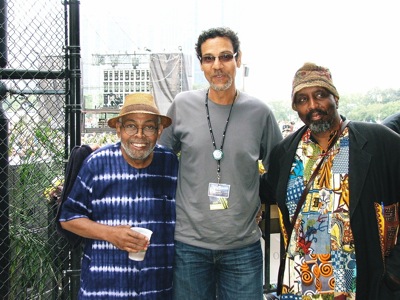
RAHSAAN CLARK MORRIS (center) with Amiri Baraka and William Parker


I first encountered Chicago-based writer Rahsaan Clark Morris a few years back when working with the Jazz Journalists Association to establish fellowships to a journalist conference in California in the name of my late friend and colleague, the Harlemite jazz writer Clarence Atkins.  Rahsaan was one of the young African American writers who were supported through this effort to attend the conference.  Rahsaan’s writings have appeared at Jazzhouse.org (the JJA site), the Jazz Institute of Chicago publication, the Great Black Music Project, JazzReview.com, and Creativity Magazine among other sources for his thoughtful voice.


What motivated you to write about this music in the first place?


I guess the thing that motivated me and got me thinking about writing in the first place was Amiri Baraka’s essay "Jazz and the White Critic" published in his collection of essays entitled Black Music from 1968.  The thought occurred to me that Black folks should be in control of their own culture and how it is appraised and critically approached.  I always thought it was the highest order of cultural arrogance to assume that someone from outside a group that had been culturally dispossessed could come in and present criticism of that culture, especially because of the pre-60s American separatism that had gone on for so long.  Baraka’s argument made the most sense to me, especially if you go from the lead point that this music comes out of the Black experience in this country.


When you first started writing about music were you aware of the dearth of African Americans writing about this music?

After reading the mastheads of certain jazz publications and reading the names of a lot of liner note authors, I could guess that there were not that many writers of color, and because they were so few in number, I could tell from the tone of the writing and some of the allusions in the writing, that there weren’t that many brothers — or sisters — writing about the music.


Why do you suppose that’s still such a glaring disparity — where you have a significant number of black musicians making this music but so few black media commentators on the music?


I think it has something to do with power: the power to put certain people into writing positions, the power to put certain people into editorial positions.  If the publications are of the commercial nature, as most are, and they are owned by white media conglomerates that live on sponsorship and backing, how can we expect an independent Afro-centric position to be put out before one that will safely further the commercial interests of the publication or media conglomerate?  I’m not saying I like it, but I am saying that’s the way it seems.  Then, there must be some networking from the journalism departments putting out writers at Berkley, NYU, Columbia, and Northwestern, and I can’t think of many who are African American males. 


    I left Denison University after my junior year to make a living in theater and always enjoyed music and writing.  But the jobs are given to graduates because, I suppose, it looks better to the employer if a resume is degree-laden.  Do you know a lot of degree-laden brothers who choose to write about Ornette Coleman or the AACM… besides maybe George Lewis


Do you think that disparity or dearth of African American jazz writers contributes to how the music is covered?


To some extent yes.  But, you do have certain publications like Wire, or Wax Poetics that do a good job of covering other stories that wouldn’t necessarily be covered in Downbeat or Jazziz, like a story on the development of the Fania record label, or how Creed Taylor put together the sound that became CTI Records.  {Editor’s note: those treatments appeared in issues of the estimable Wax Poetics]


Since you’ve been writing about this music, have you ever found yourself questioning why some musicians may be elevated over others, and is it your sense that has anything to do with the lack of cultural diversity among writers covering the music?


In my experience, it has been up to the editor who gets covered.  I write about, or "cover", anybody I choose and then it is up to the editors or people putting the pubkication together to include my pieces or not.  Sometimes, there are two African-American musicians’ CDs to be reviewed and only space enough for one review.  A white writer does one review and I do another.  I don’t think lack of cultural diversity ends up determining who gets published first, but it definitely could be a factor.  We all like to think the better piece gets published and if it is not mine but the other writers’… so be it because I know mine was good or I wouldn’t have handed it in.


What’s your sense of the indifference of so many African American-oriented publications towards serious music, despite the fact that so many African American artists continue to create serious music?


Now that is a multi-faceted question which could be explored for a while.  Most of those publications are market-driven.  Secondly, this form of Black music is not the most popular form.  At least, it seems, among American Blacks by and large.  So the publications appear to push music product that is (a) commercially viable and, (b) musically popular and/or accessible, so that months’ copy of Essence or Jet can move off the shelf.  Things may be changing, but it can’t come fast enough as far as I’m concerned.  The National Association of Negro Musicians held its convention here in Chicago andd there wasn’t a rush to get tickets.


How would you react to the contention that the way and tone of how this music is covered has something to do with who is writing about it?


That’s pretty much true of whatever topic you’re talking about.  I found some Black folks who go to hear serious music regularly who could probably write about it better than some Black writers who never get to that kind of show.  But, of course, a writer who comes from the same background as the artists involved would by nature be more sympathetic to what the artist is up to than someone who does not come from that environment.


In your experience writing about this music what have been some of your more rewarding encounters?


This actually happened before I actively started writing about the music.  I had gone with my wife to New York in the late 80s to see some plays, particularly Denzel Washington’s Shakespeare-in-the-Park production of Richard lll.  We were waiting in the line with our vouchers, which is what you have to have to get a ticket, and I was playing a cassette I had recorded probably 10 years earlier of Ornette Coleman and Dewey Redman playing live at the Jazz Showcase here in Chicago.  As we were waiting I spotted Ornette walking with his daughter through the park by the theater.  He heard the music playing and came over.  He remembered me from the Showcase concert because I had given him the master and dubbed a copy for myself that night.


    Another time later on, I was doing the lights for the Chicago Jazz Festival one year and I had been talking to Famoudou Don Moye about doing an interview with he and Lester Bowie, calling myseelf covering their performance of Brass Fantasy.  I didn’t know it, but as I was watching the rehearsal in the afternoon a woman wearing a light straw hat came down stage right in a wheel chair.  I recognized her almost immediately — it was Melba Liston.  I found out later from Dr. Bowie she had done a lot of the charts for the band and she was just checking out the rehearsal.  I asked if I could take her picture and she graciously consented.  After I got my camera out Lester and Rufus Reid came up and I took a shot of all three of them.  It is one of my favorite shots.  I noticed people asking each other, who was that woman in the wheelchair and I just smiled to myself.


What obstacles have you encountered — besides difficult editors and indifferent publications — in your efforts at covering the music?


Even though I am in the stagehands union and can get backstage to most events anywhere in this country, security is a problem and a lot of the time I will have credentials but some folks don’t believe me when I tell them I’m a freelancer for different publications.


What have been the most intriguing records released so far this year?


I still love the music of and have a lot of hope for the alto saxophonist Matana Roberts [Editor’s note: check The Independent Ear for more on Matana].  She’s originally from around [Chicago] but I think she spends more time now in Boston.  She recently made a splash with her trio Sticks and Stones on Thrill Jockey Records.  Then there is the lithe singer Ugochi (full name: Ugochi Nwaogwugguw) with Nicole Mitchell’s Black Earth Ensemble.  Her coming out will probably take somee time, but she has a remarkable voice and a great talent for delivery.  (Go to the archives at www.greatblackmusicproject.org for a review of a poetry performance by Ugochi at Malcolm X College here in [Chicago].  There is the young drummer Isaiah Spencer, who works with Ernest Dawkins’ New Horizons Ensemble and the Fred Anderson Trio.  (I call him Young Elvin because his style is as energetic and flowing as Elvin’s was.)  He also leads jam sessions every Sunday night at Fred Anderson’s Velvet Lounge.  Then there is the wordsmith Khari B., AACM saxophonist Mwata Bowden’s son who plies his trade with Ernest Dawkins’s Big Band, the Chicago Twelve, creating provocative poetry both with that ensemble and at other poetry slams.  I love the playing of vibraphonist Jason Adesiewisz, he of the young avant gardists helmed by Ken Vandermark and Hamid Drake.  Then of course the bassist Darius Savage, who sometimes shares the stage with Isaiah Spencer. 


    Nicholas Payton’s Into the Blue; Christian McBride’s Inside Straight with Steve Wilson, Eric Reed, Carl Allen & vibraphonist Warren Wolf, Jr. Kind of Brown; Nicole Mitchell’s Black Earth Strings Renegades on Delmark; Oliver Lake Organ Trio Makin’ It on Passin’ Thru Records; Hamid Drake and Friends My Blissful Mother on Tribal Records.

Posted in General Discussion | 2 Comments

Interview: The multi-faceted Douglas Ewart

DOUGLAS EWART: in a rare moment of relaxation

for a man who seems never to sleep 


The group photo of modern day renaissance men should include Douglas Ewart.  A saxophonist & all-round woodwind specialist and composer from Jamaica who emigrated to Chicago as a young man and currently splits his time between the Windy City and Minneapolis, is an intrepid instrument maker, award-winning visual artist, teacher, soothsayer, and all-around seeker in the truest sense of the word.  The former president of the Association for the Advancement of Creative Musicians (AACM), Ewart is one member of that famed musicians’ collective who chose to stay in the midwest and ply his craft, though he is a world traveler whose musical exploits may actually be more familiar to overseas audiences than even in his own backyard.  A man of many and varied — often unusual and unprecedented — projects, commissions, and boundless ideas, when I heard about one of his latest projects I had to ask questions. 


Douglas is a man who delights in making something special out of found objects.  Simply walking city streets he’ll spot something useful for his projects that many of us wouldn’t give a second thought to.  Visit the home of he and wife Janis Lane-Ewart, one time AACM administrator and current general manager of Twin Cities community radio station KFAI "Fresh Air Radio", and one could conceivably spend days digging through the artifacts and unusual objects of their many travels.  This latest effort was to be a project not only involving his original music… but spinning tops!  Read on…


You’ve always struck me as a kind of improvising renaissance man — musician, composer, visual artist, educator…  How do you juggle all those balls and maintain balance in your career?


I thrive on being engaged in a multitude of things.  I have been working at developing several skills over many decades; therefore, I have attained some level of profiency at several occupations.  I feel something is missing if I’m not working on several projects simultaneously.  If you do a little on a consistent basis, you would be surprised how much you can accomplish.  I always have some projects that I am working on that are in stages of development, some of these projects take years to complete.  I don’t mind that some things take a long time to complete.  If you are working on various projects you have something to look forward to doing each day, and that is key to being enthusiastic about life, being able to work and achieve results is a wonderful feeling.  I feel that we complain too much about life, about what is not right.  Be grateful to be able to walk and talk on your volition.
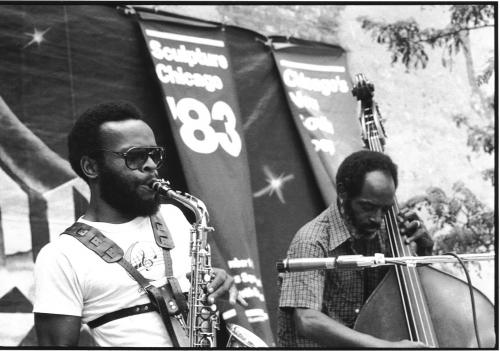
 

DOUGLAS EWART (saxophone)in performance with bassist Donald Rafael Garrett

at an event combining two of his passions: music & sculpture


    You have to make time for the things that you feel are important to you, as it helps in defining your well-being.  If you say ‘I don’t have time to do this or that’ then you may never get those things started or completed.  However, if you get started and do a little at a time, one day you can stop everything else and complete that project or item.  I have a motto: "five-fifteen minutes a day will get you there."  If you say I love to play music, paint or roller skate but I don’t have time, then you get out of practice, and you get out of the mind set to do the particular thing.  You get out of courtship with that thing and that thing rejects you when you go to it, as you have not been there for it; things have a life of their own and they demand attention.  But if you take your easel out and set it up, make one stroke a day with your paintbrush you will soon have a completed work.  If you practice your instrument regularly even if you don’t have a lot of time, you develop your embouchure and when you do have time you will be in the proper mental and physical state to extend your time allocation to that thing, study or discipline.  Consistency creates momentum and continuum.  The discipline is the crucial element.  It reminds me of saving money.  If you cannot save when you have small amounts of money you won’t or can’t when you have a lot because you have not developed the discipline of saving.


I understand your latest project — which like so many of your efforts seems to combine your music and your visual arts & craftsmen skills — involves composition and spinning tops.


Yes, I have been contemplating a work entitled "Ewart Sonic Tops" for several years now.  The idea is to make at least two hundred or more tops that make sounds.  So about two years ago I decided I better get started with the construction of the tops if I was to accomplish the colossal task.  I have completed over two hundred functioning tops from bamboo, cups, saucers, vases, candle holders, LPs. CDs, DVDs, clarinet bells, toilet plungers, plastic jars, bowls, globes, wheels, etc.  The tops are utilized as sound and movement generators in my work.  The tops make flute like sounds, rumbling sounds, rubbing sounds, rattliing sounds, humming sounds, accelerating and decelerating sounds, Doppler effect and some indescribable sounds.


    The movements of the tops are quite varied based on the materials they’re made of; equilibrium, texture of the surfaces on which it is spun, the velocity of the launch, etc.  The tops have personalities just like people; some tops are steady and remain in one place from the initial launch, some tops are erratic, some flit about, some spin for a long time, some spin for a short time, some are persistent and continue to spin even when they encounter obstacles, and some are very reluctant to stop spinning and bob & weave in an effort at resisting gravity.  The tops are launched or spun by twirling or twisting them with the thumb and index fingers, by holding the palms of the hands in vertical and parallel manner facing each other, and placing the spindle attached to the top between the palms, then in a rubbing or rolling manner [you] twist and release the top.


    "Ewart Sonic Tops" is a multi-dimensional work and concept.  Sound, music, movement, visuals, tactility, structure, practice and improvisation are endemic to all my current endeavors as an artist.  I want to link children and adults in a very basic yet complex manner.  I want to magnify the links and overlaps of play and work, laughter and seriousness, esoteric and generic, ethereal and earthy, mythology and pragmatism, gravity and levitation, meditation and concentration… the fine lines between child and adult, imagination and realism.


Musicians from Jamaica are almost automatically stereotyped as being either reggae musicians or somehow part of that milieu.  You completed a very interesting project earlier this year between George Lewis (brilliant trombonist-composer, Director of the Jazz Studies program at Columbia University, and author of the definitive volume on the AACM A Power Stronger Than Itself), the recently-passed Jamaican jazz trumpeter and festival impressario Sonny Bradshaw, and yourself.  What was the genesis of that collaboration and how did it turn out?


"In Search of The Lost Riddim" was a magnificent project!  Herbie Miller proposed the project to George Lewis, and with consultation from several people, including me, the project was distilled.  Herbie Miller is a historian, musical impressario, and avid supporter of the arts.  The project was sponsored by The Center for Jazz Studies at Columbia University and Harlem Stage and took place at Aaron Davis Hall last February.  The program featured musician-composers Cedric Brooks (tenor saxophone), Ernest Ranglin (guitar), Orville Hammond (piano & flute), Wayne Batchelor (bass). Desmond Jones (drums), Larry McDonald (conga) and myself on reeds & percussion.  Sonny Bradshaw was unable to participate due to illness.  [Editor’s note: The veteran musician and Jamaican jazz festival producer Sonny Bradshaw, who once expressed skepticism about the original compositions of Ewart and Lewis after witnessing one of their performances, passed on to ancestry last October 10.]


    We played some Jamaican traditional folk songs, Rasta liturgical pieces, and some ska.  Some of the songs were "Never Get Weary", "Holy Mount Zion", "Liza", "Bridge View" by Roland Alphonso and several original works by Cedric Brooks, Ernest Ranglin, Orville Hammond, and me.  We had a round table discussion convened by Herbie Miller that included Ernest, Cedric, Larry and myself.  We discussed the music, art, Rasta, and other pivotal aspects of Jamaican culture.  The roundtable was followed by the concert.  It was a delightful project and was part of a dream fulfilled as I got to perform with one of my idols, the incomparable Ernest Ranglin.  I knew Ernest as a boy but never got to formally meet him and to have the pleasure and privilege to play with this master musician was a highlight of my career.  I love reggae and ska and have played in various bands that play those branches of music.  I feel all types of music are critical and lend themselves to be creatively rendered.  It’s the quality and creativity that counts.


One of the more fascinating elements among so many in my reading of George Lewis’ excellent history of the AACM, A Power Stronger Than Itself, was learning more about your history and evolution from Jamaica to Chicago to joining and eventually becoming president of the AACM.  I was particularly interested to learn that you had much contact with the legendary Count Ossie as a young musicians.  Talk about those experiences.


I knew Count Ossie when I was a boy growing up in eastern Kingston, Jamaica.  Count didn’t live far rom my family’s home.  I used to go to his house on Saturdays to hear reasoning and to listen to the drums; these gatherings were called groundations.  My grandmother was a Seventh Day Adventist and I attended church on Saturdays.  I would go to church to establish my attendance and then go to Count’s without my grandmother’s knowledge.  I saw all the great Jamaican musicians there: Donald Drummond, John Dizzy Moore, Rico Rodriguez, Roland Alphonso, Tommy McCook, etc.  It was a great experience for me as I was exposed to a multitude of philosophies, personalities, intellectuals, artists and everyday heroes and survivors.  Count knew several members of my family and he was always welcoming.


    When I heard Count [Ossie] it was a powerful, and encompassing feeling.  The drums made you feel powerful, elated, connected, and confident.  I was inspired and wanted to play the repeater, which is the drum on which Count was a master.  Count Oswald Williams came from St. Thomas and was schooled in Kumina drumming, which was one of the musical blue prints for Akete or Nyahbingi Drumming.  Kumina is an Afrocentric polytheistic religious movement and music; drum music is a central component.


    I did fashion some drums from various cans and attempted to play them when I was home.  I eventually had an opportunity to try some of the drums at Count’s camp.  When I was an adolescent I moved into the Wareika Hills for a period and lived on Douglas Mack’s and Alvin "Powdy" Bryant’s camps.  It was a powerful experience about what self-determination means and costs.  It was not fashionable to be a Rasta in those days.  As Rastas we were subjected to police raids, beatings, illegal search and seizures, arrest, and all too often imprisonment.  Fortunately I was never beaten or arrested.


    I was also quite familiar with the music of Dizzy Gillespie, Clifford Brown, Charles Mingus, Charlie Parker, Ella Fitzgerald, Franz List, Bach, Dakota Staton, Ray Charles, Louis Jordan, Little Richard, Shirley and Lee, etc.  I had a great desire to play the trumpet but did not have access at that time.  I migrated to Chicago in June, 1963.  I was looking for some challenging, creative music and found the Association for the Advancement of Creative Musicians (AACM).  I began attending AACM concers at Lincoln Center in Chicago.  The concerts were given every Sunday and I attended faithfully.  I eventually met all of the founding and charter members of the AACM.  Several people and I began asking the musicians about lessons and the AACM formally launched its school of music in the fall of 1967.


    I had bought a trumpet in 1966 but was unable to get what I considered a good sound.  I bought a Buescher alto saxophone from Joseph Jarman and began teaching myself to play it.  Then I took some lessons from Jarman and joined the AACM School of Music in the fall of 1967.  I began studying composition, theory, saxophone and clarinet and taught myself how to play the flute.  We began writing compositions right away at the AACM’s School of Music and presented them in our recitals.  I also formed several bands: the Cosmic Musicians, and The Elements.  I also began playing with some rock and roll and Rhythm & Blues bands.  Joseph Jarman was one of my chief mentors and I began playing with him during those years.


How did you eventually rise to become president of the AACM?


After attending the AACM School of Music, I became a member in 1968; it was a very informal induction for me.  The usual process is formal and one has to be voted into the organization.  My dedication and commitment made for a very natural kind of induction into the AACM.  I used to assist with publicity, concessions, and monitoring the door at concerts.  I became president during the migration of the founding charter members [from Chicago] to New York and Europe.  I was installed in 1979 and was president for seven consecutive years.  It was a very great period for the AACM as we were assisted with some grants from the National Endowment for the Arts and other philanthropic institutions. We were able to hire Janis Lane as an administrator.  She was very able and we were very successful.  We rented a space that centralized our activities.  The AACM Space housed our offices, school, and concerts.  I resigned my post as president because I was awarded a US Japan Exchange Fellowship in 1986.  I have since served as chairman and co-chairman as recently as the early part of 2009.


What would you say about the AACM as it approaches its 50th anniversary as the most significant collective of improvising artists of the latter half of the 20th century?


The AACM has been a tremendous organization in the field of music and beyond.  We have survived and thrived.  The AACM has some of the most brilliant theorists, conceptualists, composers and music practitioners the world has ever known.  When you think about it, the AACM has a staggering number of monumental accomplishments.  Some of its pivotal achievements in addition to the music are longevity, consistency, and perseverance.  We have stayed together because many of us realize the importance of the collective.  We have stayed together because of mutual respect and the recognition that collectivity is what made it possible for us to survive as a people.


Since you are an artist who is constantly developing new approaches and new projects, what have you got on the burner these days?


I am now working on a drum piece.  I’m constructing a set of drums using discarded rackets, trampolines, crutches, etc.  I hope to get it mounted sometime in 2010 or 2011.  I mentioned the Ewart Sonic Tops earlier.  I am very interested in utilizing some of the experiences and games of childhood to bolster our current conducts.  The tops piece was very successful as it brought people from all backgrounds, walks of life, and age groups in a very engaging, playful, reflective, skillful, problem solving activity.  The work emphasized the communal and individualist aspects of play and work.  I want to continue using sound, visual arts, movement and poetry to galvanize our human family.  I feel that pieces like Ewart Sonic Tops can bring people together in a manner that enables them to have substantive and rewarding exchanges in a very playful and relaxed environment.
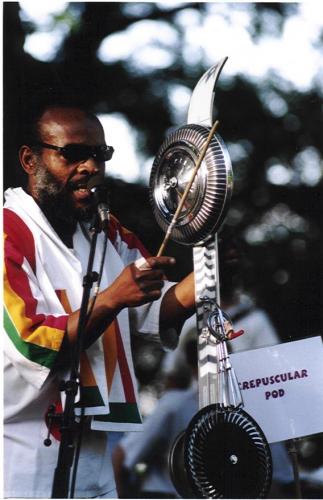
 

EWART exploring one of his inventions


You seem to have recorded your work rather sparingly — or perhaps it’s that you’ve been afforded the opportunity to do so sparingly.  Where does documenting and releasing your music for public consumption rank in importance for you?


Documentation and its dissemination are crucial for me.  Howevere, I am not willing to give my work away just to have it out in the public.  I have had offers from companies but not the kind of offers that I am willing to take.  I have been putting out my work on my Aarawak Recording Company label.  The process is slow but sure and I have total control over all aspects of the product.  Playing is far more iimportant to me than making records.  I constantly record my performances and will continue to put them  out when it is feasible.  There is no lack of product.  I say to all artists: document, document, document!  If you have product documented you are prepared to package and disseminate when that opportunity becomes available to you.  I have a new CD Velvet Fire which will drop on December 13; its dedicated to [saxophonist and early AACM membere] Fred Anderson.


Talk about your work as an educator.


I’ve been involved in education a great part of my life.  I was a tutor at the AACM School of Music while I was a student and I had a work-study job in the music department at Loop Junior College.  In fact, while I was a student at Loop I co-taught a course in Black Music with Ahmed Ben Bayla.  I really got my teaching acumen together when I worked for Urban Gateways doing residencies in public and some private schools as an artist-in-residence.  Those experiences really equipped me to go anywhere and teach.  It was the most challenging teaching job due to the lack of discipline that so many of our young people are exposed to from their inceptive years.  Parents lack discipline in what to eat, when to eat, how to scold, how to talk to their children, how to think, etc.  I worked for Urban Gateways for over ten years.  I also ran many workshops in instrument construction and performance in various communities as an independent artist.


Twenty years ago I moved to Minneapolis and began teaching in the public and private schools for Compas, who used the Urban Gateways model for their organization.  I used to be a guest lecturer at The School of the Art Institute of Chicago.  After moving to Minneapolis I was offered a visiting artist job, which evolved to a professorship.  I’ve taught instrument making, music history of Latin America and the Caribbean, music of Asia and the Pacific, Contemporary Music Seminar and Jazz History.  I love teaching as it compels me to do vigorous and rigorous study.  I love to read but being a teacherr fuels the quest for knowledge ten times over.  My music history classes cover a lot of ground.  If you are really going to understand the music you have to know something about the religions, politics, foods, classes, skills, and cultural underpinnings of the people. 


Any closing thoughts you’d like to share?


I want to continue to make art that brings the youth and the elders together.  I want to see the US government invest a billion dollars in the arts.  We have spent trillions on implements of war to no avail.  When we spend on the arts the money changes hands incessantly and we have positive products as a result.  Real detente begins with the arts.  I believe in the trickle up theory!  The government should have stimulated our economy by giving the poor people some real money… like $3-500,000 per family.  Instead the money was given to the same crooks that put the world economy in shambles and they are still stealing and blocking poor people from accessing desperately needed funds.  But the public is too silent and silence means consent.  We must take to the streets and make our power known and felt in massive non-violent protest. 


    Please get yourself a permanent cup to [purchase] your coffee and tea from carryout places.  If more of us do this we will reduce our waste markedly.  Let’s continue to support President Barak Obama.  His tasks are formidable and numerous, and we have a lot of people and systems that are averse to change.  Truth and change are costly, challenging and very difficult to implement.  This is a great country but we have miles to go in human relations.


Select Douglas Ewart Discography

As leader

Douglas Ewart, Red Hills, Aarawack

Douglas Ewart, Bamboo Forest, Aarawack

Douglas Ewart/George Lewis, Jila-Save!, The Imaginary Suite

Douglas Ewart, Angels of Entrance, Aarawack

Douglas Ewart, Bamboo Meditations at Banff, Aarawak

Doglas Ewart, Songs of Sun Live, Innova

Douglas Ewart Quintet Visionfest Vision Live Quintet, Crepescule IV in Powderhorn Park, Thirsty Ear


As sideman

George Lewis, Chicago Slow Dance, Lovely Music

George Lewis, Homage to Charles Parker, Black Saint

George Lewis, Shadowgraph, Black Saint

George Lewis, Changing With the Times, New World

Chico Freeman, Morning Prayer, Whynot

Dennis Gonzalez, Namesake, Silkheart

Leo Smith, Budding of a Rose, Moers

Roscoe Mitchell Creative Orchestra, Sketchees from Bamboo, Moers

Diem Jones, Black Fish Jazz, Black Fish

Bams, De Ce Monde, Junkadelic

Muhal Richard Abrams, Lifea Blinec, Arista Novus

Anthony Braxton, For Trio, Arista Novus

Roscoe Mitchell, Maze, Nessa

Henry Threadgill, X75, Arista Novus

AACM, Great Black Music Live, AACM

AACM, A Power Stronger Than Itself, AACM

Roy C. McBride, Live at Third Ear, New Dream Ark

The Visitors, Citizens of the Planet, Mikai Music

 

Posted in Artist's P.O.V. | 3 Comments