
Bill Anschell spins cautionary, biting, and often hilarious tales of navigating the world as a jazz musicians…
 | |||
Bill and I first became acquainted during his days in arts administration when he moved to Atlanta to serve as Jazz Coordinator for the Southern Arts Federation (SAF; now South Arts), the regional arts organization for the Southeast states. While at SAF Bill established the valuable syndicated radio show Jazz South, which marvelously spotlighted a number of the southern states’ unsung jazz heroes. Meantime Bill kept his keyboard chops sharp performing around the Atlanta area.
Obviously Bill Anschell has always been not only a swinging and productive pianist and bandleader, but a keen observer of the various precincts, happenstances, and pecularities of being an active jazz musician – particularly the various pecadillos faced by the legion of working, blue collar jazz musicians one might encounter striving mightily (or perhaps not much at all) at your favorite neighborhood hangout . Perhaps the earliest documented public pronouncements of Bill’s biting wit arrived in his series of columns under the moniker “Mr. PC” (no relation to Paul Chambers) via his website www.billanschell.com and subsequently published at allaboutjazz.com, and available via Facebook page. Bill detailed his comedic jazz writings for The Independent Ear in January 2017.
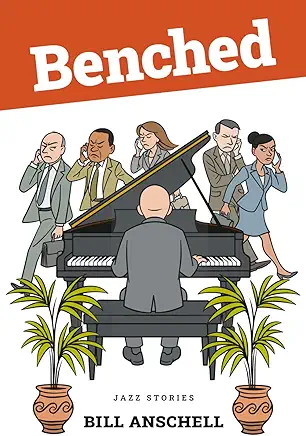
In late 2025 his jazz stories – including some reprised Mr. PC columns and anecdotes – arrived in the hilarious compilation Benched, published quite naturally by the entity Blow Hard Music! Its been nearly 10 years since our first Independent Ear encounter with Bill Anschell and clearly some questions were in order on the subject of Benched.
1) What compelled you to start your “Mr. P.C.” series of columns, and how many columns have you contributed to All About Jazz?
I can remember driving across Idaho on a duo tour with saxophonist Brent Jensen about 20 years ago, and describing my fledgling idea for the column to him. In the course of the tour, I came up with “Mr. P.C.’s Guide to Jazz Etiquette and Bandstand Decorum” as the full (now seldom-used) name. I liked it partly because it sounds like a 19th-century traveling circus or an elixir, but more than that because of the many meanings of P.C.: Paul Chambers and the Coltrane tune named for him; Political Correctness, which is at the core of Mr. P.C.’s over-the-top persona; and even Personal Consultant (along the lines of Dear Abby). Brent wound up submitting several questions over the years, always under a pseudonym, of course. You didn’t ask, but now it can be told: Many of the questions come from readers, but I throw in more than a few of my own.
As for how many columns I’ve written, I’d never thought to keep track until now, so it was a fun exercise. Here are the stats: 128 columns, with exactly 400 questions/responses. For Benched, I winnowed them down to the very best ones, so Mr. P.C. is presented at the height of his prowess, which is just slightly above sea level.
2) What was the overall response to your “Mr. P.C.” contributions, and how/when did it become apparent that your “Mr. P.C.” pieces warranted a book?

The column has a following on both a dedicated Facebook page and on allaboutjazz.com. But I got more encouragement from readers of my short stories than from readers of Mr. P.C., and the stories are probably more central to the book. A couple of those stories have had pretty huge readership: Michael Ricci told me that “Careers in Jazz”—the biggest one—has logged more than 700,000 reads over its 20 years on allaboutjazz.com. Both “Careers in Jazz” and “Jazz Jam Sessions: a First-Timer’s Guide” have been translated into multiple languages and posted on non-English websites. “Careers in Jazz” was even the centerpiece of a Wall Street Journal article on the disappearing jazz audience; WSJ said “Careers” was “being passed among economist-bloggers as a comic case study in market dysfunction.”
I think you probably remember the genesis of my whole story-writing sideline. It came about gradually: I used to send out a holiday newsletter to my friends—yourself included—and at some point, I started including short stories. Three of the eight stories in Benched first appeared in that newsletter. One of them was the jazz jam session piece; that was in the early days of email, and I started getting messages from friends saying, “Since you’re a jazz humor guy, you’ll probably like the attached piece.” The attachment was, in fact, an excerpt from my jazz jam session primer, retitled and with my name removed. It was kind of an early version of going viral (albeit anonymously), and at that point I thought, “Hey, maybe people actually like this stuff.”
When I made the decision to turn it all into a book, I spent a ton of time editing/expanding/rewriting all of the stories. While the original versions are still archived on allaboutjazz.com and other websites, I think the book versions are much improved, albeit in subtle ways.
3) Given your reputation as being an artist of sometimes sardonic humor, just how deeply was your tongue embedded in your cheek as you wrote this book?
Very deeply—my humor is satiric, for sure, and sometimes on the dark side. But my intention with all these pieces has been to give people laughs, especially jazz musicians and the greater jazz community; that’s 95% of what I’m going for. The other 5% is to give non-jazzers some insights into the singular, crazy jazz world whose practitioners navigate barriers—some funny, some serious—at every turn. It’s kind of the ultimate “thin line between tragedy and comedy” reality, and my stories try to capture that. I’ve lived in that world for more than four decades now, and I wouldn’t trade it for any other. Most of my best friends are jazz musicians, and I still practice for hours every day. But I would probably go crazy living a jazz musician’s life if I didn’t see the humor in it, along with the endless artistic challenge.
4) Since you’re a working jazz musician – and a former arts administrator – where do you see yourself fitting in your Jazz Caste Hierarchy?
I’m glad you asked that; you’re not the first. It’s said that you “write what you know,” and that is definitely the story with my pieces. I’ve had a really diverse career playing and supporting the music; at one time or another I’ve been most of the many career types described in “Careers in Jazz.” Even the ones I haven’t lived, I’ve been very close to, through musical friends and bandmates.
Having said all that, if I had to honestly pick a single “Careers in Jazz” label from Day One of my career to the present, I would probably call myself a Gig Whore. If you’ve read the story, you’ll know that’s less self-effacing than it sounds—there are Gig Whores, myself included, who are very serious about the music, practicing hard and having occasional breakthroughs. I’ve gotten to play with world-class musicians and been to parts of the planet I would never otherwise have seen. But I’ve also played an awful lot of background music gigs, and worse. For most of my career, there were three kinds of gigs I would take: gigs that promised great music, gigs that paid well, and gigs that would give me stories to tell.
5) Ultimately, how would you hope that your fellow musicians receive and react to Benched?
Tom Kranz featured me on his excellent “Type. Tune. Tint.” podcast, and I like his description of the book: “With cynicism and affection, Bill Anschell pulls back the bandstand curtain.” That’s pretty much right on the money. I hope my fellow musicians are able to feel the affection, brush off the cynicism, and above all, enjoy the humor. That, more than anything else, is why I wrote the book.
6) Should we expect a follow-up volume to Benched?
Absolutely not. At age 66, forty-some years into my career, my tales have now been told.
Thanks for the great questions.